Greensboro Massacre
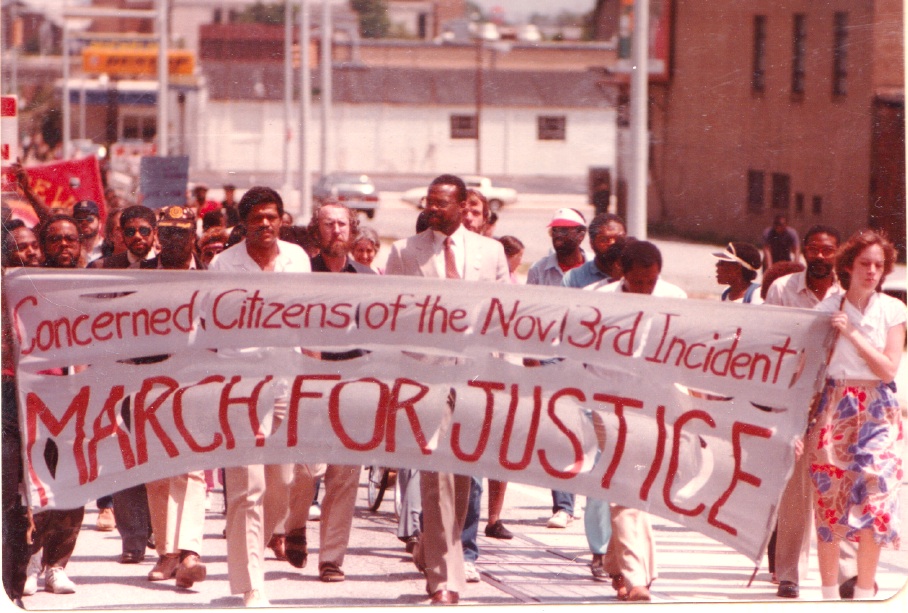
Four television news crews were already rolling tape when the caravan arrived. It was November 3, 1979, a Saturday morning in Greensboro, North Carolina, and members of the Communist Workers Party had gathered at the corner of Everitt and Carver Streets in Morningside Homes, a public housing project, to begin their "Death to the Klan" march. The cameras were there because the CWP had publicized the event aggressively, with flyers calling for radical opposition to the Ku Klux Klan. What the cameras recorded, starting at approximately 11:20 a.m., was not a protest march. It was eighty-eight seconds of gunfire that left five people dead on the pavement, broadcast that evening on national and international news.
Organizers in the Mill Towns
The Communist Workers Party had its roots in a 1973 New York Marxist formation called the Workers Viewpoint Organization. In 1976, WVO members came to North Carolina and began recruiting Black and white activists in Greensboro and Durham who were already engaged in healthcare and textile organizing. They took jobs in the local mills, attempting to build multi-racial unions from the shop floor. Among them was James Waller, a physician who left his medical career to become a full-time labor organizer, eventually rising to president of the local textile workers' unions at Cone's Granite Finishing Plant in Haw River. In the Carolina Piedmont, the communists found traction especially among Black workers, who had only recently been hired for mill work since the passage of the federal Equal Employment Opportunities Act in 1972. By 1979, the WVO had renamed itself the Communist Workers Party and was planning a public march against the Klan in Greensboro -- a city that had been a major site of civil rights sit-ins in the 1960s.
Informants on Both Sides
The Greensboro Police Department had an informant inside the Klan and Nazi group: Eddie Dawson, a Klansman who had previously been on the FBI payroll. Police provided Dawson with a copy of the march permit, including the unpublished starting location. The federal Bureau of Alcohol, Tobacco and Firearms had its own agent, Bernard Butkovich, embedded in the Nazi organization since three months earlier. On the morning of November 3, Dawson notified the police that the Klan was prepared for armed violence and that a caravan of nine cars carrying Klansmen and Nazis with firearms was heading toward the marchers. The march permit specified that participants were to be unarmed. Despite advance knowledge that armed white supremacists were converging on an event where demonstrators were expected to be defenseless, no police were present at the gathering point when the caravan arrived. The nearest officers were blocks away.
Eighty-Eight Seconds
The caravan of nine cars and a van, carrying an estimated forty Klansmen and American Nazi Party members, drove past the front of the housing project. The two groups heckled each other. Some marchers struck the cars with picket sticks. Then the first shot came from the lead car -- witnesses and later evidence identified Klansman Mark Sherer as the first to fire, using a black powder pistol. A second shot went into the air from Klansman Brent Fletcher. Within seconds, guns were out across the caravan. The filming never stopped. Five people were killed: labor organizers Cesar Cauce, Michael Nathan, William Sampson, Sandra Smith, and James Waller. Nathan was a physician; Smith was a nurse. Cauce was Cuban-American, Smith was Black, and the other three were white, two of them Jewish. Both Black and white marchers were among the wounded, along with one Klansman and two news crew members.
Three Trials, No Convictions
What followed the massacre was a legal odyssey that compounded the outrage. In the first state criminal trial, six Klansmen and Nazis were charged with murder. An all-white jury acquitted all of them, accepting claims of self-defense despite the filmed evidence. A second federal criminal trial in 1984 charged nine defendants with racially motivated violence. Again, all were acquitted; this jury accepted the argument that the defendants' actions were motivated by hatred of communism, not racial animus. Neither trial examined the role of government informants or police absence. It was not until a 1985 federal civil trial that any accountability was established: a jury found two Klansmen, three neo-Nazis, two Greensboro police officers, and a police informant liable for the wrongful death of Michael Nathan and injuries to two survivors. The city of Greensboro paid the entire judgment.
The Long Road to Acknowledgment
Twenty-five years after the shootings, a privately formed Greensboro Truth and Reconciliation Commission -- modeled on South Africa's post-apartheid process -- conducted an investigation. Its final report concluded that both sides had used inflammatory rhetoric, but that the Klan and Nazis had intended violence, and that the police department bore significant responsibility by allowing the anticipated confrontation to proceed without protection. The commission noted that police had successfully prevented violence at previous confrontations between the same groups simply by being present. In 2009, the Greensboro City Council issued a statement of regret. In 2015, the city unveiled a historical marker at the site reading: "Greensboro Massacre -- Ku Klux Klan and American Nazi Party members, on Nov. 3, 1979, shot and killed five Communist Workers Party members one-tenth mile north." Two council members voted against the marker, saying they did not consider the event a massacre. In 2020, the city council formally apologized.
From the Air
Located at 36.07°N, 79.76°W in the Morningside Homes neighborhood of Greensboro, North Carolina. The site is at the intersection of Everitt and Carver Streets in the eastern part of the city. Piedmont Triad International Airport (KGSO) is approximately 8 nm west-northwest. The area is a residential neighborhood within Greensboro's urban grid. Recommended viewing altitude: 2,000-3,000 feet AGL. The historical marker is at street level and not visible from the air, but the housing project layout and surrounding streets are identifiable.