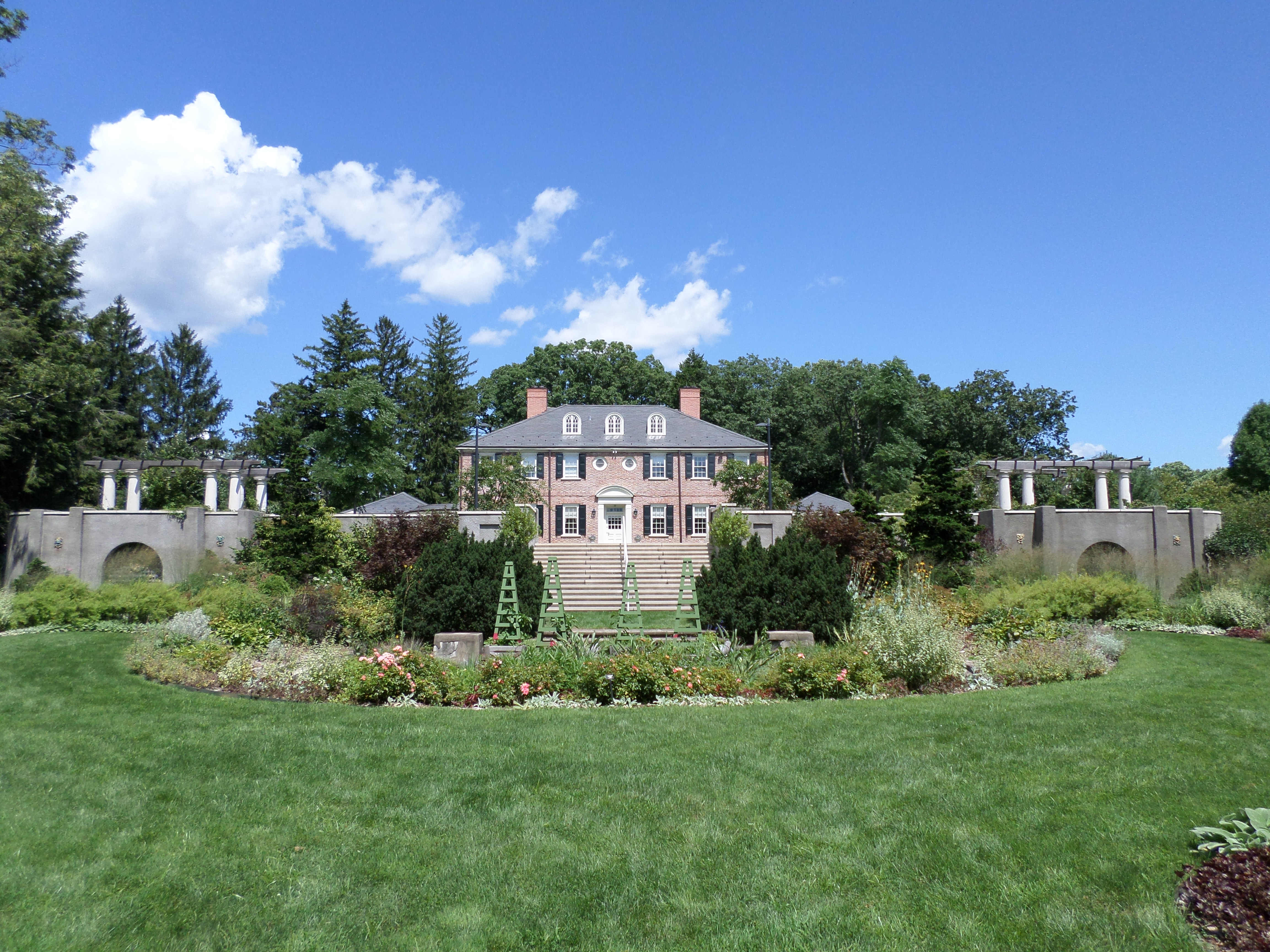
Greenwood Gardens
Joseph Day made his fortune selling other people's land — and then spent it creating something entirely his own. In 1906, the prominent real estate auctioneer purchased 79 acres in the Short Hills section of Millburn, New Jersey, and began building what he called Pleasant Days: an Italianate mansion with 28 rooms, flanked by terraced gardens, stone pergolas, and a carriage house that spoke to serious ambitions. The estate he raised on that hillside still stands, now open to the public as Greenwood Gardens, and it carries within its 28 remaining acres a quiet insistence that beauty is worth preserving.
The Men Who Built It
Day didn't simply hire contractors — he hired craftsmen with legacies. The mansion itself was designed by architect William W. Renwick and constructed by Rafael Guastavino's Guastavino Fireproof Construction Company, the firm behind some of the most technically ambitious tile vaulting in American architecture. The result was a home built in tile and stucco, an Italianate statement set against New Jersey hillside. The terraces, pergolas, and garden walls were built from local stone, anchoring the estate to its specific patch of Essex County ground. Day lived there until his death in 1944, and the property then passed to Peter B. Blanchard Jr., who renamed it The Greenwoods — the name that eventually evolved into Greenwood Gardens.
Art Worked Into the Landscape
Two works of art define the garden's character above all others. At its entrance stands a wrought iron gate by Samuel Yellin, the Philadelphia blacksmith whose ironwork graces the Federal Reserve Bank of New York and dozens of other American landmarks. Yellin's gate at Greenwood is alive with birds, vines, and trailing plants — metalwork that feels botanical, as if the iron itself grew from the ground. Elsewhere on the property, a bronze statue of a boy holding two geese by sculptor Emilio Angela catches light in the garden and anchors one of the terraced spaces with quiet warmth. These aren't decorations placed on a finished property; they are part of how the estate was imagined.
The Quiet Decades and a Return
For much of the twentieth century, Greenwood Gardens remained private, its terraces and teahouse and summerhouse — all built around 1920 — slowly absorbed by the rhythms of private ownership. The garden's isolation preserved it from the redevelopment pressure that erased so many comparable estates across New Jersey's suburbs. In 2019, restoration work began in earnest with the reconstruction of the Reflecting Pool Terrace, recreating the original pool from the 1920s plans. When the gardens reopened after the pandemic closures of 2020, visitors returned quickly: 4,300 people came through in just two months, a number that suggested how much the place had been missed.
What Remains
Today the property encompasses 28 acres of formal Italianate landscape, with the mansion, carriage house, summerhouse, teahouse, worker cottages, terraces, and pergolas all still present. The Garden Conservancy has been involved in preservation efforts, recognizing Greenwood as one of the rare examples of an intact early-twentieth-century designed landscape surviving in the metropolitan area. Concerts, educational tours, and seasonal events draw visitors from across the region. It is the kind of place that rewards walking slowly — where every stone wall has been there for a century, where the ironwork at the gate has weathered into something even better than it started, and where the scale feels human even as the ambition was clearly grand.
From the Air
Greenwood Gardens sits at approximately 40.74°N, 74.31°W in the Short Hills section of Millburn, Essex County, New Jersey. At 2,000–3,000 feet AGL, the forested hillside neighborhood of Short Hills is visible southwest of Newark. The nearest major airport is Newark Liberty International (KEWR), roughly 8 miles to the northeast. Teterboro Airport (KTEB) lies about 12 miles to the north. The Watchung ridgeline provides a useful geographic reference when approaching from the west.