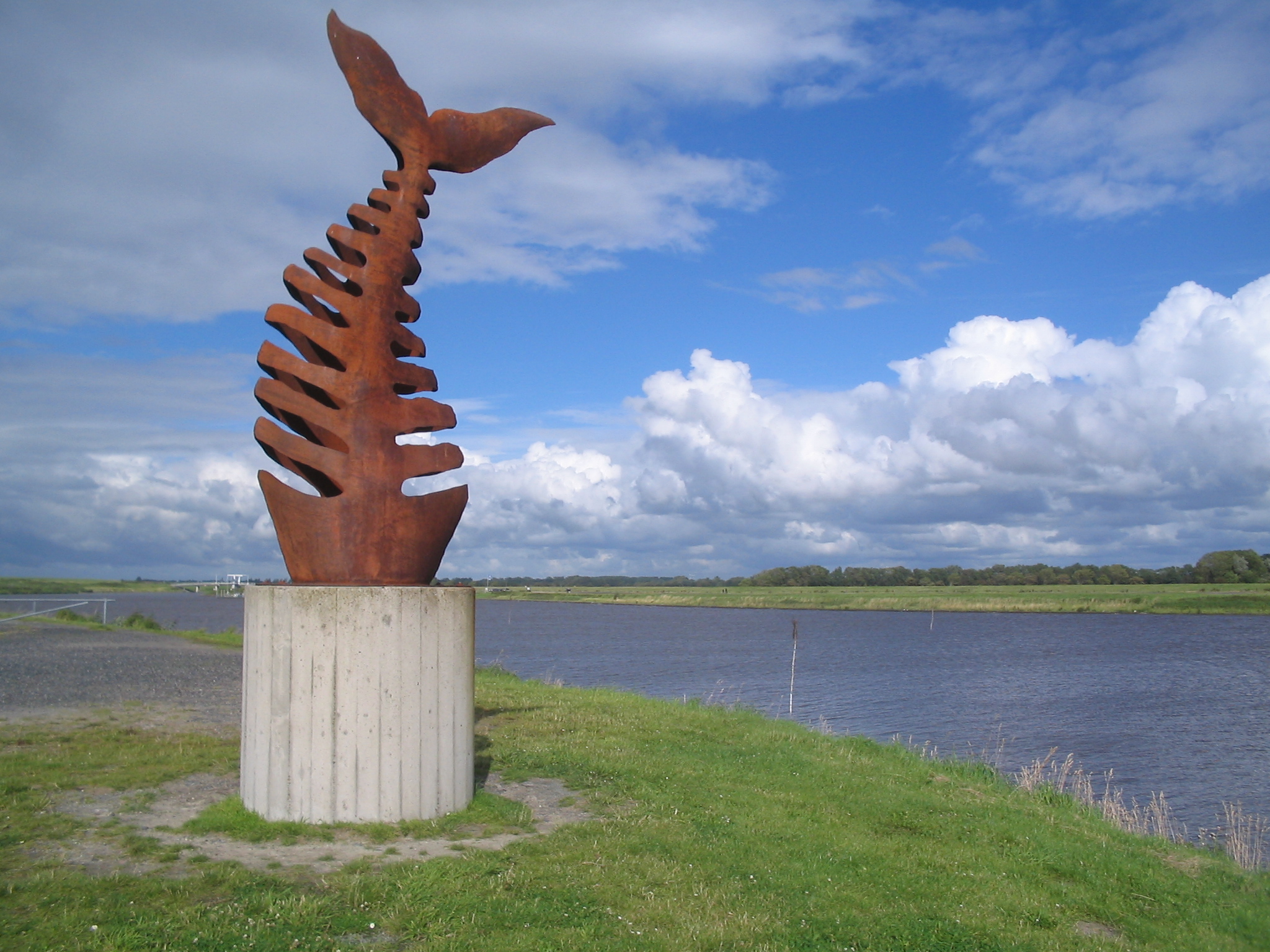
Greetsiel
Twenty-eight shrimp cutters tie up at Greetsiel each evening. They are painted in a deliberately gaudy palette - bright reds, blues, yellows, names like Ostfriesland and Greta picked out in white - and they bring back small grey-pink crustaceans called Krabben that the village has been pulling out of the Wadden Sea for six centuries. The whole working harbor is what postcards aspire to. Across the canal, the twin windmills lean toward each other on the same low rise: the green one built in 1856, the red one in 1706. Greetsiel is the kind of place where, if you tried to design it on purpose, nobody would believe you.
The Bay That Used to Be Bigger
Greetsiel sits on the Leybucht, a bay that has been steadily shrinking for six hundred years as East Frisians built dykes and turned its mud into farmland. In the 14th century the Leybucht was a sprawling expanse that reached deep inland; today it is a fraction of that size, and Greetsiel is the only port left on it. The village first appears in the historical record in 1388, in letters complaining that Hamburg ships anchored here had to pay tariffs. Already at that point the place had a function: a sluice village - the German word Siel means exactly that - where freshwater drainage from the inland marshes met salt water from the North Sea. The Domain of Appingen, the local abbey, founded the settlement under the protection of the Cirksena chiefs. As Appingen's importance faded, Greetsiel rose.
A Count and a Humanist
Two famous men were born in Greetsiel. Count Edzard the Great arrived in 1462 at the Cirksenaburg, the family castle whose foundations now lie beneath the Steinhaus on Hohe Straße. Under his rule East Frisia stretched at its widest, from the Weser River to Groningen. The other native son was Ubbo Emmius, born in 1547, who would become the first rector magnificus of the University of Groningen and one of the great Renaissance historians of his region. His birthplace still stands in the village. Edzard expanded a country. Emmius wrote one into existence. Greetsiel can claim both, although it does so quietly - this is not a place that builds monuments to itself.
Cobblestones and Bell-Gables
Of all the East Frisian Siel villages, Greetsiel kept its old fishermen's cottages best. The row along Sielstraße facing the harbor is the photographic motif: brick houses with bell-shaped Dutch gables, the most striking being No. 11 (dated 1741) and No. 15 (1792). Poppingas Old Bakery at No. 21, from the 19th century, still has its original interior and now works as a museum and café. The Greetsiel Church was built between 1380 and 1410 as the private chapel of chief Haro Edzardsna; its small flèche carries a 1730 weather vane shaped like a ship, and the pulpit dates from 1669. The Hohes Haus on Hohe Straße, anchor-plated 1696, was the treasurer's residence - though the building was already considered old by the mid-1500s, suggesting an earlier structure underneath. The whole village is brick and tile and water, woven together by the smell of the harbor and the cry of gulls.
Shrimp, Ships in Bottles, and the Annual Parade
The 28 working shrimp cutters are not a museum exhibit. They go out, they bring back catches, and once a year in mid-summer the village holds the Kutterkorso - a boat parade in which the cutters carry guests on a four-hour cruise of the Leybucht while bands play and shrimp-shelling competitions break out on the quay. The other surprising claim: Greetsiel hosts the largest ship-in-a-bottle museum in Europe, with about 800 examples. The annual Greetsieler Woche art exhibition has been running for more than 30 years and awards the Imke Folkerts Prize, worth 10,000 euros, every two years. In a village of about 1,500 year-round inhabitants, the summer population swells dramatically. The 1990s brought one practical update: the Leybuchthörn, a spit extending into the Wadden Sea, with a lock and reservoir, so that the harbor is now accessible at any tide. The cutters can come and go regardless of the moon.
How the Capital Ended Up in Pewsum
When the municipality of Krummhörn was created in 1972, somebody had to choose an administrative seat. Greetsiel was the obvious candidate - bigger, more famous, more central in the cultural imagination of the region. Pewsum was duller. Pewsum won. The reasoning was geographic: Greetsiel sat too far out at the coastal edge, and the new municipality needed a capital that everyone could reach without driving past the windmills. The choice annoyed the Greetsielers, and locally the matter has not been entirely settled. But in retrospect, losing the bureaucracy was probably the best thing that ever happened to the village. Pewsum got the paperwork. Greetsiel kept the cutters, the gables, the windmills, and the ships in bottles.
From the Air
Located at 53.50°N, 7.09°E on the Leybucht bay in western East Frisia. From the air, look for the twin windmills standing side by side just outside the village, the harbor entrance with its lock at the Leybuchthörn, and the row of brick houses along Sielstraße facing the inner harbor. The nearby Pilsum Lighthouse, a small yellow-and-red tower on the polders to the north, is also visible. Nearest airfields: Emden (EDWE) about 18 km south and Norden-Norddeich (EDWS) about 20 km northeast. Best viewed from 1,500-3,500 ft on clear days; the Wadden Sea tidal patterns are particularly striking at low tide.