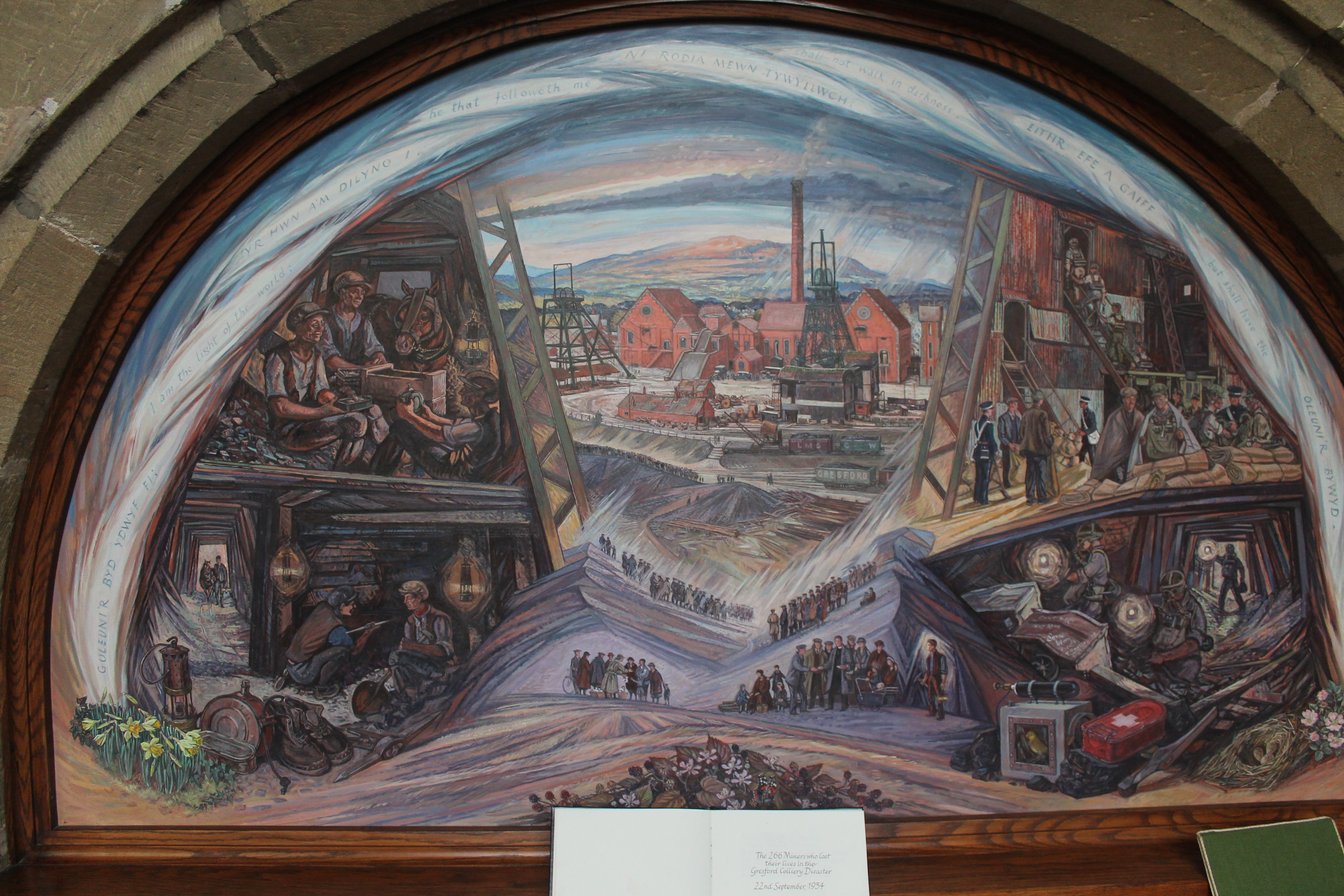
Gresford Disaster
At two in the morning on 22 September 1934, the night shift at Gresford Colliery near Wrexham was working the Dennis section, more than a thousand feet underground. What happened next would make Gresford one of the deadliest mining disasters in British history. An explosion tore through the workings, followed by an underground fire that raged beyond any hope of control. Two hundred and sixty-one men died that night and in the hours that followed, leaving behind families who would never see most of their loved ones brought home.
The Night the Ground Shook
The Dennis section of Gresford Colliery was a deep and gaseous seam, one that demanded constant vigilance against the buildup of firedamp. In the early hours of that September morning, something ignited the gas. The explosion ripped through the tunnels with devastating force, and the fire that followed made rescue nearly impossible. Three rescue workers lost their lives attempting to reach survivors, their bravery a measure of the desperation felt above ground. Of the 261 miners who perished, only eight bodies were ever recovered. The rest remained entombed in the darkness where they had worked, a fact that compounded the grief of the families waiting at the pithead.
Questions Without Answers
The inquiry that followed the disaster proved almost as painful as the event itself. Evidence pointed to failures in safety procedures and poor mine management as contributory factors, but the investigation never conclusively identified a single cause. The mine's owners faced accusations that safety records had been falsified, that firemen's reports showing dangerous gas levels had been ignored or altered. The decision to seal the damaged sections permanently, rather than attempt to recover the bodies, provoked public outrage. For the bereaved families, it meant no funerals, no burials, no final goodbyes. The sealed tunnels became a grave that could never be visited, a wound that could never quite close.
What the Miners Knew
Mining communities understood risk in ways that surface dwellers rarely grasped. The men who descended into Gresford each shift knew the Dennis section was dangerous. They knew about firedamp, about the explosive mixture of methane and air that could be ignited by a single spark from a pick striking stone. They went down anyway because the colliery was the economic heart of the community, because their fathers and grandfathers had gone down before them, and because the alternative was poverty. The disaster exposed what many miners had long suspected: that the pressure to maintain production often overrode safety precautions, and that the men at the coal face bore the consequences of decisions made in offices far above them.
Memory Carved in Wheel and Stone
Today, the Gresford Disaster Memorial stands near the former colliery site, centered on one of the pit's winding wheels. The wheel is a powerful symbol, the mechanism that lowered men into the earth and raised coal to the surface, now standing still as a monument to those it could not bring back. Each year on 22 September, a memorial service is held at the site. The hymn 'Gresford,' composed by Robert Saint in memory of the disaster, has become one of the most recognized pieces of brass band music in Britain, performed at miners' memorials across the country. The colliery itself closed in 1973, but the memorial endures, a reminder that 261 men went to work one autumn night and never came home. Their names are recorded. Their stories belong to a community that has never forgotten them.
From the Air
Located at 53.067N, 2.945W near Wrexham in northeast Wales. The former colliery site is on the eastern edge of Gresford village. The Gresford Disaster Memorial with its distinctive winding wheel is visible at ground level. Nearest airports include Hawarden (EGNR, 10nm north) and Wrexham's airfields. The Dee Valley and Welsh borderlands provide visual orientation.