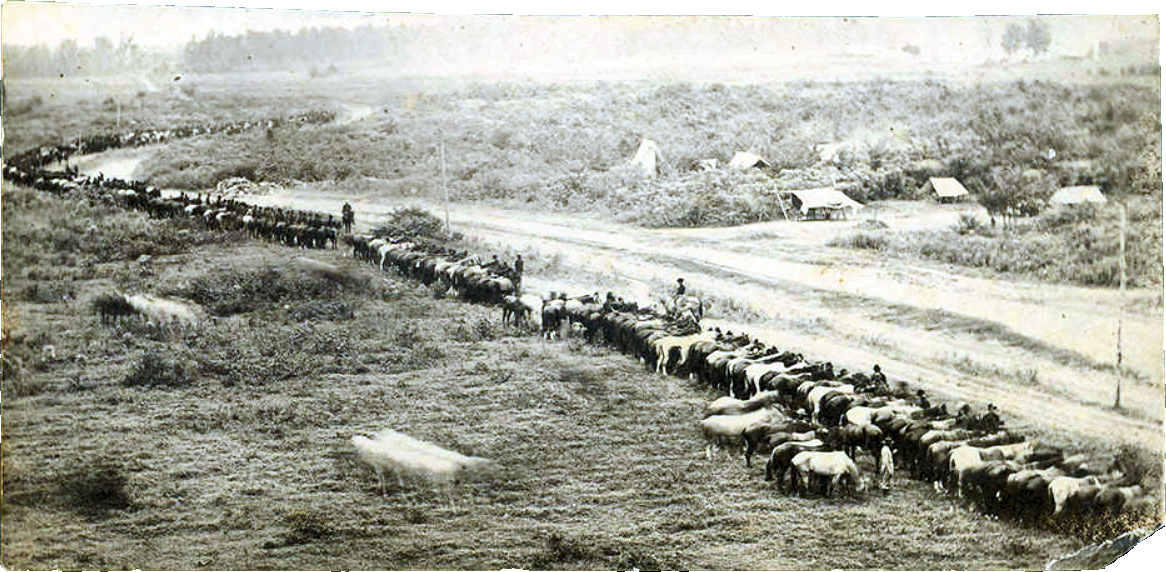
Grierson's Raid
The man Ulysses Grant chose to ride through the heart of Mississippi hated horses. Colonel Benjamin Grierson had been kicked in the head by one as a child, and the experience left him with a lifelong aversion to the animals that would define his most famous exploit. On April 17, 1863, Grierson led 1,700 cavalrymen out of La Grange, Tennessee, and pointed them south into enemy territory. Over the next sixteen days, they would ride the entire length of Mississippi, from the Tennessee border to Union-held Baton Rouge, Louisiana, tearing through a state that no Union soldier had crossed before. The raid was a diversion, designed to pull Confederate attention away from Grant's main thrust against Vicksburg. It worked beyond anyone's expectations.
The Music Teacher on Horseback
The idea for a deep cavalry strike through Mississippi originated with Major General Charles Hamilton, who commanded the Union's Corinth sector. Hamilton eventually resigned over a dispute about command assignments, and Grant accepted the resignation without hesitation. But the concept survived. By early 1863, Confederate cavalry raiders like Nathan Bedford Forrest and John Hunt Morgan had been humiliating Union expeditions across the Western Theater. Grant needed someone who could play the same game in reverse. Grierson, the former music teacher from Illinois, commanded a brigade of the 6th and 7th Illinois and 2nd Iowa Cavalry regiments. He was an unlikely choice for a mission that required spending over two weeks in the saddle, deep behind enemy lines. But Grant trusted his judgment, and Grierson understood that audacity could compensate for numbers.
Sixteen Days Through Hostile Ground
Grierson's troopers rode south from Tennessee through the length of Mississippi, some wearing Confederate uniforms as scouts for the main column. They tore up railroads and burned crossties, freed enslaved people, destroyed Confederate storehouses, wrecked locomotives, ripped apart bridges and trestles, and inflicted roughly ten times the casualties they received. Total losses for Grierson's brigade: three killed, seven wounded, and nine missing. Five men too sick to ride were left behind along the route. Against those modest numbers, Grierson reported killing or wounding 100 Confederates, capturing 500 more, destroying between 50 and 60 miles of railroad, wrecking over 3,000 stands of arms, and seizing 1,000 horses and mules. Detachments split off to make feints in multiple directions, leaving Confederate commanders confused about the raiders' actual location, intent, and route.
A Garrison That Could Not Respond
Lieutenant General John C. Pemberton commanded the Confederate garrison at Vicksburg, dug in behind heavily fortified trenches on the east bank of the Mississippi River. Pemberton had few cavalry of his own and could do nothing to stop Grierson from rampaging through the state's interior. Multiple Confederate cavalry units gave chase, most notably Wirt Adams' regiment and Robert V. Richardson's Tennessee cavalry, but none could pin down the elusive column driving southward. Meanwhile, Nathan Bedford Forrest was occupied further east, pursuing and capturing Colonel Abel Streight in Alabama after a separate, poorly planned Union raid. With an entire division of Pemberton's troops tied up defending the Vicksburg-to-Jackson railroad against Grierson, and William T. Sherman feinting northeast of Vicksburg at the Battle of Snyder's Bluff, the Confederates could not muster enough force to oppose Grant's eventual crossing of the Mississippi at Bruinsburg.
The Diversion That Changed the War
Grierson's men reached Baton Rouge on May 2, 1863, having completed one of the most remarkable cavalry operations of the Civil War. The raid did exactly what Grant needed: it blinded and distracted the Confederate defenders of Vicksburg during the critical weeks when Grant was maneuvering to cross the Mississippi and approach the fortress from the south and east. Vicksburg fell on July 4, 1863, splitting the Confederacy in two. The raid captured the public imagination as well. Harold Sinclair's 1956 novel The Horse Soldiers fictionalized the exploit, and John Ford turned it into a 1959 film starring John Wayne and William Holden. But the real story needed no embellishment: a brigade of Illinois and Iowa farm boys, led by a horse-hating music teacher, rode through the entire state of Mississippi and came out the other side with the Confederacy's attention firmly fixed in the wrong direction.
From the Air
Coordinates: 32.8667N, 88.8203W. The raid's route traced a roughly north-to-south path through the length of Mississippi, from La Grange, Tennessee, to Baton Rouge, Louisiana. This location marks the general area of east-central Mississippi where the raiders passed through. The nearest airport is Meridian Regional Airport / Key Field (KMEI), approximately 35nm to the south. From 5,000 feet AGL, the landscape below is the rolling pine and hardwood forests of east-central Mississippi, crossed by rural highways and the railroad corridors that were Grierson's primary targets. The route roughly parallels modern US-45 and the rail lines that still thread through this part of the state.