Griffith Observatory
Griffith J. Griffith donated the land for the observatory in 1896 — 3,015 acres of hillside above Los Angeles — with a specific intention attached. Griffith believed that if ordinary people could look through a telescope and see the same stars that scientists saw, they would become better people. He was an idealist, and also a convicted criminal (he shot his wife in 1903 and served two years in prison). The observatory that bears his name opened in 1935 and has been free to the public ever since. Over 9 million people have looked through its 12-inch Zeiss refracting telescope, making it the most-viewed telescope in the world.
Built from a Bequest
Griffith J. Griffith made his money in land speculation and mining and donated his Rancho Los Feliz property to the City of Los Angeles on December 16, 1896. In his will, he left funds to build an observatory, an exhibit hall, and a planetarium. The project was controversial — given Griffith's criminal history, the city initially refused to accept additional gifts from him — but eventually moved forward after his death in 1919.
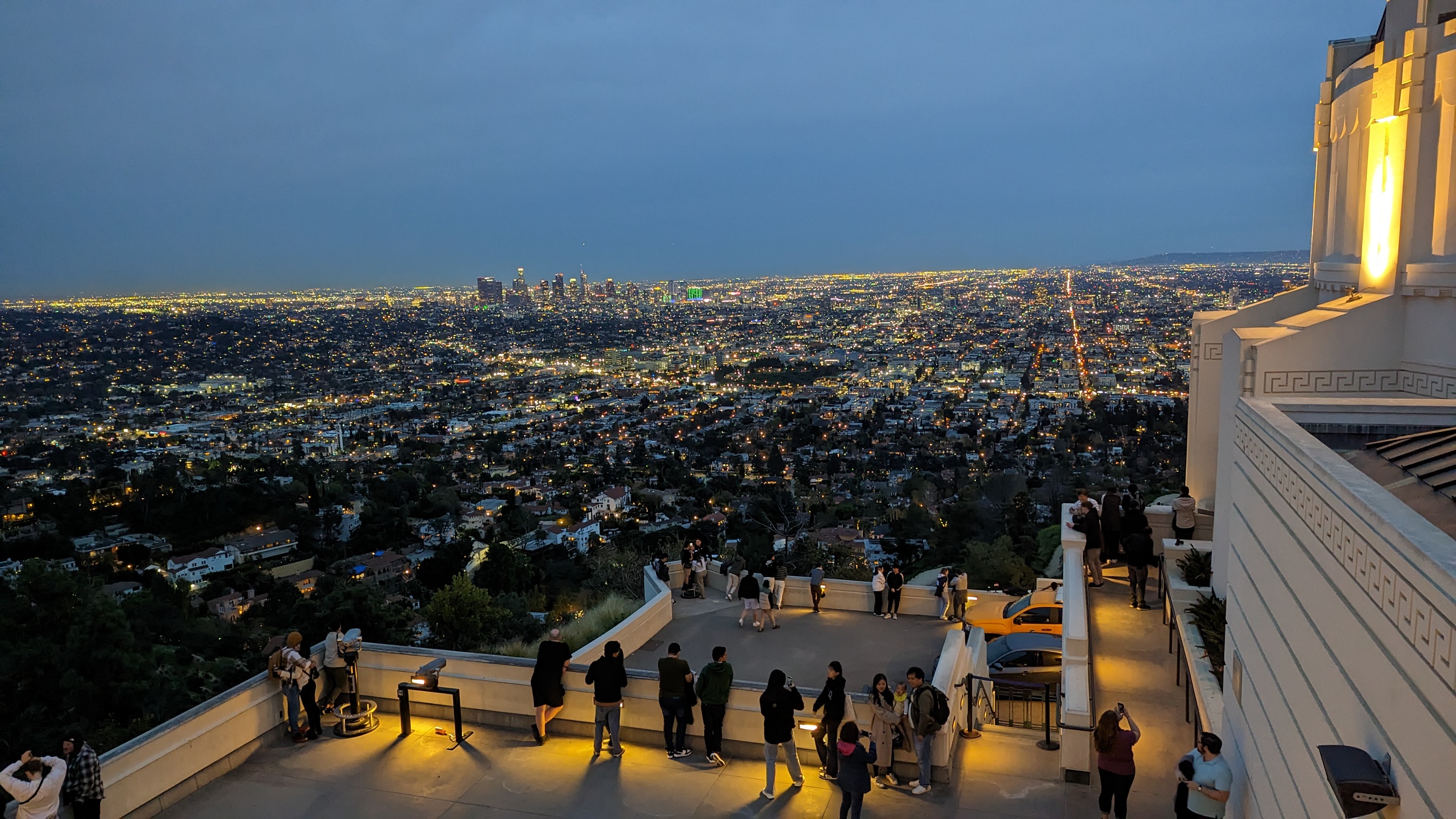
The observatory opened May 14, 1935. The building is Art Deco in style, with a central dome flanked by two smaller domes, sitting on the south-facing slope of Mount Hollywood. Its position commands a view of the Los Angeles Basin from Downtown to Hollywood to the Pacific Ocean, with the Hollywood Sign visible to the northwest. From the day it opened, admission to the building and grounds was free. It has remained so. Los Angeles Mayor Fletcher Bowron noted at the dedication that "the common man" was the observatory's intended visitor — Griffith had left instructions that no one should be charged to enter.
What's Inside
The observatory's first exhibit, installed in 1935, was a Foucault pendulum — the standard demonstration of Earth's rotation, which continues to fascinate in a way that no verbal explanation quite matches. Other original exhibits included the 12-inch Zeiss refracting telescope in the east dome, a solar telescope in the west dome, and a 38-foot relief model of the Moon's north polar region. A Tesla coil — one of a pair built in 1910 by aviator and inventor Earle Ovington — generates spectacular electrical displays.
The observatory closed January 6, 2002, for a $93 million renovation, funded largely by a public bond issue. It reopened November 2, 2006, with a completely restored exterior, new planetarium dome, underground expansion, and the new Leonard Nimoy Event Horizon Theater. In 2008, the observatory broadcast live coverage of the Phoenix spacecraft's landing on Mars. The Astronomers Monument on the front lawn honors Hipparchus, Copernicus, Galileo, Kepler, Newton, and Herschel — six figures represented in a 1934 New Deal artwork by six local artists.
On Screen and in Memory
The Griffith Observatory's Art Deco silhouette is one of the most recognized architectural profiles in American popular culture, primarily because it appears in so many films. James Dean's rebel turned here in 1955's Rebel Without a Cause, and the observatory's parking lot and exterior provided the climactic setting. The building has appeared in Terminator, La La Land, The Rocketeer, numerous episodes of Buffy the Vampire Slayer, and in the title sequence of BoJack Horseman. The list of productions that have filmed here runs to dozens.
Beyond film, the observatory functions as what Griffith intended: a place where Angelenos go to see the sky. On clear evenings, the viewing queue for the public telescope forms early and moves slowly. The city sprawls below in amber light. The San Gabriel Mountains rise to the east. For a building that serves millions of annual visitors on a steep hillside without charging admission, it achieves something quietly remarkable — it treats the understanding of the universe as a public good.
From the Air
Located at 34.12°N, 118.30°W on the south slope of Mount Hollywood in Griffith Park, the observatory's three white domes are among the most recognizable landmarks from the air in the Los Angeles Basin. Visible on approach from the south, west, or east. The Hollywood Sign on Mount Lee is approximately 1 mile NW. Nearest airports: Burbank (KBUR, 5 miles N), Van Nuys (KVNY, 10 miles NW). Best viewed at 2,000–4,000 ft AGL.