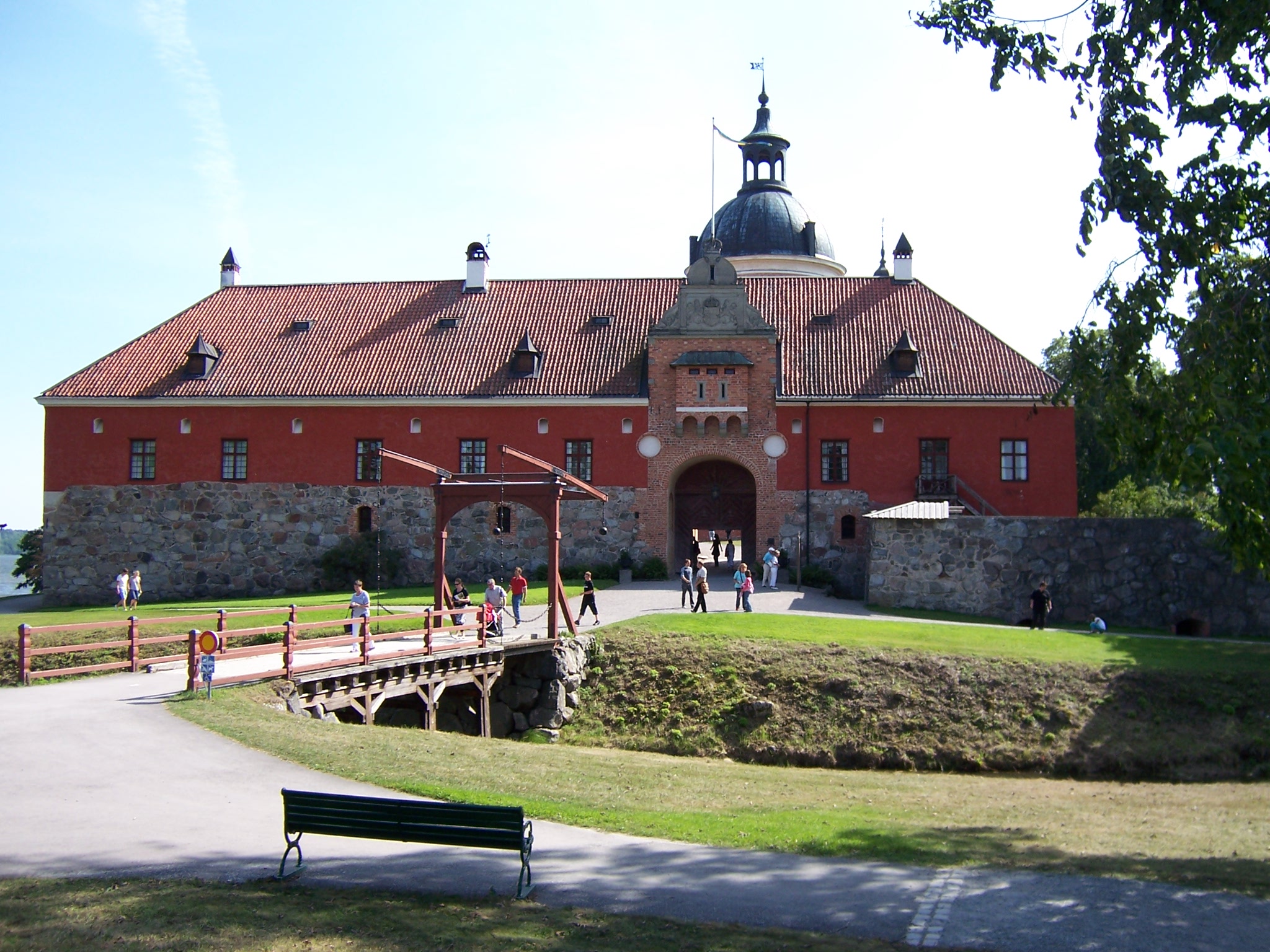
Gripsholm Castle
The castle has a lion. It is badly stuffed. Very badly stuffed. The taxidermist who preserved this gift from the Bey of Algiers in the 1730s had apparently never seen a living lion, and the result has become one of the most famous failed taxidermy attempts in history, grinning maniacally from its display case while visitors photograph it for social media. But the Lion of Gripsholm Castle is merely the most recent chapter in a story that spans six and a half centuries, a story of monks and kings, imprisoned royals and widowed queens, all played out within the red brick walls of one of Sweden's most storied palaces.
From Fortress to Monastery to Crown
Bo Jonsson Grip built a fortress here in the 1370s, giving the castle the name it still bears. Queen Margaret I purchased it in 1404, and the crown held it until Sten Sture the Elder acquired the property in 1472 through a land exchange. The Regent donated Gripsholm to the Carthusian order in 1498, and for nearly thirty years, monks walked these halls in silence, devoted to contemplation and prayer. The Swedish Reformation ended that chapter abruptly. King Gustav I dissolved the monastery in 1526, tore down the medieval buildings, and constructed a new fortified castle with circular corner towers between 1537 and 1545. Of the original fortress, only a single wall facade remains. The Vasa dynasty held Gripsholm in high regard as a reminder of their descent from earlier rulers.
A Prison for Kings
Gripsholm Castle has seen more royal prisoners than most dungeons. Between 1563 and 1567, King Eric XIV imprisoned his own brother John and John's wife Catherine Jagiellon within these walls. Their son Sigismund III Vasa was born here on June 20, 1566, a future king of both Poland and Sweden entering the world in a prison cell. When John eventually deposed Eric, the tables turned dramatically. The former king became the prisoner, held at Gripsholm from 1571 to 1573 before being moved to other castles. The castle continued this grim tradition into the nineteenth century. After the Coup of 1809, Gustav IV Adolf and his family were imprisoned here following his deposition, forced to sign the abdication document within the very walls that had once served as a royal residence.
The Widows' Palace
Between imprisonments, Gripsholm served as a dower residence for royal widows. Maria Eleonora of Brandenburg, widow of the legendary Gustavus Adolphus, lived here from 1636 to 1640. Queen Hedvig Eleonora occupied the castle for over sixty years, from 1654 until her death in 1715, rebuilding and expanding it substantially. She often lived here with her court even before being widowed in 1660, making Gripsholm a center of Swedish aristocratic life. After Hedvig Eleonora's death, the castle fell into disuse, even serving as a prison for commoners during the eighteenth century. King Gustav III revived Gripsholm in 1773, renovating it for his consort Sophia Magdalena and adding a theater in one of the towers where the French Theater of Gustav III performed from 1781 to 1792.
Portraits and Controversy
In 1822, Gripsholm Castle became home to the National Portrait Gallery of Sweden, one of the oldest portrait collections in the world. The Nationalmuseum took over supervision in the 1860s, and the collection remains here today. Between 1889 and 1894, architect Fredrik Lilljekvist undertook a controversial restoration that stripped away many seventeenth and eighteenth-century alterations while adding a third floor. Purists criticized the changes, but the planned demolition of an entire wing was ultimately abandoned. Now the castle operates as a museum open to the public, its rooms filled with paintings and works of art accumulated over centuries. And in one corner, the badly stuffed lion grins on, an accidental masterpiece of taxidermic failure that has brought Gripsholm Castle more fame than any king ever could.
From the Air
Gripsholm Castle sits at 59.26N, 17.22E on the shores of Lake Malaren in south-central Sweden, approximately 60 kilometers west of Stockholm. The castle's distinctive red brick towers and waterside position make it easy to identify from the air. Approach from the east over Lake Malaren or from Stockholm Arlanda Airport (ESSA) to the northeast. The small town of Mariefred lies adjacent to the castle. Stockholm Skavsta Airport (ESKN) is approximately 50 kilometers to the south. The castle grounds extend to the water's edge, and the surrounding Swedish countryside is a mix of lakes, forests, and agricultural land.