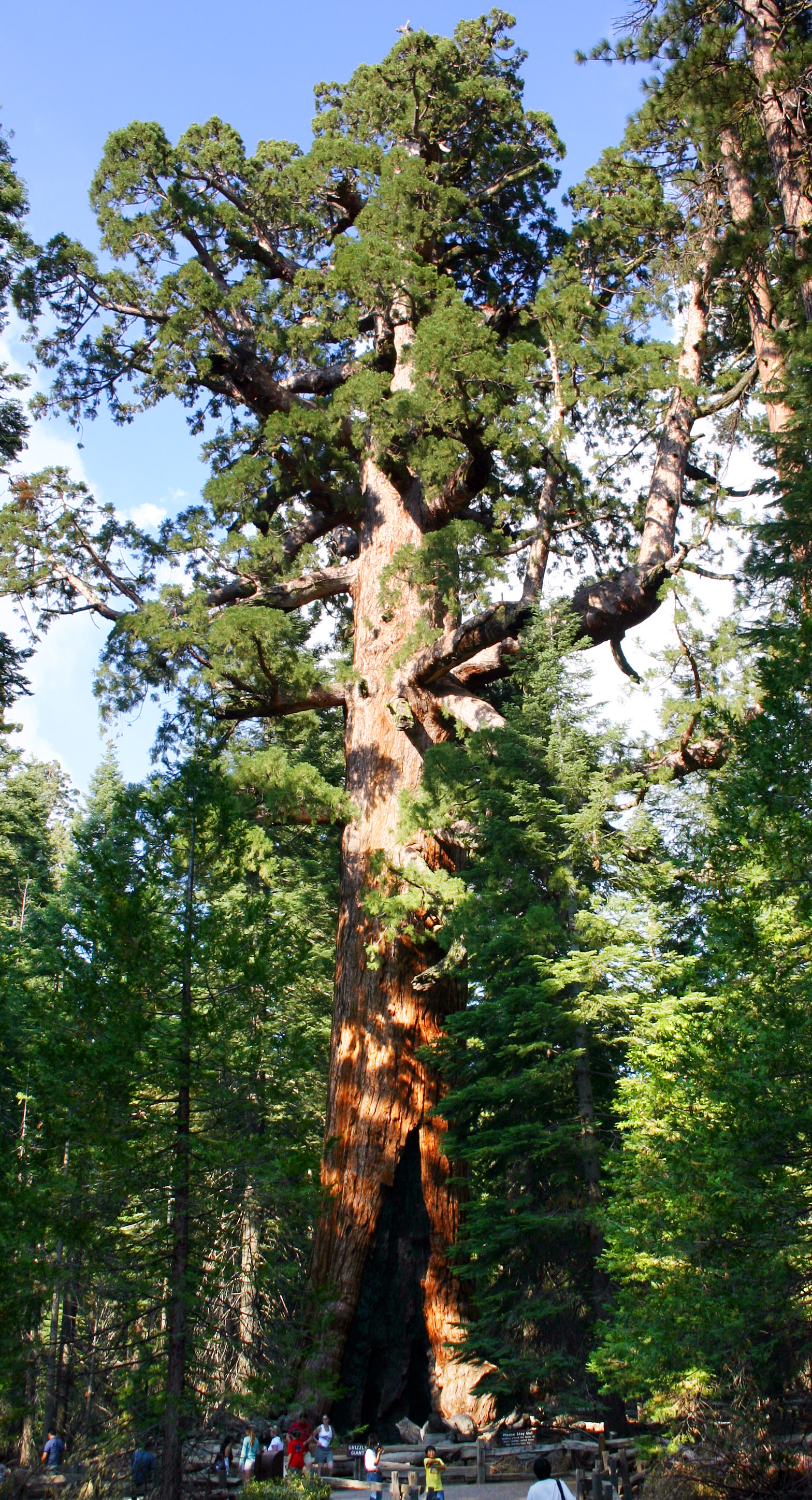
The Tree That Proved the West Wasn't Lying
In the 1860s, when Carleton Watkins hauled his mammoth-plate camera into Mariposa Grove and aimed it upward, he was trying to solve a credibility problem. Reports of trees wider than houses had been filtering east across the continent, and educated Easterners dismissed them as the California Hoax. The Civil War had severed easy travel between coasts, and no one could simply go and look. Watkins's photographs changed that. One image in particular - tiny human figures dwarfed at the base of an impossibly wide trunk - silenced the doubters. The tree in that photograph was the Grizzly Giant, and it has been reshaping the way Americans think about nature ever since.
A Name Earned in Defiance
When publisher James M. Hutchings first encountered the tree in 1859, he was guided there by Galen Clark, the naturalist who had appointed himself unofficial guardian of Mariposa Grove. Hutchings christened it the Grizzled Giant, writing that the tree "looks at you as defiantly as the oldest veteran grizzly bear ever could." By 1888, common usage had trimmed the name to Grizzly Giant - more direct, less poetic, but fitting for a tree that has spent millennia refusing to yield. Early visitors believed it to be the oldest living thing on Earth. David Starr Jordan, president of Stanford University, estimated its age at 8,000 to 10,000 years. Modern ring-dating techniques have settled on a figure around 2,995 years, with a margin of error of 250 years in either direction. That makes the Grizzly Giant roughly as old as Homer's Greece - not the oldest sequoia, but old enough that any quibble over centuries feels absurd.
Fire, Lightning, and 3,700 Tons of Stubbornness
The Grizzly Giant's survival is less a testament to luck than to the particular engineering of sequoia bark, which can grow over two feet thick and is nearly fireproof. Even so, centuries of burns have claimed over 80 percent of the tree's bark and sapwood, along with significant heartwood. The damage has throttled nutrient intake, slowing both growth and healing to a crawl. Fire is only one adversary. In 1942, a single storm struck the tree with lightning six times. Since 1904, foresters have monitored its 18-foot lean - a tilt dramatic enough that first-time visitors instinctively step back. Yet the Grizzly Giant stays upright. Its trunk curves to compensate for the lean, its massive branches act as counterweights, and a root system spreading far beyond the visible canopy anchors the whole structure. The tree weighs an estimated 3,700 tons, and every one of them is precisely balanced.
The Photographs That Built a Movement
Carleton Watkins's photographs did more than document a tree. They restructured the relationship between the American East and the American West. His albumen prints of the Grizzly Giant reached botanist Asa Gray, who was so struck by them that he acquired Watkins's full collection. In 1872, Gray used the images in a lecture for the American Association for the Advancement of Science, arguing that the sequoias' ecological importance demanded study and protection. Those lectures built scientific momentum that fed directly into California's early conservation laws. A few years later, painter Albert Bierstadt translated Watkins's vision into a five-by-ten-foot oil canvas during visits to Yosemite between 1871 and 1873. Displayed at the 1876 Centennial Exposition in Philadelphia, the painting brought the sequoia's grandeur to millions who would never make the journey west. Together, Watkins's camera and Bierstadt's brush made the Grizzly Giant a national symbol - proof that the American landscape contained wonders worth saving.
Presidential Shade
The tree has a history of attracting power. Theodore Roosevelt visited in 1903, camping with John Muir in the nearby Yosemite backcountry and stopping at the Grizzly Giant during a trip that deepened his commitment to conservation. William Howard Taft followed in 1909. U.S. cavalry troops were photographed in formation at the tree's base during the years the Army administered Yosemite, from 1891 to 1913. The Grizzly Giant became a kind of secular pilgrimage site, a place where the nation's leaders came to stand in the presence of something older and larger than any institution. That tradition continues. A million visitors pass through Mariposa Grove each year, and the Grizzly Giant remains the centerpiece - the 26th-largest living giant sequoia, with a measured volume of 34,005 cubic feet, a trunk diameter of roughly 30 feet at its base, and a first branch six feet across.
Still Standing, Still Leaning
Today, the Grizzly Giant occupies a grove that has undergone its own transformation. Mariposa Grove closed in 2015 for a four-year restoration project that removed roads, restored natural water flows, and eliminated private car access. Visitors now ride a shuttle from a welcome plaza near the park's south entrance. The walk to the Grizzly Giant is quieter than it once was - no trams, no gift shops, just the sound of wind in the canopy and the particular silence that old forests create. The tree still leans its 18 feet. It still bears the scars of centuries of fire and the blackened gouges left by lightning. Its crown is ragged, its bark is missing, and its growth has slowed to nearly nothing. But sequoias are built to endure on a timescale that makes human worry seem impatient. The Grizzly Giant was already ancient when Rome fell. It has outlasted every empire that has known about it. There is no particular reason to believe it will stop now.
From the Air
Located at 37.50°N, 119.60°W in the Mariposa Grove area of southern Yosemite National Park. From altitude, the grove appears as a dense stand of exceptionally large conifers on the western slope of the Sierra Nevada. The nearest airport is Mariposa-Yosemite Airport (MPI), approximately 30 nm northwest. Fresno Yosemite International (KFAT) lies about 50 nm to the south-southwest. Recommended viewing altitude: 5,000-8,000 ft AGL for grove context. The terrain rises steeply in this area; maintain awareness of Sierra Nevada ridgelines and typical afternoon convective activity in summer months.