Groeninge Monument
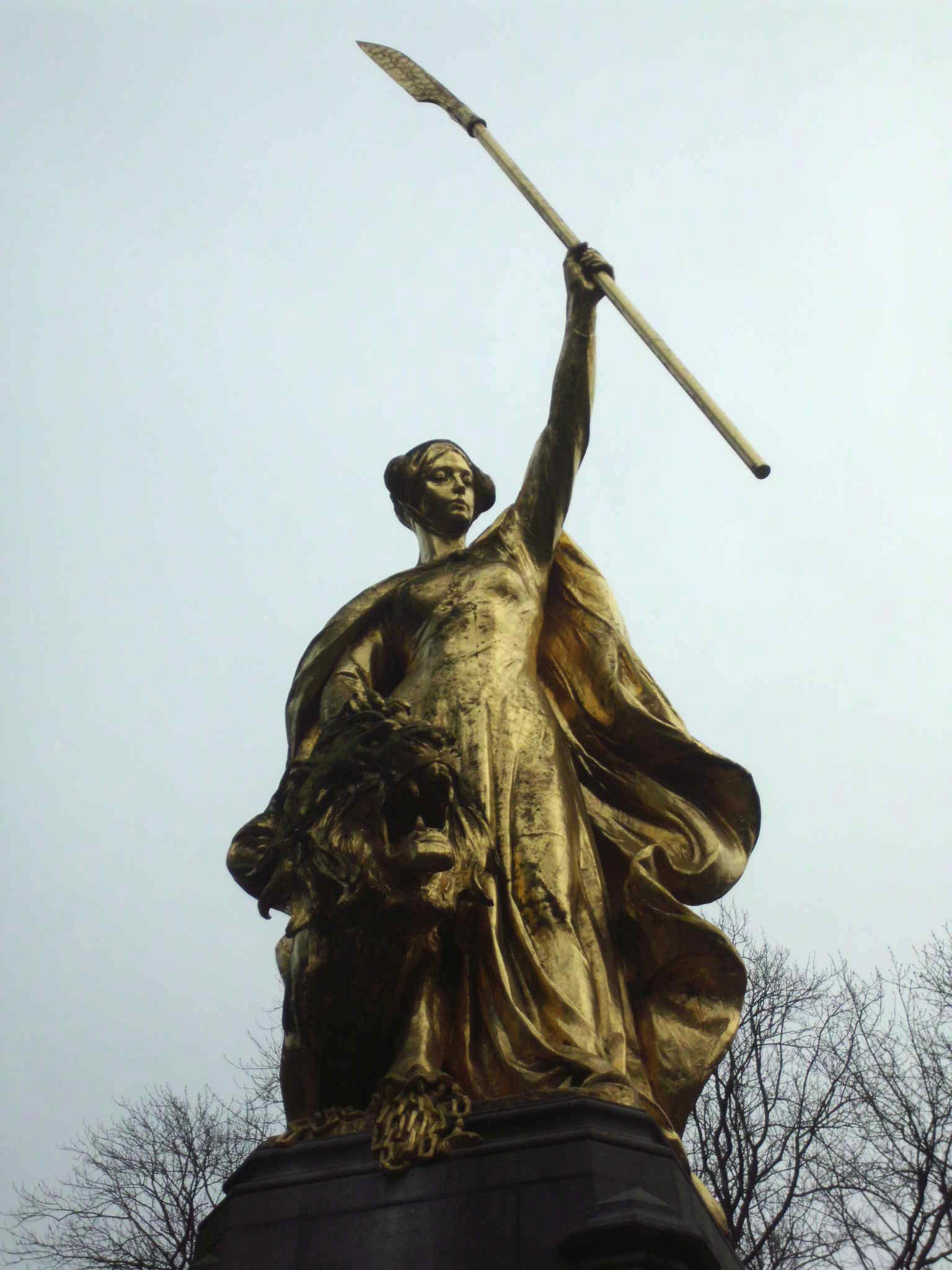
She stands on the exact ground where it happened. The gilded Virgin of Flanders lifts a weapon skyward in one hand while clutching a lion with broken chains in the other. The lion's gaze is fixed toward France. Behind her rises a triumphal arch, and beneath her feet lie bronze reliefs depicting the death of Count Robert II of Artois, fallen beside his horse in the mud of Kortrijk on July 11, 1302. The Groeninge Monument marks the spot where Flemish militia shattered the myth of French knightly invincibility, and it has stood as a symbol of Flemish identity for over a century.
Six Hundred Years Late
The monument was meant to commemorate the 600th anniversary of the Battle of the Golden Spurs, but art takes time. Sculptor Godfried Devreese designed the statue, and the Fonderie Nationale des Bronzes cast it in bronze. The planned 1902 unveiling came and went, and it was not until August 5, 1906, that the gilded figure finally rose above the Groeningepark. The delay hardly mattered. The battle it commemorates had waited six centuries to be properly honored; four more years were nothing. The park itself sits on what was once the Groeninge battlefield, and visitors enter through the Groeningegate, a triumphal arch that frames the monument beyond.
A Weapon of Confusion
Look closely at what the Virgin holds aloft, and you will see a war scythe. Around the time of the monument's construction, there was considerable confusion about which weapon the Flemish actually used to defeat the French knights. The answer was the goedendag, a thick wooden shaft topped with a steel spike, designed to punch through armor joints. But the war scythe had become fixed in popular imagination, and so a scythe the Virgin holds. The error speaks to how myths crystallize around historical events, how the story of the battle became as important as the battle itself.
The Lion Looks to France
Every detail of the monument carries meaning. The Flemish Lion, symbol of Flanders since the Middle Ages, strains against chains that have been broken. Its head is turned toward France, the ancient adversary, in a posture of defiance rather than supplication. The base of the monument depicts three scenes from the battle: mourning for a fallen soldier, the death of Robert II of Artois, and the victory. The coats of arms of Flanders and Kortrijk complete the iconography. The inscription reads 'KORTRIJK - SLAG DER GULDEN SPOREN XI JULI MCCCII' in Dutch, and July 11 has been the official holiday of the Flemish Community since 1973.
The Birth of a Nation
The Battle of the Golden Spurs became more than history in the 19th century. It became a founding myth. After Belgian independence in 1830, the Flemish victory was reinterpreted as a symbol of resistance to foreign rule and a precedent for Flemish identity within the new nation. The Romanticist painter Nicaise de Keyser depicted the battle in 1836, and Hendrik Conscience made it the centerpiece of his 1838 novel The Lion of Flanders, which brought the story to a mass audience. King Albert I invoked the battle at the start of World War I to inspire Flemish soldiers. The monument stands today as the physical embodiment of that cultural memory, a gilded figure on a medieval battlefield proclaiming that this ground, this history, belongs to Flanders.
From the Air
Located at 50.829N, 3.276E in the Groeningepark on the southern edge of Kortrijk's historic center. The gilded statue and triumphal arch are distinctive landmarks. The monument stands on the actual battlefield where the 1302 Battle of the Golden Spurs was fought along the Groeninge stream. The Leie River flows through Kortrijk just north of the site. Kortrijk-Wevelgem Airport (EBKT) is 5km southwest. The medieval belfry and church spires of Kortrijk's center provide reference points. The monument is best viewed at lower altitudes when the gilding catches the light.