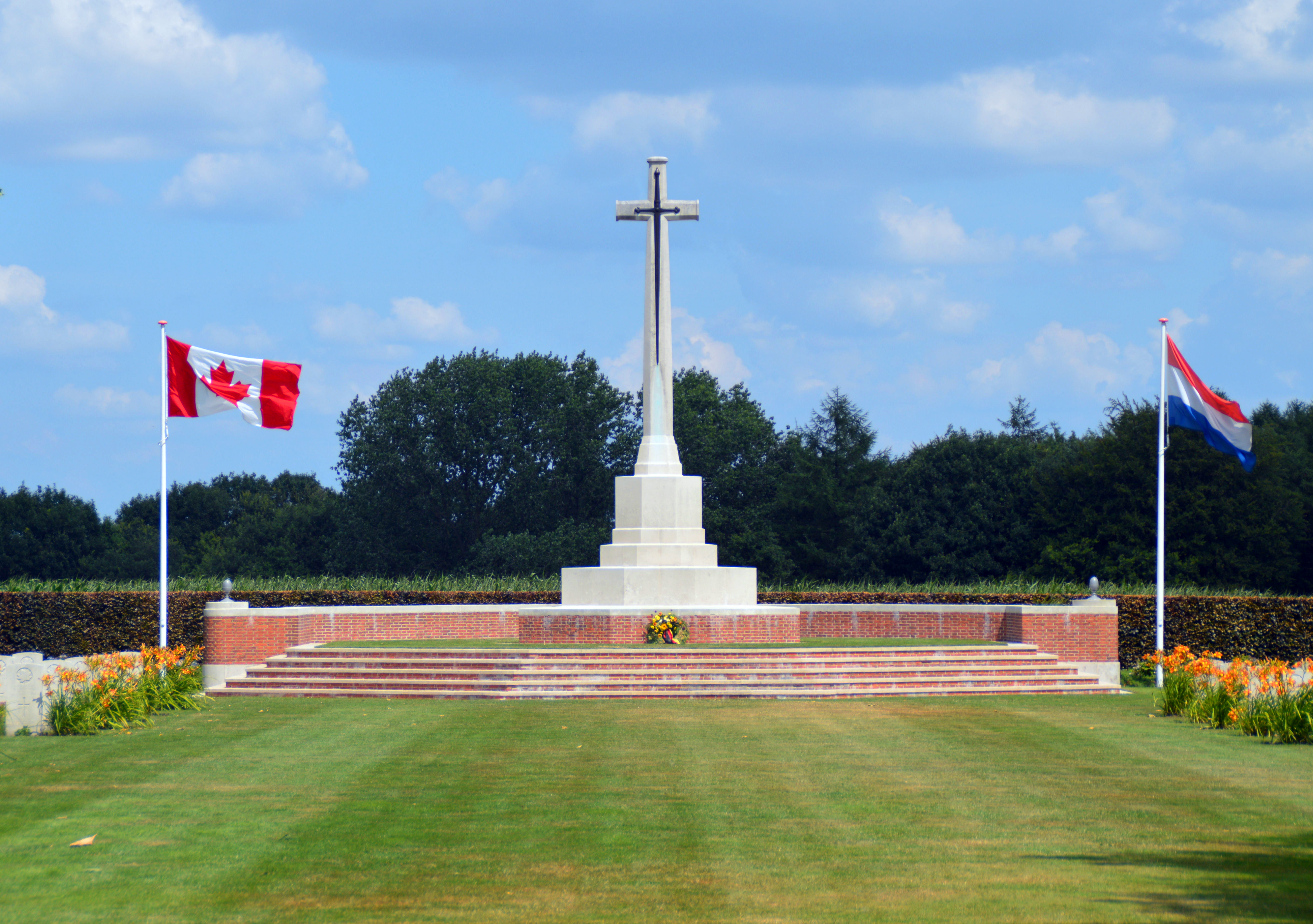
Groesbeek Canadian War Cemetery
General Harry Crerar, commanding the First Canadian Army in north-west Europe, gave an order in 1945 that would shape this cemetery for as long as it stands: no Canadian dead were to be buried in German soil. Canadians had died by the thousands in the Rhineland battles of February and March 1945, fighting their way through the Reichswald forest into Hitler's Reich. After the war, their bodies were exhumed from German earth and carried back across the border to a sloping field outside the Dutch village of Groesbeek. Today 2,338 Canadian soldiers lie here, in rows of white Portland stone that fall away toward the Rhine plain. Almost all of them were in their early twenties.
Why the Bodies Crossed a Border
It is one of the few cases in modern history where war dead were moved across an international frontier on principle. The Commonwealth War Graves Commission usually buries soldiers near where they fell. But the Rhineland campaign, Operation Veritable, had carried First Canadian Army into Germany itself, through forests like the Reichswald and across the Rhine. General Crerar's order meant gravediggers had work to do after the shooting stopped. Bodies were lifted from temporary German plots, carried west, and reinterred in this Dutch field eight kilometers southeast of Nijmegen. The single exception is one Canadian who remains buried at Reichswald Forest War Cemetery on the German side. The cemetery was designed by the Commission's architect Philip Hepworth, and dedicated on 5 May 1947 by Queen Wilhelmina of the Netherlands.
The Names That Have No Grave
Twin colonnaded buildings face each other across the grass forecourt, between the entrance and the Stone of Remembrance. Their rear walls carry panels of Portland stone, and on those panels are inscribed 1,016 names. These are the men of the Commonwealth land forces who died in north-west Europe between the crossing of the Seine at the end of August 1944 and the German surrender, and whose graves are unknown. Since the panels were carved, four of those graves have been found, and four names have been quietly amended in the records. Among the missing whose names are here: Gustave Bieler, Frank Pickersgill, and Romeo Sabourin, three Canadian agents of the Special Operations Executive who parachuted into occupied France, were captured by the Germans, and were executed in concentration camps. There are no graves to visit for them; only their names on this wall.
The Twenty-Three-Year-Old With the Victoria Cross
Aubrey Cosens of the Queen's Own Rifles of Canada was twenty-three years old when he died near Mooshof, Germany on 26 February 1945. After his platoon commander was killed and the platoon was down to four men, Cosens took command, climbed aboard the lead tank, and directed it to ram three farm buildings held by German paratroopers. Then he went into the buildings alone, with a rifle and a Sten, and killed or captured every defender. He was killed by a sniper a few minutes later, as he walked back to report. He never knew that his name had been put forward for the Victoria Cross. He lies here now, one of 2,338. Beside him, in the cemetery's rows, are airmen like William Klersy, a Royal Canadian Air Force ace who survived the war only to die in a flying accident at twenty-two in May 1945, two weeks after Germany surrendered.
The Children Who Tend the Graves
What surprises Canadian families who visit for the first time is the flowers. The graves are always tended. Across the Netherlands, Dutch schoolchildren adopt war graves and care for them; here at Groesbeek they have been doing it for three generations. The arrangement is not formal, exactly, and not Canadian, and not anything the Commission requires. It is simply something the Dutch decided to do, and have kept doing, because these are the boys who freed their country. On the third day of the International Four Days Marches Nijmegen, the route brings thousands of military marchers from dozens of countries past the cemetery, and they stop for a ceremony at the Cross of Sacrifice. For a few minutes the silence is total. Then the marchers shoulder their packs and move on, and the children come back, and the rows of white stones look out across the Rhine plain that 2,338 young men did not live to see.
From the Air
Coordinates 51.798°N, 5.932°E, on rising ground about two kilometers north of Groesbeek village and eight kilometers southeast of Nijmegen. From the air the cemetery's geometry is unmistakable: a long grass forecourt with twin colonnaded buildings flanking the entrance, and rectangular plots of white headstones falling away toward the German border. Nijmegen lies clearly to the northwest, with the wide Waal river beyond it. Maastricht Aachen Airport (EHBK) is roughly 60 km south; Eindhoven (EHEH) about 50 km southwest. Best flown at low altitude in late morning, when the sun is high enough to wash the Portland stone in bright white.