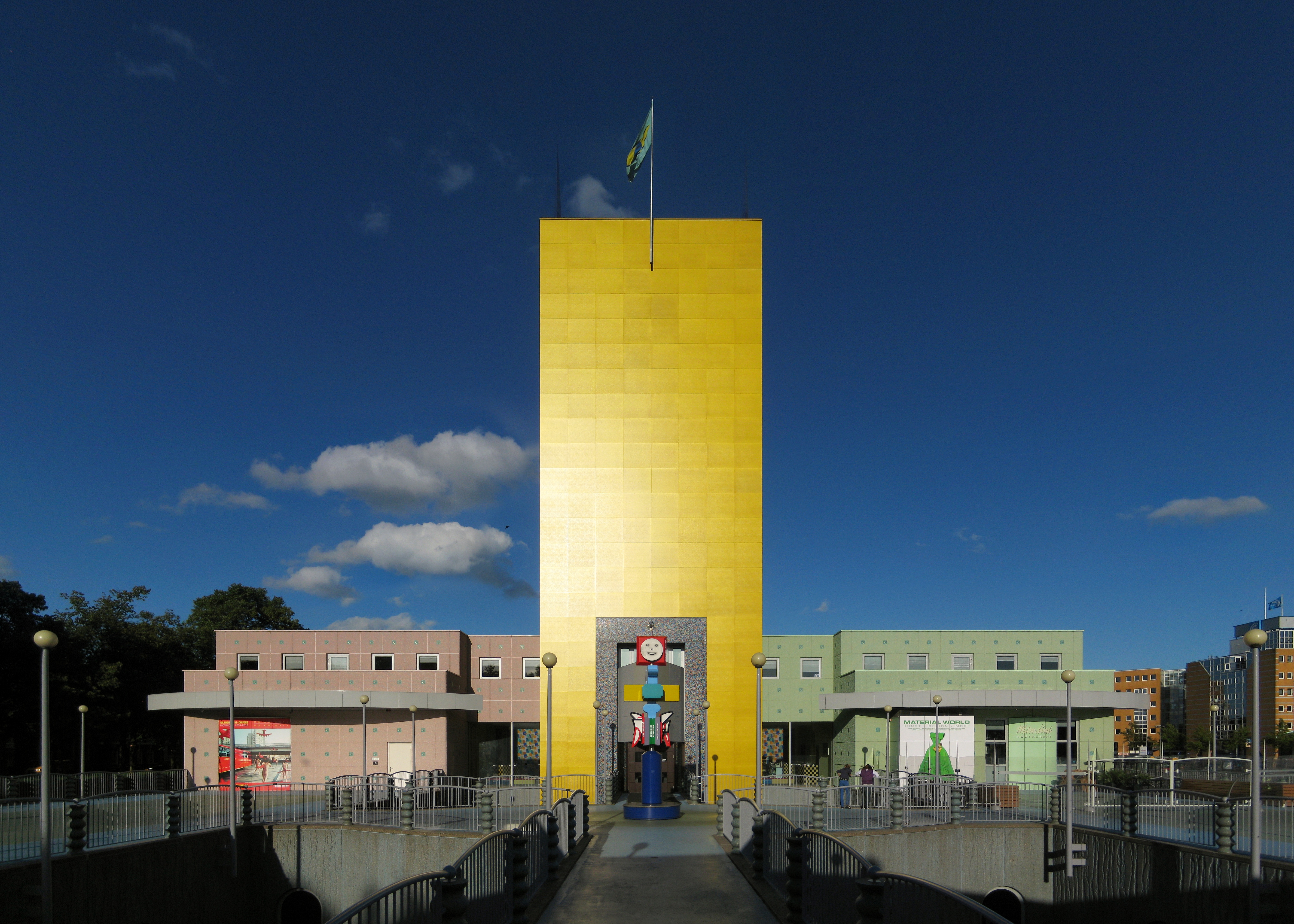
Groninger Museum
Frans Haks wanted something extravagant. As director of the Groninger Museum in 1990, he was looking at a hopelessly cramped old building on the Praediniussingel and a once-in-a-generation pot of money from Gasunie, the Dutch natural gas company, which was celebrating its twenty-fifth anniversary and wanted to give the city a present worth 25 million guilders. So Haks made an unusual decision. He refused to hire architects for the conceptual studies. He wanted designers, furniture makers, and provocateurs - people who would think about a building the way someone thinks about a chair or a clothing line. What he got, four years later, was a museum that locals tried to halt in the high court and then, slowly, learned to love.
Frank Stella Wants Teflon
Haks first approached the American artist Frank Stella to design one of the museum's planned pavilions. Stella accepted and produced a vision that turned out to be unbuildable for the budget on offer: he wanted the entire structure made of Teflon. The municipality, looking at the figures, asked him to revise. He declined. The Vienna-based architecture collective Coop Himmelb(l)au stepped in to take the commission for the pavilion Stella had abandoned. They delivered a pale-blue deconstructivist box that looks as though it has been folded and creased rather than built. Alessandro Mendini, the Italian designer and former member of the Memphis Group, took the central pavilion and produced a yellow brick tower in defiant primary colour. Philippe Starck, the French industrial designer best known for furniture, took a third. The result was three buildings designed by three completely different sensibilities, joined together and dropped into a canal.
The Lawsuit
Local residents were not, initially, charmed. Citizens fearing that an eccentric postmodern building would crash their property values went to court. They succeeded in halting construction for an entire year. The objections were specific: the design was peculiar, the colours were aggressive, the shapes refused to harmonise with anything around them. Alderman Ypke Gietema - the politician who had pushed hardest for the museum to be sited on its present spot, straddling the Verbindingskanaal between the Central Station and the old city - stayed firm through what the museum's own history calls "acrimonious objections". Construction resumed in 1992. The building opened in 1994. Within a few years the same residents who had sued to stop it were giving directions to tourists by pointing at it.
A Bridge as Architecture
The museum sits in the water rather than next to it. The central pavilions float on a platform built into the Verbindingskanaal, and a pedestrian and cycle bridge connects them directly to the train station on one side and the old city on the other. The bridge is not an afterthought - it is part of how the building works. Visitors arriving at Groningen Centraal walk out of the station and into the museum's geometry, and through it on their way to the Vismarkt and the Grote Markt beyond. The route turned an awkward institutional siting problem into one of the most-photographed entrances to any old Dutch town. The whole composition - the bridge, the canal, the three argumentative pavilions - has become, almost without intending it, the postcard image of contemporary Groningen.
What Hangs Inside
The collection holds roughly 80,000 objects organised into five areas: the archaeology and history of Groningen, visual arts from 1500 to 1950, art after 1950, contemporary art and design and fashion and photography, and East Asian ceramics. About 30,000 items have been digitised and are searchable online. The exhibition programme has always run hot. A 2002 retrospective of Ilya Repin, the "Russian Rembrandt", drew traditionalists. Andres Serrano's photography in another year drew protesters. In 2012 the fashion designer Iris van Herpen got a full show, and Azzedine Alaïa another. The 2015 blockbuster "David Bowie is" became the museum's most consequential exhibition for an unintended reason: on 10 January 2016, while the show was on the walls, Bowie died of cancer at age 69. The museum, normally closed on Mondays, opened its doors that day, put out a condolence register, and let fans in for free.
The Numbers, Steady
Since 2008 visitor counts have moved within a fairly stable band - somewhere between 150,000 and 300,000 a year, with 2010 dragged down by a long renovation closure from April to December. The high-water mark was 2019, when over 324,000 people came through. The 2024 figure was just under 166,000, a softer year following the post-pandemic adjustment that hit museums across the Netherlands. Even so, the Groninger Museum remains comfortably the most visited museum in the province. Andreas Blühm directed the institution from 2012 to 2025; Roos Gortzak became the museum's first female director in 2025, taking over with Jan Geert Vierkant in a new two-person leadership structure. The building that residents sued to stop is now a thirty-year-old fixture, and the only people who still find it strange are the ones seeing it for the first time.
From the Air
The Groninger Museum sits at 53.212°N, 6.566°E, straddling the Verbindingskanaal just south of Groningen Central Station and immediately north of the diepenring canal ring that defines the old city. The bright yellow Mendini tower and the pale blue Coop Himmelb(l)au pavilion make the complex easy to spot from the air against the surrounding russet brick of central Groningen. Nearest airport: Groningen Airport Eelde (EHGG), 4.8 nautical miles south. Recommended viewing altitude 2,000-2,500 feet; the museum is a useful visual anchor for finding the Martinitoren about 400 metres to the northeast.