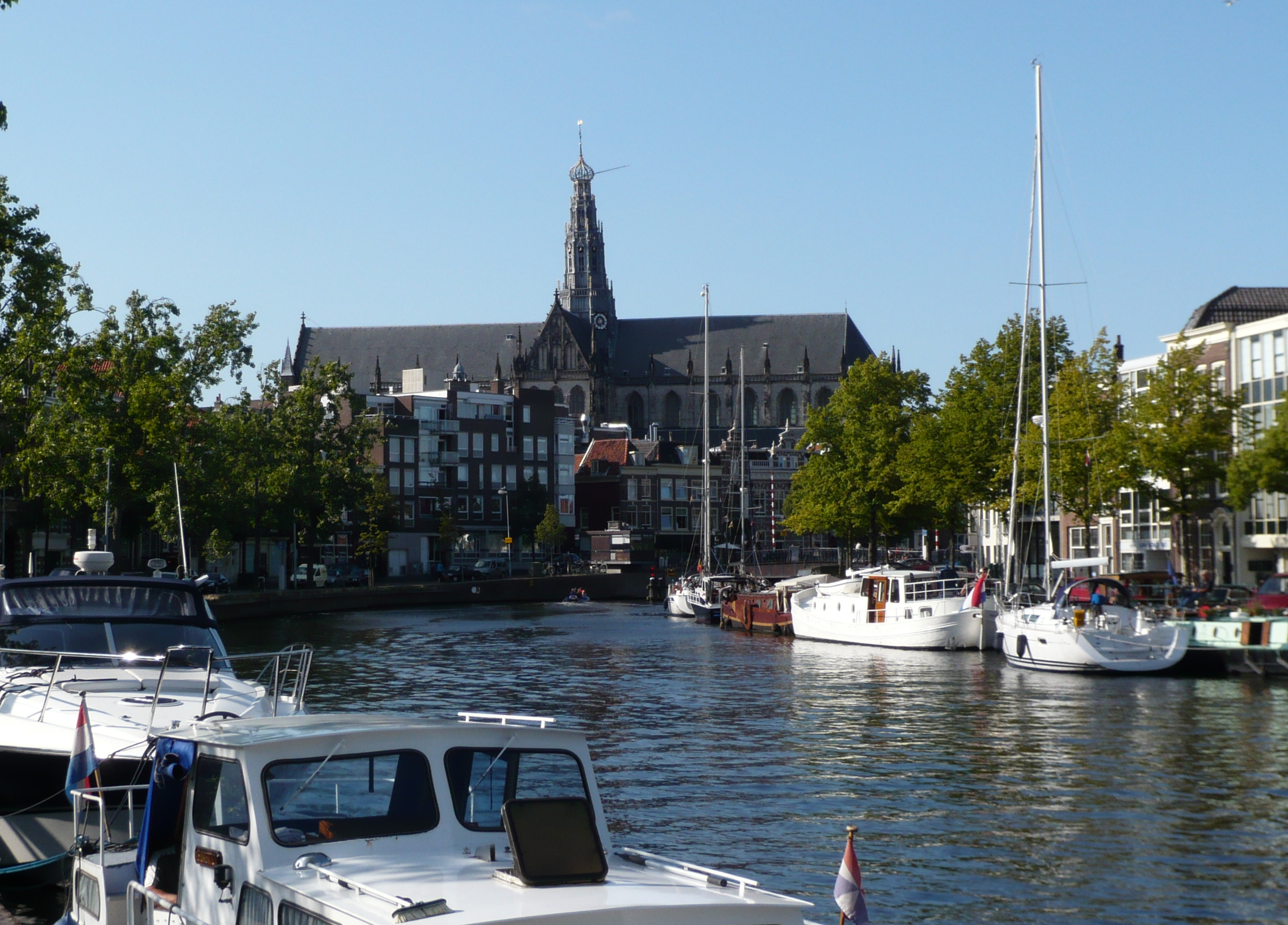
Grote Kerk, Haarlem
In 1766, a ten-year-old boy was lifted onto the bench of the largest organ in the world. He had been touring Europe with his father since he was seven, performing for kings and electors, and now he had come to Haarlem to play the Christian Muller organ at the Sint-Bavokerk. The instrument behind him rose nearly thirty meters into the Gothic nave, sixty stops and pedal towers of polished tin, with stucco cherubs by Jan van Logteren swarming the case. The boy was Wolfgang Amadeus Mozart. Handel had played the same instrument before him. Mendelssohn would play it later. The boy pressed the keys, and the church, which the Dutch simply call Grote Kerk, the Big Church, filled with sound that locals still claim could loosen mortar from the brimstones.
Stone Above the Market
The first church on this site was mentioned in 1307, a wooden structure that burned in the fourteenth century. What rose in its place became one of the dominant silhouettes of the Dutch Golden Age. The Gothic tower lifts above the Grote Markt where the fish vendors and flower sellers still set up their stalls, and the whitewashed nave inside is so vast that the painters Pieter Saenredam and the Berckheyde brothers spent careers depicting its receding columns and pale light. The church was officially elevated to cathedral in 1559, but only for nineteen years. By 1578 the Catholics were gone, driven out by the Haarlemse Noon, a violent reformation moment when Protestant soldiers killed a priest at the altar. The statuary came down from the niches outside. The church became simply Big.
The Painter Beneath Your Feet
Until 1831 the wealthy of Haarlem were buried under the stone floor of the church, and walking the aisles today is walking on their names. Pieter Teyler van der Hulst, whose fortune created the city's great museum, lies here. So do the painters Maarten van Heemskerck, Jacob and Salomon van Ruisdael, and Pieter Saenredam, who painted these very interiors. Frans Hals, the master of the loose brushwork and laughing burghers, was buried in 1666 in the grave of his first wife's grandfather. For nearly three centuries he had no marker of his own. Only in 1962 did Haarlem finally give him a stone. The corpses underfoot once rotted in such numbers that a foul odor seeped up through the flagstones, and the wealthy who paid for the privilege of burial there were said, in local lore, to be stinking rich.
The Organ That Shook Mortar
Christian Muller of Amsterdam built the great organ between 1735 and 1738. When it was finished it held the world record: sixty voices, 32-foot pedal towers, almost five thousand pipes. Herman Melville never saw it but knew its reputation. In Moby-Dick he reaches for it to describe the inside of a whale's mouth, asking whether the colonnades of bone might make one feel as if standing inside the great Haarlem organ. The instrument was modified across the centuries, most drastically by Marcussen between 1959 and 1961, and again voiced between 1987 and 2000. Free concerts run all year. Walk in on a Tuesday in summer and you may hear the carillon outside answered by the Muller pipes inside, the bourdon bell Roeland, cast in 1503 and weighing nearly five tons, striking the hour above it all.
Bells, Legends, and a Hand That Grew
Two bells in the tower, named Piet and Hein, are called the Damiaatjes. Local legend insists Haarlem knights brought them home from Damietta during the Fifth Crusade in 1219, a story painted into stained glass and woven into the city's coat of arms. The bells were really cast in 1562 by Johannes Dircks of Aalst, but the legend stuck, and the Damiaatjes still chime every evening between nine and nine-thirty as they did when the city gates closed at dusk. Other stories lurk in the stones. Beneath gravestone number seven near the choir gate, the locals say, lies a man who beat his mother as a child. His hand, the story goes, began to grow up through the grave after he died, and a copper plate had to be laid down to stop it. The Grote Kerk is full of these small dark fables. Even Anthony Fokker, in 1911, banked his early airplane around the tower for a Queen's Day stunt, photographed for the morning papers as he passed.
From the Air
Located at 52.3808N, 4.6364E in central Haarlem, the Grote Kerk tower rises above the Grote Markt and is the most prominent vertical feature in the city skyline, visible from cruising altitudes in clear weather. The tower stands roughly 15 km west-southwest of Amsterdam Schiphol (EHAM), the closest major airport, and serves as a useful visual landmark for low-level approaches over the polders west of the Randstad. The town lies on the Spaarne river between the coastal dunes and the Haarlemmermeer polder.