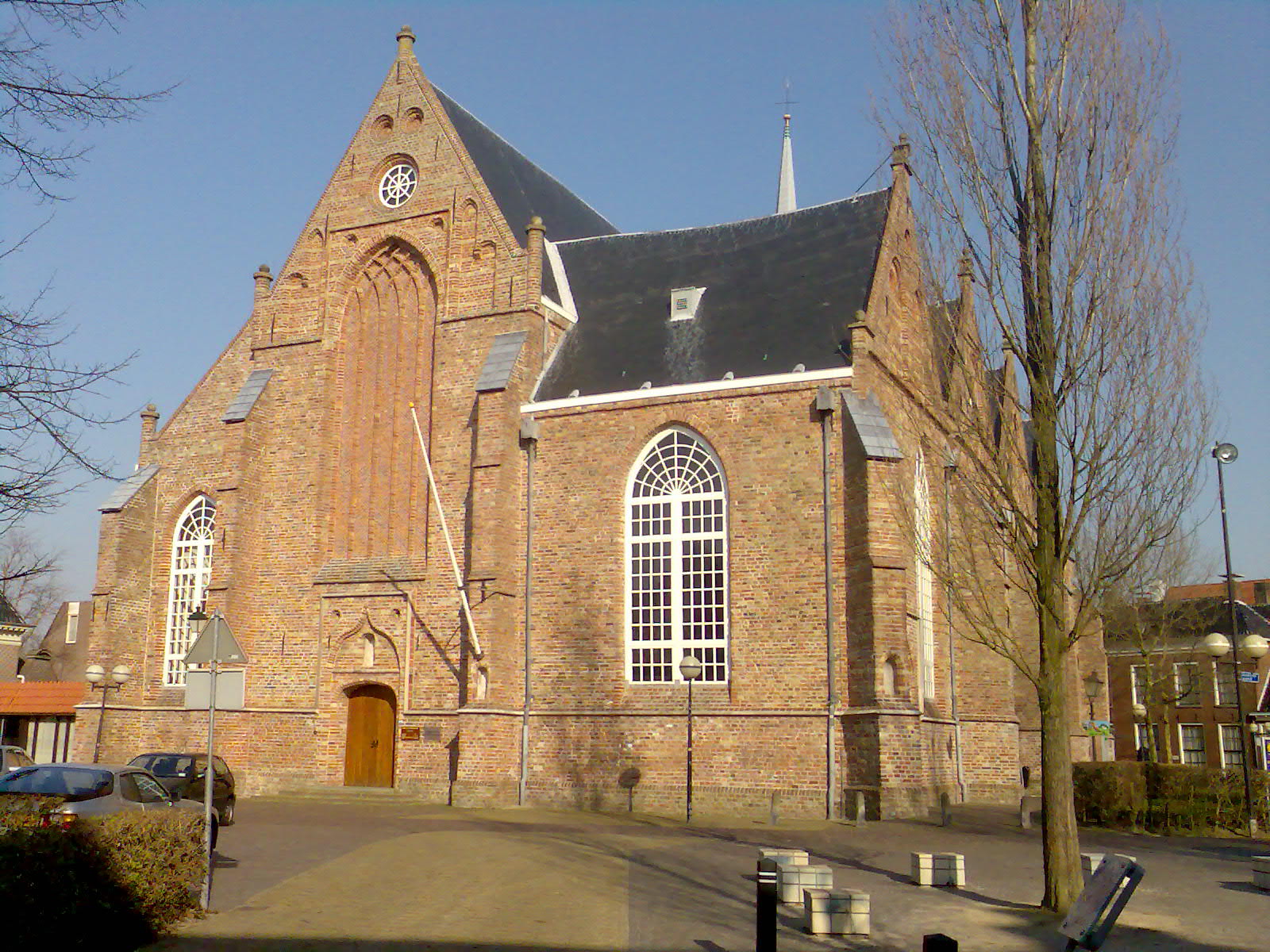
Grote or Jacobijnerkerk
Three cities in the Netherlands hold a royal crypt: Delft, Breda, and Leeuwarden. The first two are the obvious ones, tied to the House of Orange that most outsiders associate with the Dutch crown. Leeuwarden is the surprise. Inside the choir of the Grote or Jacobijnerkerk - a brick Gothic church that began life in 1245 as a Dominican monastery - lie the bones of the Frisian Nassaus, the cousins whose bloodline would eventually furnish every Dutch monarch from William I onward. Walk in expecting a small provincial church. Stand under the vaulted ceiling, breathe the cold air that smells faintly of stone and old wood, and understand that the modern Netherlands has one of its taproots planted right here.
Built by the Friars, Kept by the Province
The Dominicans - the Jacobins, in French and Dutch shorthand - arrived in Leeuwarden in 1245 and started building. The result is the oldest structure standing in the city. Fire damaged the church in 1392; it was restored two years later. An aisle was added in 1504, a westward bay completed in 1521, and the whole place rebalanced through restoration in the 1970s. That restoration turned up something unexpected. Beneath layers of whitewash were medieval murals, finished in 1575 and then painted over only three years later when Reformation iconoclasts decided saints on the walls were no longer appropriate. The murals are visible again now, fragments of a Catholic past preserved by the Protestants who tried to hide them.
The Muller Organ
The pipe organ at the west end of the nave was built in 1727 by Christian Muller of Amsterdam, the same builder whose later instrument at Haarlem's Sint-Bavo became one of the most famous organs in Europe. The Leeuwarden Muller has three manuals and thirty-seven stops, and it is widely considered one of the most beautifully voiced baroque organs in the Netherlands. Famous hands have played it. Camille Saint-Saens, the French composer, gave a recital here in 1897. Albert Schweitzer - theologian, organist, and the man who would later win the Nobel Peace Prize for his work as a doctor in Gabon - played a concert at the Grote Kerk in 1932. When the organ sounds, the air in the nave thickens. Three centuries of varnish and lead pipe answer the player back.
The Royal Crypt
In the choir, beneath the floor, lies the crypt of the Frisian Nassaus. Countess Anna of Nassau was interred here in 1588. William Louis, Count of Nassau-Dillenburg, joined her in 1620. Ernest Casimir followed in 1632, Henry Casimir I in 1640, William Frederick in 1664, Henry Casimir II and Albertine Agnes both in 1696, and finally Marie Louise of Hesse-Kassel in 1765. These were the stadhouders of Friesland - rulers in all but name - and their line eventually merged with the main House of Orange to produce the modern Dutch monarchy. In 1795, revolutionaries inspired by France stormed in during the Batavian Revolution and smashed the graves. The crypt sat in disrepair until 1948, when the fiftieth anniversary of Queen Wilhelmina's reign prompted a full rehabilitation. The bones were reinterred. The space was restored.
Glass for the Twentieth Century
The stained glass came later. Cor Reisma made three windows in 1957 commemorating the Frisian Nassaus. In 1963, Dick Osinga designed and Willem Bogtman fabricated the Wilhelmina Window on the right - a meditation on the Dutch resurrection from the Second World War, with a plaque to Queen Juliana added beneath it in 2005. Two more windows by Jos de Ridder went in during the long restoration of the 1970s. On 17 April 2018, exactly 437 years to the day after William the Silent convened the provincial Diet that met inside these walls, the King's Commissioner of Friesland unveiled a bronze relief by sculptor Eric Claus. The relief commemorates that 1581 assembly. History in this church compounds, layer on layer.
Standing in the Square
Outside, the cobbled square - the Jacobijnerkerkhof - was once the friars' graveyard, and the name still tells you so. Today it is a quiet pocket in the city center, lined with brick gables and bicycles. Look up at the brickwork of the church and you can read the centuries: thirteenth-century base, fifteenth-century westward extension, the eighteenth-century touches around the entrance. The whole structure leans slightly. That is normal in this part of the world, where everything heavy eventually settles into Frisian peat. The building does not seem to mind.
From the Air
Located at 53.2039 N, 5.7972 E in central Leeuwarden, Friesland. From the air, the Grote Kerk reads as a long brick rectangle with a low tower at the west end, dominating the small Jacobijnerkerkhof square. The leaning Oldehove tower sits 400 meters to the west and provides an easier landmark from altitude. Closest airport is Leeuwarden Air Base (ICAO: EHLW), about 5 km northwest; nearest civilian field is Drachten Airfield (ICAO: EHDR), 25 km southeast. Best viewed from 1,000 to 2,500 feet AGL in clear conditions.