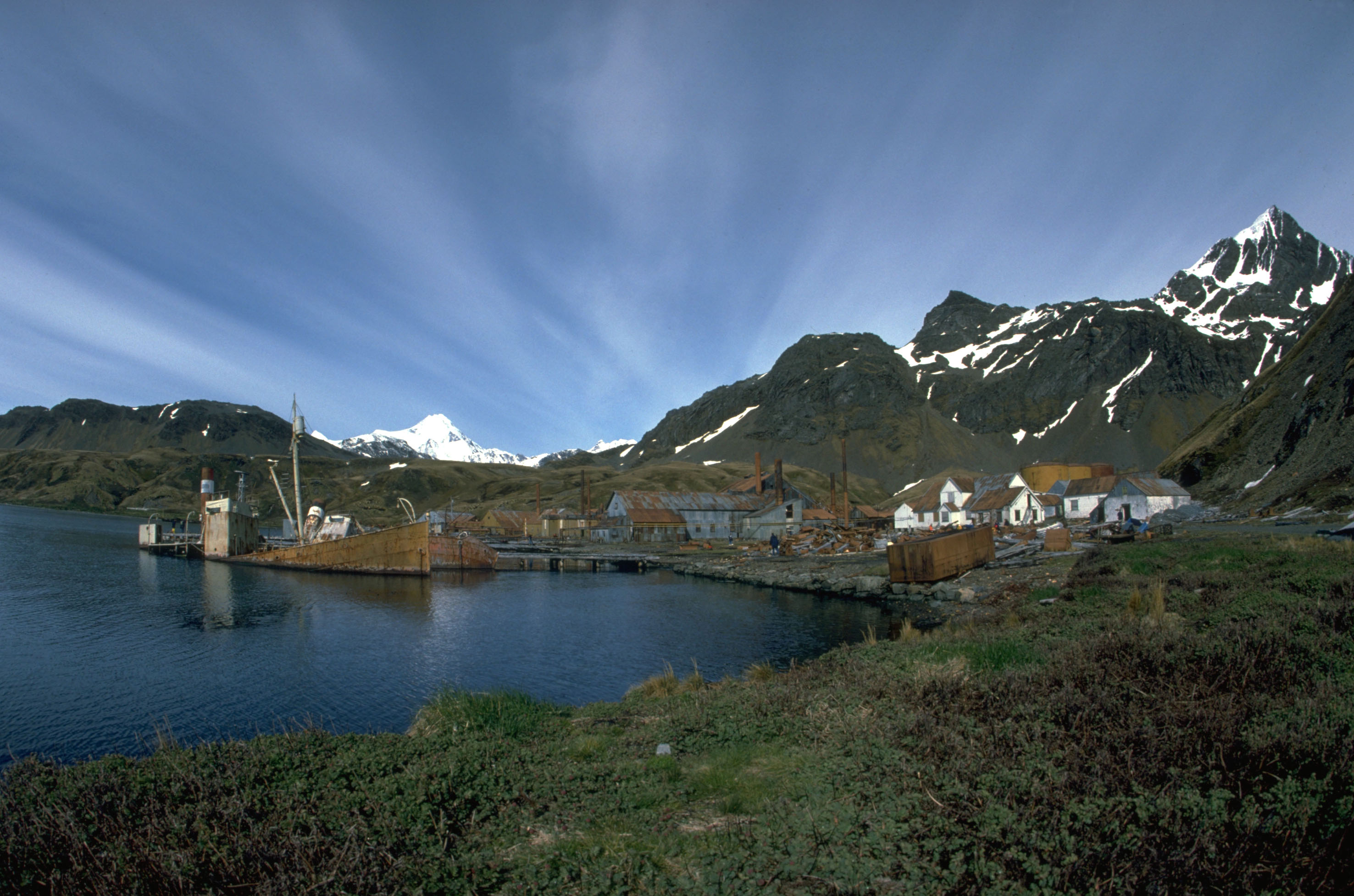
Grytviken
The whaling station has been mouldering since 1966, its structures slowly surrendering to rust in shades of orange that glow against the grey Antarctic sky. Grytviken - 'Pot Bay' in Swedish - took its name from the old pots left behind by seal hunters, then became the center of an industry that killed so many whales it eventually ran out of them. Now the machines that rendered blubber into oil sit silent, their hulks colonized by elephant seals too young to remember what happened here. But the real reason visitors come lies up the hill: a simple grave marked by a stone cross, where Ernest Shackleton rests at the end of the world he spent his life exploring.
The Slaughter
Norwegian Carl Anton Larsen founded Grytviken in 1904, choosing this harbor for its shelter from South Georgia's brutal winds and its supply of fresh water. What followed was industrial carnage on a scale difficult to comprehend. Whale catchers brought their kills to the station, where the carcasses were winched up slipways and systematically dismembered. Blubber went into the steam-heated digesters. Meat went into processing plants. Bones went into grinding mills. Nothing was wasted except the species itself.
At its peak, South Georgia's whaling stations processed over 7,000 whales per year. Grytviken operated until 1964, closing only when whale populations crashed so catastrophically that hunting was no longer profitable. The other stations - Leith, Stromness, Husvik - closed in the years following. What had taken millennia for evolution to create, industrial whaling destroyed in six decades.
Shackleton's Rest
The whalers' cemetery predates the church, opening in 1902 for men who died in this unforgiving land. The graves cluster on a slope facing the harbor, their crosses marking Norwegian, Swedish, and British names. But one grave draws the visitors: Ernest Shackleton, 1874-1922.
Shackleton had reached South Georgia once before in extraordinary circumstances - navigating a small boat 1,300 kilometers across the Southern Ocean from Elephant Island, then crossing the island's mountainous interior to reach help for his stranded men. It was the defining achievement of polar exploration, a rescue mission that saved every member of his expedition. He returned in 1922 on another journey south, but his heart gave out in Grytviken's harbor. His wife asked that he be buried where his heart had always been.
The Second Deputy
Also interred at Grytviken are the ashes of Frank Wild, Shackleton's deputy who held the stranded men together on Elephant Island while the boss sailed for help. Wild was present on that final 1922 expedition too - a shoe-string affair that tried to continue south after Shackleton's death but was forced back by thick ice, lack of equipment, and muddled objectives.
Wild's story ended less grandly. He drifted through failed farming ventures in Africa, fell into poverty, and died in Johannesburg in 1939. His ashes were placed in a vault and forgotten. Only in 2011 were they traced and finally brought to South Georgia, to rest beside the man he had followed to the edge of the world. A smaller headstone marks his grave: 'Shackleton's right-hand man.'
The Living Station
King Edward Point, a kilometer east along a dirt track, serves as South Georgia's capital and port of entry. All vessels must have prior permission to visit, and inspections are mandatory for first arrivals. A few staff operate the research station and manage the steady stream of cruise ship visitors - this is the main tourist stop on voyages to the Antarctic Peninsula.
The whaling station itself remains off-limits in parts, its structures unsafe after decades of neglect. But you can walk among the rusting machines using the museum's map to identify which building served which grim purpose. Elephant seals lounge among the equipment, untroubled by the irony. King penguins wander through. The wind carries the smell of guano and rust.
It's become tradition to toast Shackleton at his grave - bringing whatever you have aboard and splashing a bit on the stone. Schnapps and sake both have history among the whalers. One modern whisky, Mackinlay's Shackleton Blended Malt, replicates bottles found in 2006 at his 1907 expedition base on Ross Island, frozen and forgotten for a century.
The Third Death
One more grave deserves mention, though it tells a different story. Felix Artuso, an Argentine submarine petty officer, died in 1982 during the British recapture of South Georgia in the Falklands War. He had already been taken prisoner when a British soldier, thinking Artuso was trying to sabotage his submarine, shot him dead.
The grave lies near the whalers' plots, a reminder that South Georgia's isolation hasn't spared it from the conflicts of the wider world. Argentina claimed the island then and maintains that claim now, though British administration continues. Artuso's death - friendly fire, prisoner of war, accident or crime depending on perspective - adds a darker note to the cemetery's roll call of men who came to this remote place and never left.
From the Air
Located at 54.28S, 36.51W on the northeastern coast of South Georgia Island. The whaling station sits on the shore of King Edward Cove, a sheltered inlet off Cumberland East Bay. King Edward Point (the administrative center) is 1km to the east along a dirt track. The whalers' cemetery containing Shackleton's grave is on rising ground south of the station. The distinctive rust-orange structures of the abandoned whaling station are visible from the air against the grey-green landscape. Mountains rise steeply behind the station; Nordenskjold Glacier is visible to the south. The island has no airport - access is by ship only from the Falkland Islands (1,400km west), Ushuaia (1,500km southwest), or as part of Antarctic cruises. Expect strong katabatic winds descending from the glaciers, variable weather, and significant wildlife (elephant seals, fur seals, penguins) on and around any potential landing areas.