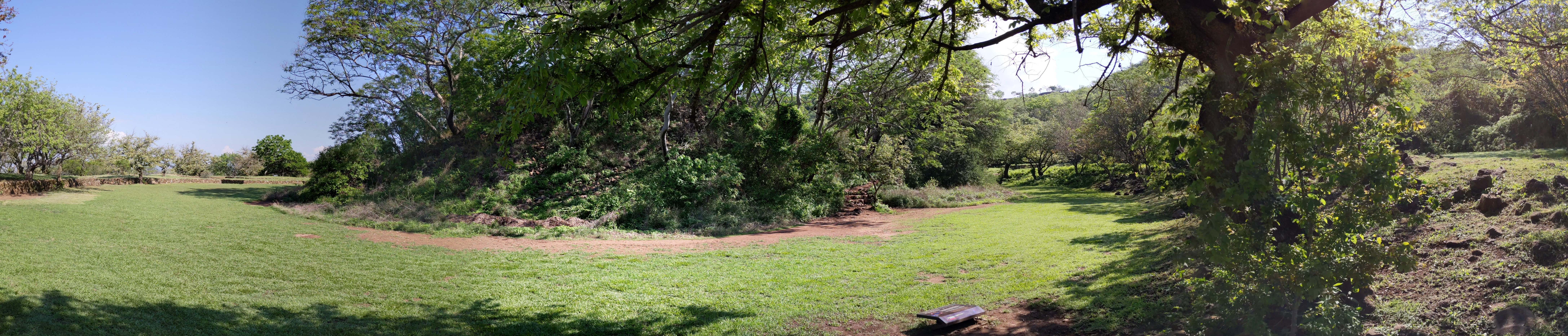
Guachimontones
For almost seventy years, archaeologists walked right past them. The circular stepped structures in the hills above the town of Teuchitlan, Jalisco, bore no resemblance to the rectangular pyramids that defined Mesoamerican archaeology, and so they went unrecognized. It was not until 1974 that Phil Weigand and Joseph Mountjoy published the first descriptions of these bulls-eye-shaped buildings, overturning the academic consensus that West Mexico had contributed nothing monumental to pre-Columbian civilization. Los Guachimontones, the largest of several dozen Teuchitlan Culture sites in the Tequila Valleys, dates from roughly 300 BCE to 450 CE and is now part of the Agave Landscape and Ancient Industrial Facilities of Tequila UNESCO World Heritage Site. The circular forms, unique in Mesoamerica, may represent artificial mountains, solar symbols, or stages for the volador pole ceremony. What they certainly represent is a civilization that has been drastically underestimated.
Circles in the Hills
A guachimonton is unlike any other Mesoamerican building. The basic structure consists of a circular patio platform that forms the base, a ring-shaped banquette built on top of it, a central altar in the middle, and an even number of rectangular platforms arranged around the banquette, ranging from four to sixteen. The effect, seen from above, is a precise bulls-eye: concentric rings of stone and earth stepping upward to a central point. The site of Los Guachimontones covers approximately 19 hectares across two ceremonial centers, with twenty-five guachimontones documented by survey work between 2013 and 2017. Circle 1, the largest, was built between roughly 160 and 40 BCE. Ball Court 1, stretching 110 meters, is notable for its straight-sided lateral platforms, a regional variation that raises questions about what version of the Mesoamerican ballgame the Teuchitlan people played.
Feasts, Chiefs, and 112,000 Days of Labor
The political structure of the Teuchitlan Culture has been debated for decades. One model proposes a segmentary state, with competing chiefdoms that cooperated in defense of the valleys but traded and clashed with each other. Chiefs maintained power not through coercion but through consensus, bolstered by their ability to acquire exotic goods like jadeite and shell from distant trade networks. Feasting was central to this system: elites hosted large gatherings, converting surplus and artisan goods into social prestige. An architectural energetics analysis of Circle 2 estimated that constructing the entire building would have required 112,651 person-days of labor across six construction seasons, much of it spent hauling clay from sources roughly a kilometer away at the base of the hills. The labor for each of the ten platforms varied significantly in volume and method, suggesting that separate groups built separate sections, competing through construction as much as cooperating.
Ancestors Below, the Sun Above
The Teuchitlan Culture participated in the Western Mexico shaft tomb tradition, burying some individuals deep underground in chambered tombs accompanied by ceramic vessels, figurines, shell ornaments, conch trumpets, and jadeite. Ceramic models recovered from these tombs depict miniature guachimontones with a pole in the center and a figure perched on top, strongly suggesting that the sites hosted a version of the volador ceremony still practiced in Mexico today. The cosmological interpretation runs deep. The central altar may represent an artificial mountain, a feature of immense spiritual significance in Mesoamerican belief, the place where gods dwelled, where water originated, and where caves led to the underworld. Shaft tombs, then, were artificial caves. Together, the tombs below, the guachimonton at ground level, and the pole reaching skyward mapped the three planes of Mesoamerican cosmology: underworld, earthly plane, and heavens. Another interpretation, drawing on Wixaritari (Huichol) ethnography, sees the circular form as a representation of the sun and connects the structures to the Wixaritari deities Grandfather Fire and Father Sun.
Red Paint on White Clay
The artistic output of Los Guachimontones centered on ceramics, shell, and obsidian. The most distinctive pottery style is Oconahua Red-on-White, characterized by geometric red patterns painted on a white background. Serpent motifs appear frequently, linking the local artistic tradition to broader Mesoamerican symbolism. The site also produced hollow ceramic figures and solid figurines in the Ameca-Eztatlan and San Juanito styles. These figures are commonly labeled 'shaft tomb figures' because looters first found them in burial contexts, but excavations at Los Guachimontones have recovered figurines in non-mortuary settings, many showing use-wear and breakage that indicate they had active lives before being interred as offerings. Phil Weigand directed excavations from 1999 until his death in 2011, and Dr. Verenice Heredia Espinoza of El Colegio de Michoacan continues the work, analyzing the substantial collection of artifacts his decades of research produced. The site that was invisible to archaeologists for seventy years now yields new understanding with every season of digging.
From the Air
Los Guachimontones sits at 20.695N, 103.836W in the hills above the town of Teuchitlan in the Tequila Valleys of Jalisco. From 3,000-6,000 feet AGL, the circular guachimonton structures are visible on the hillsides as concentric rings of restored stonework amid green slopes. The site covers approximately 19 hectares across two ceremonial areas. Guadalajara International Airport (MMGL) is approximately 55 km to the east. The broader Tequila Valley landscape features distinctive blue agave fields. Expect generally good visibility in dry season with convective buildup in summer afternoons.