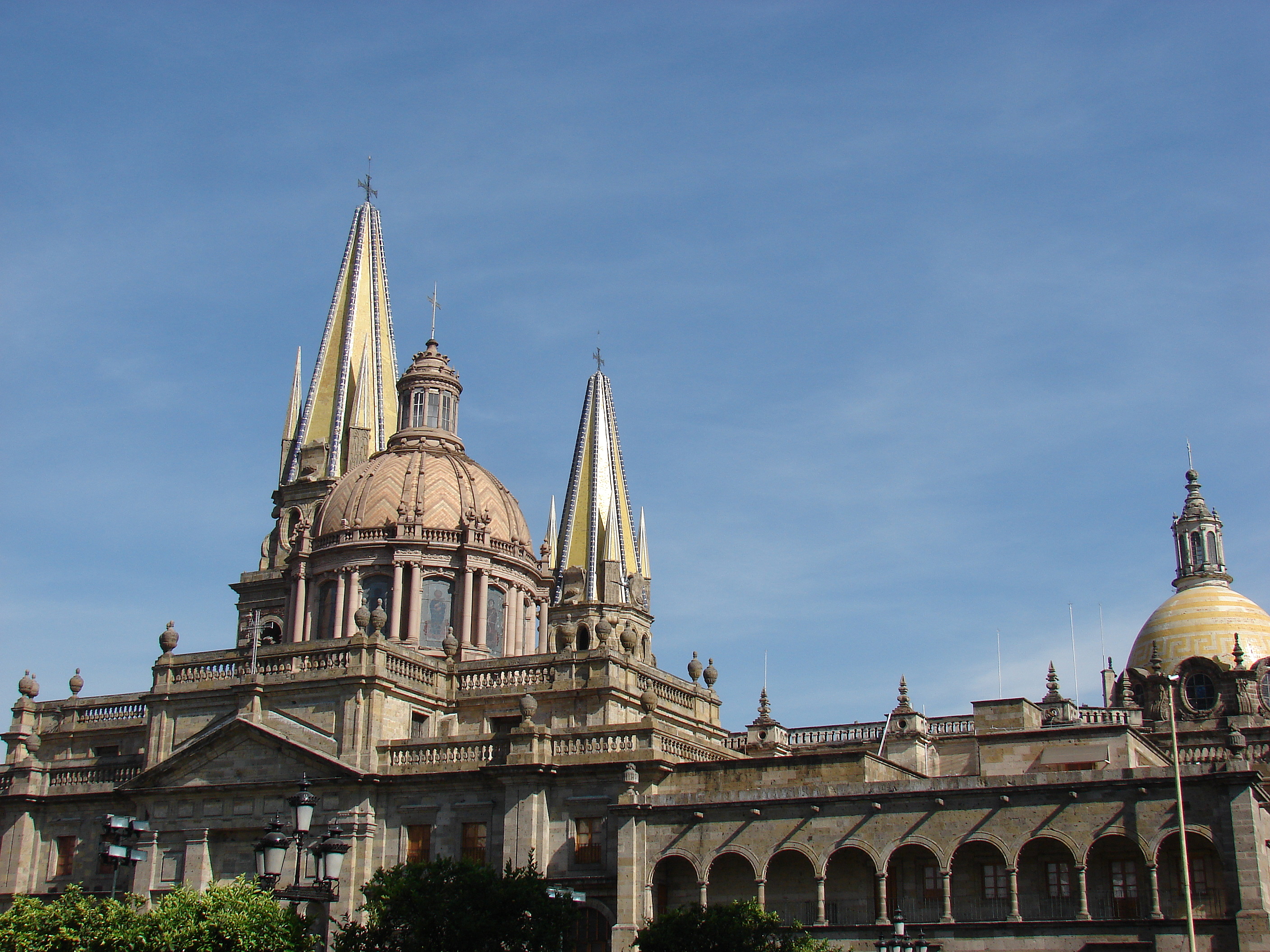
Guadalajara Cathedral
On May 30, 1574, someone fired celebratory gunshots into the air during Mass. Bullets fell back onto the roof and set the cathedral ablaze. It was not the first disaster to befall Guadalajara's main church, nor would it be the last. The Cathedral of the Assumption of Our Lady has been burned, shaken to rubble by earthquakes, and rebuilt so many times that its current form is a composite of centuries -- Spanish Renaissance walls supporting neo-Gothic towers that did not exist until 1854. The building at the heart of Guadalajara is less a single architectural statement than a record of persistence.
From Adobe to Cathedral
The first church on this site was built in 1541 from adobe with a thatched roof, a humble structure for a settlement still finding its footing in New Spain. Seven years later, in 1548, the Holy See designated the region a diocese, and the little adobe church became a cathedral by decree if not by grandeur. King Felipe II commissioned a proper replacement in 1561, designed by master architect Martín Casillas, but funds came slowly. Construction dragged for decades. The new cathedral was not completed until February 1618, and it took nearly another century to be formally consecrated, on October 12, 1716. By the time the church was officially sacred, the city had grown up around it.
Towers That Would Not Stay Standing
In the early morning of May 31, 1818, an earthquake shook Guadalajara and brought the cathedral's towers and dome crashing down. Replacement structures were built, only to be destroyed by another earthquake in 1849. For years the cathedral stood damaged and tower-less, its silhouette diminished against the city skyline. Bishop Diego Aranda finally commissioned local architect Manuel Gómez Ibarra to design new towers. Ibarra, already known for his work on the Hospicio Cabañas, drew up the neo-Gothic spires that now define the cathedral's profile -- conical towers rising from square bases, capped with Greek crosses, their upper portions tiled in yellow and blue. Construction began on July 30, 1851, and was completed three years later on July 15, 1854, at a cost of 33,521 pesos. The towers that visitors see today are the cathedral's third set, and its most enduring.
A Blending of Styles
Walk around the cathedral's exterior and you trace the history of its construction. The main body is Spanish Renaissance: geometric, proportional, built on a basilica plan with pilasters in colossal order framing the entrance and semicircular arches flanked by columns. Then the eye travels upward to the towers, and the style shifts entirely. Four pinnacles at each tower's base give way to the neo-Gothic cones that Ibarra designed after the earthquakes, an addition that should clash with the Renaissance body but somehow coheres. The stained glass inside was imported from France, depicting biblical scenes across the dome at the rear of the nave. The central altar is crafted from marble and silver, and the walls carry paintings by notable colonial-era artists.
The Living Cathedral
The cathedral's crypt holds the remains of three cardinals and several bishops of the diocese. Among them rests Cardinal Juan Jesús Posadas Ocampo, assassinated in 1993 at Guadalajara International Airport in a shooting that remains controversial. The interior holds altars dedicated to a roster of saints and advocations: Our Lady of the Assumption, Our Lady of Guadalupe, Our Lady of Zapopan (the patron saint of Guadalajara), Saint Dominic, Saint Thomas Aquinas, and Saint Christopher, among others. On the south side, the Sagrario Metropolitano serves as the administrative wing, its own temple-front facade giving it the appearance of a separate church. Flanked by four public plazas, the cathedral remains the gravitational center of Guadalajara's historic core, a building that has burned and collapsed and risen again, its mismatched towers proof that survival matters more than stylistic purity.
From the Air
Located at 20.68°N, 103.35°W in the Centro district of Guadalajara, Jalisco. The cathedral's distinctive twin neo-Gothic spires with yellow and blue tile tops are visible from altitude as a landmark in Guadalajara's historic core. The building is surrounded by four plazas. Nearest airport is Guadalajara Miguel Hidalgo y Costilla International (MMGL/GDL), approximately 16 km to the south. Elevation roughly 5,100 feet. Clear conditions most of the year.