Guadalupe Island Biosphere Reserve
In 1892, a Smithsonian expedition discovered a small group of northern elephant seals on a remote volcanic shore 150 miles off Baja California, a species thought extinct since the 1880s. Tragically, they killed most of the animals they found for specimens. Yet somehow enough seals remained hidden to rebuild, and their descendants now number over 200,000 across the Pacific. Guadalupe Island has become one of the most remarkable conservation success stories in the Pacific. This isolated Mexican territory, fog-shrouded and wave-battered, serves as both sanctuary and laboratory, proving that damaged ecosystems can heal when given the chance.
A Place of Last Chances
Guadalupe Island rises from the deep Pacific as a volcanic fortress, its precipitous sea cliffs reaching heights that rival coastal mountains. The island stretches 22 miles from north to south, its terrain ranging from fog-drenched cypress forests in the north to barren desert scrub in the south. A single freshwater spring sustains the roughly 100 seasonal fishermen who live here. The cold California Current sweeps past, moderating temperatures and bringing an extraordinary abundance of marine life to these waters. Heavy fog blankets the higher slopes much of the year, providing crucial moisture through fog drip that sustains vegetation the annual rainfall alone could never support.
The Goat Apocalypse
Whalers and seal hunters introduced goats to Guadalupe in the early 19th century, and the consequences proved catastrophic. Without predators, the goat population exploded to an estimated 100,000 by 1870. They devoured everything. By 2005, when Mexico established the biosphere reserve, 41 percent of the island lay completely barren. Forest and woodland that once covered 15 percent of the land had shrunk to less than one percent. Only 130 Guadalupe pines survived. Just 20 island oaks remained. Ten California junipers clung to existence. Scientists believed the remnant forests had no future. Then came the removal effort: most goats were captured and transported to mainland farmers. By 2007, the island became goat-free. A decade later, thousands of pine seedlings had sprouted, and native vegetation was reclaiming the barren slopes.
Resurrection of the Seals
The Guadalupe fur seal and northern elephant seal both owe their existence to this island. Commercial hunters pursued them relentlessly for pelts and oil throughout the 19th century, driving both species to the edge of oblivion. A few Guadalupe fur seals, discovered hiding in a cave in 1954, became the foundation for a population that now numbers approximately 40,000 across the Pacific islands of Mexico. The elephant seals, despite scientists collecting several specimens after their supposed extinction, rebuilt from perhaps dozens of individuals to 10,000 on Guadalupe alone by 2015. The pinnipeds now crowd the rocky shorelines, bellowing and sparring, their recovery a testament to the resilience of life when hunting pressure lifts.
Realm of the White Shark
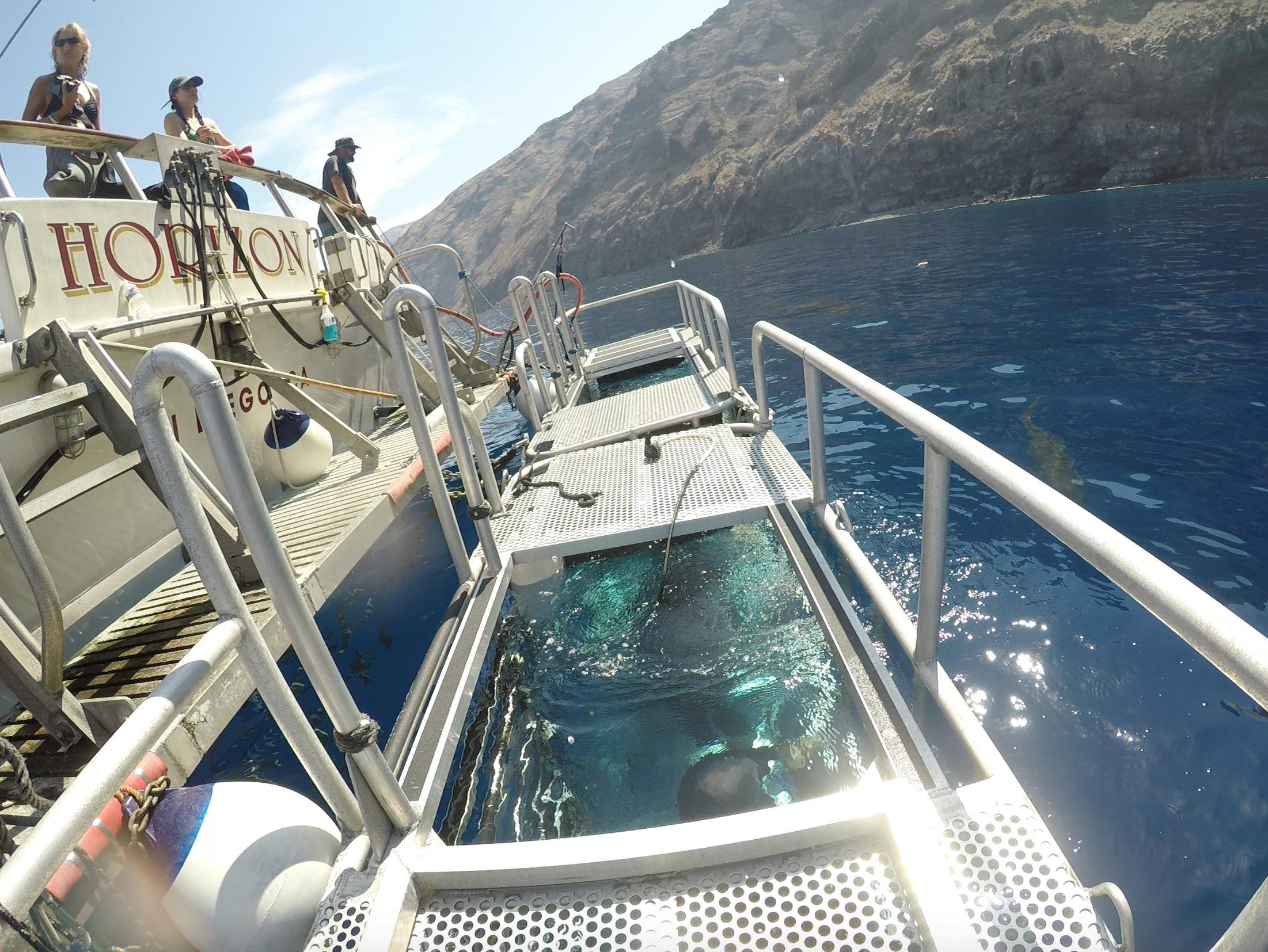
More than 300 great white sharks frequent the crystalline waters around Guadalupe, drawn by the abundant seal populations. Males arrive in July, females in September, and they patrol these hunting grounds until February before embarking on a remarkable 2,000-mile journey to the White Shark Cafe, a mysterious gathering point between Guadalupe and Hawaii that takes them about a month to reach. The exceptional water clarity made Guadalupe famous among shark-cage diving enthusiasts seeking encounters with these apex predators. However, in January 2023, Mexico permanently banned all tourism within the reserve, including cage diving, film production, and liveaboard diving, closing this window into the underwater world.
Continuing the Recovery
The restoration work continues. A nursery near the island's center has produced 90,000 native seedlings since 2015, focusing on endemic trees like the Guadalupe cypress. The Mexican government has implemented programs for erosion control and fire prevention. Feral cats remain a threat, having caused the extinction of six bird species, but eradication efforts have reduced their numbers to roughly 400, with complete removal expected by 2025. Already, 22 species of seabirds have returned to the Pacific islands since 2010. At the southern tip, a fenced enclosure protects 220 Laysan albatross nests from the remaining cats. Bird by bird, plant by plant, Guadalupe Island demonstrates that conservation, given time and commitment, can reverse even seemingly irreparable damage.
From the Air
Guadalupe Island lies at 29.05N, 118.26W, approximately 150 miles west of Baja California. The volcanic island is easily identifiable from altitude by its isolation and mountainous terrain. No civilian airports exist; approach with caution as this is a protected biosphere reserve with restricted access. Nearest major airport is Tijuana (MMTJ) on the mainland.