Guanajuato (city)
Three kilometers of road run beneath Guanajuato, following the bed of a river that no longer flows there. The city's main thoroughfare is literally underground -- carved through the old course of the Guanajuato River, now drained and paved, where cars thread between stone walls once slicked with current. Above, the city spills across an impossibly steep ravine in shades of pink, green, ocher, and red, its colonial buildings stacked so tightly that many streets are really just alleys, and the plazas are so small they feel like wide spots in a hallway. This is what silver bought: a city too beautiful and too improbable for the terrain it occupies.
The Metal That Made a City
Silver was discovered in the Guanajuato region in 1548, and within decades the narrow canyon was filling with fortune-seekers. The first significant mine, San Bernabe, operated from the sixteenth century until 1928 and triggered the discovery of deposits that would make this one of the richest mining districts on Earth. At its peak, the Valenciana mine alone produced sixty percent of the world's silver output. The wealth reshaped the landscape. Mine owners built churches in the extravagant Churrigueresque style, their pink sandstone facades dripping with carved saints, scrollwork, and gilded altarpieces. Neighborhoods like Cata, Rayas y Mellado, and Valenciana still carry the names of the mines that created them. Even the Guadalupe Mine complex, with its enormous buttressed stone walls, looks more like a medieval fortress than an industrial site -- a testament to how seriously the colonial powers guarded their silver.
Callejoneadas and the Alley of the Kiss
Guanajuato's geography forces intimacy. The alleys twist and climb, balconies nearly touching across the gap. One passage, the Callejon del Beso, is so narrow -- barely 68 centimeters wide -- that lovers on opposing balconies can lean across and kiss, giving the alley its name and its legend of two doomed sweethearts. This closeness also gave birth to a local tradition: the callejoneada, a roving street party led by student musicians from the University of Guanajuato. Dressed in period costume, the musicians wind through the alleys with their audience trailing behind, singing, drinking, and stopping at plazas no bigger than a living room. The university itself began as a Jesuit school for children in the 1730s, sponsored by Josefa Teresa de Busto y Moya, who donated a fifth of her personal fortune to establish the institution in her own home. Its monumental staircase now dominates the hillside like a stone waterfall.
The Unquiet Dead
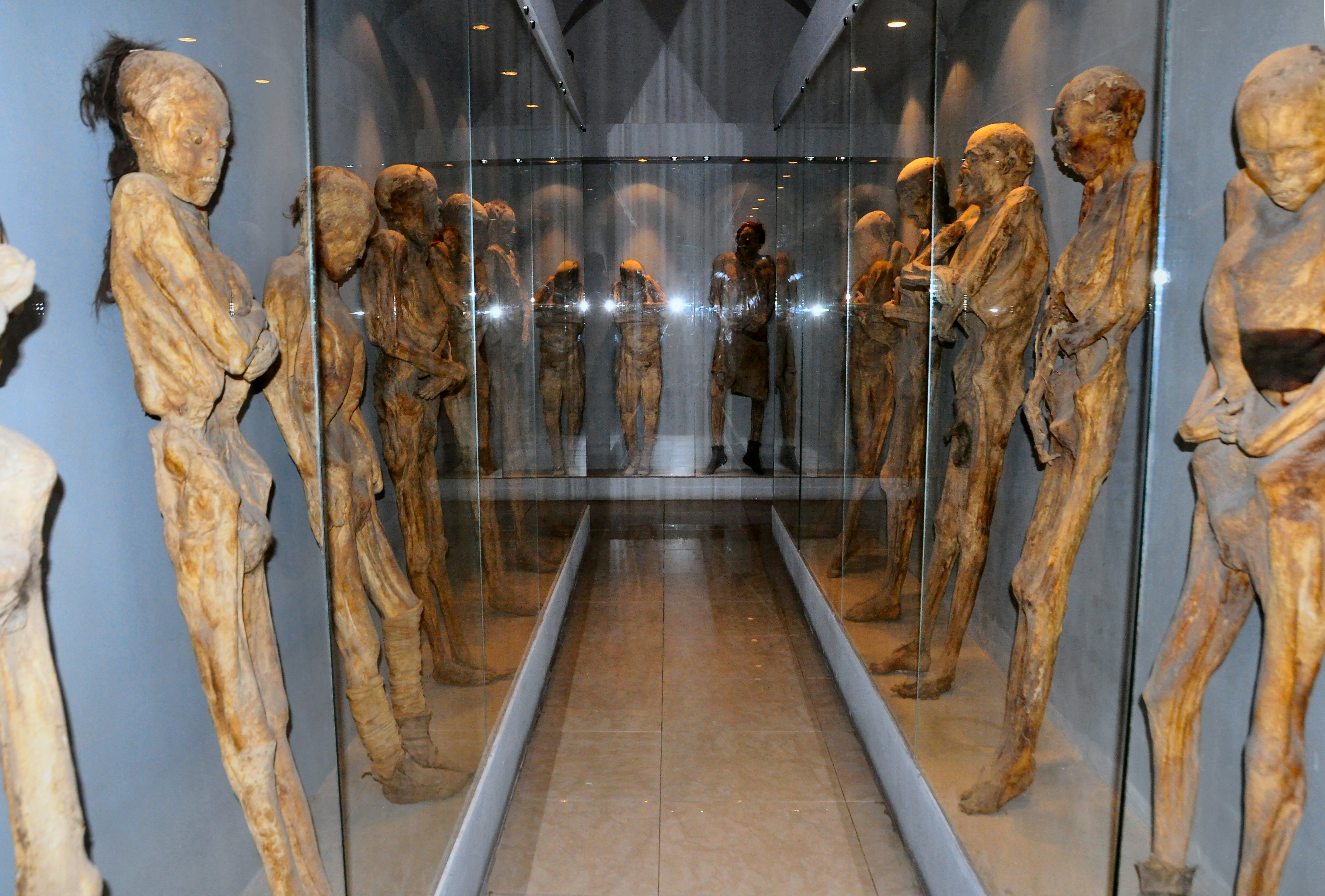
Guanajuato's most unsettling attraction is its mummy museum, housed beside the municipal cemetery in the Tepetapa neighborhood. Between 1870 and 1958, workers disinterring bodies from above-ground cement crypts discovered that dozens had mummified naturally -- preserved by the altitude and mineral-rich soil rather than by any deliberate embalming. The collection, considered the largest of naturally mummified remains in the Western Hemisphere, includes people who died between 1850 and 1950. Scientific study launched in 2007 has revealed evidence of rheumatoid arthritis, tuberculosis, and severe anemia among the specimens. The folklore is darker: one mummy's contorted face was long attributed to a fatal blow, another woman was said to have been hanged by her husband, and a third supposedly buried alive. Researchers have found no evidence for the last two stories, but the legends persist, and visitors keep coming.
Independence Began Here
On September 28, 1810, the insurgent army of Miguel Hidalgo and Ignacio Allende poured into Guanajuato through the Callejon Tecolote. Their target was the Alhondiga de Granaditas, a massive two-story granary with thick walls and almost no windows, where royalist troops had barricaded themselves. The battle that followed was the first major engagement of the Mexican War of Independence. Today the Alhondiga's courtyard serves as the traditional stage for reenacting Hidalgo's Grito de Dolores each Independence Day, and the building hosts events during the Festival Internacional Cervantino -- the annual arts festival that fills forty-nine theaters, plazas, and venues across the city each October with opera, theater, film, and dance.
Legends on Every Corner
Guanajuato collects legends the way other cities collect statues. Cerro de la Bufa harbors the story of an enchanted princess who appears on feast days, asking men to carry her to the Basilica in the city center. If the man agrees but loses his nerve along the way, she transforms into a serpent and kills him. No one has ever completed the journey. In the caves of the same mountain, two grottos consecrated to Ignatius of Loyola were supposedly once used by brujos for their rituals, forcing a painted image of the saint on the cave wall to witness their ceremonies. Even the Presa de la Olla dam, built in the mid-eighteenth century, has its own origin story: a poor miner came to give thanks for the rains. Now, every June, the Feast of San Juan culminates when the dam is ceremonially opened and hundreds gather to watch the water rush free.
From the Air
Located at 21.02N, 101.26W in a narrow mountain canyon at approximately 2,000 meters (6,500 feet) elevation. The city is visible from the air as a dense, colorful cluster of buildings filling a ravine in otherwise rugged terrain. Look for the distinctive underground road tunnels and the spires of colonial churches. The nearby Valenciana mine complex sits about 6 km northeast. Nearest airport: Del Bajio International (MMLO/BJX) approximately 30 km west. Maintain safe altitude over mountainous terrain. The Christ the King Monument on Cubilete Mountain is a visible landmark to the southwest.