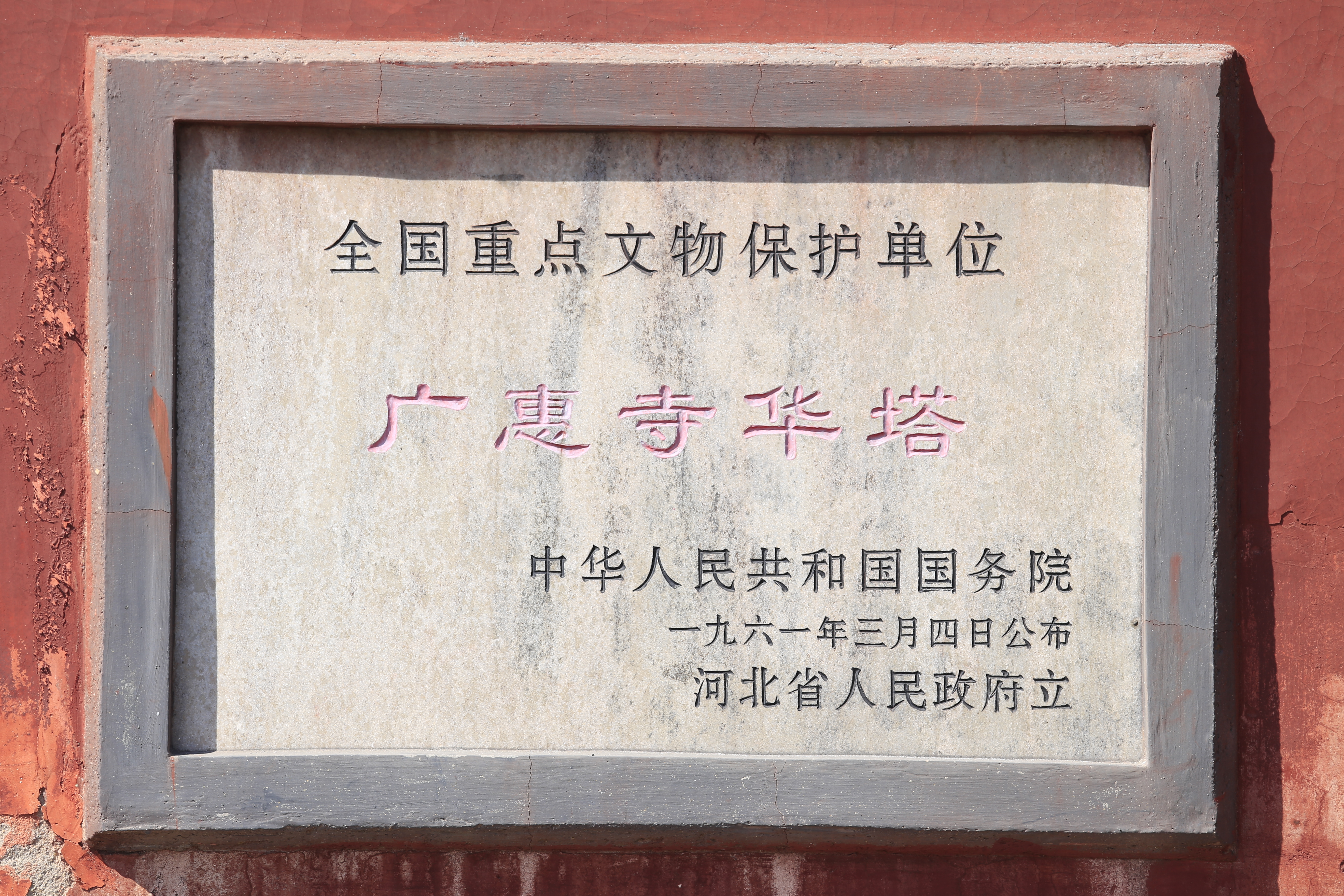
Guanghui Temple Huatai Pagoda
Its shape gave it a name. The Chinese call it Huata, the Flower Pagoda, because its upper tiers blossom outward in a cascade of sculpted warriors, elephants, lions, and bodhisattvas that evoke the form of a bouquet. Standing on Guanghui Road in Zhengding County, about 15 kilometers north of Shijiazhuang, this four-story octagonal tower is unlike any other pagoda in China, and people have been trying to understand its origins, protect its structure, and occasionally steal its contents for centuries.
A Construction Date Nobody Can Agree On
Scholars have argued for decades about when the Guanghui Temple Flower Pagoda was first built. Some attribute it to the reign of Emperor Gaozu Li Yuan of the Tang dynasty. Others push its origins further back to the Sixteen Kingdoms period, with repairs during the Tang and a complete rebuilding during the Dading period of the Jin dynasty. Still others propose a Sui or Tang dynasty origin. The State Council settled the debate officially in 1961, adopting the position that the tower was rebuilt during the Jin dynasty when it published the first batch of national key cultural relics protection units. But inscriptions discovered during restoration complicate even that determination. One dates to the fourth year of Taiping Xingguo, or 979 AD, and appears to be a visitor's inscription, which establishes that the tower existed no later than the Northern Song dynasty. The Guanghui Temple itself was built during the Zheng Yuan period of the Tang dynasty, between 785 and 804 AD.
Eight Sides, Eight Layers of Sculpture
The pagoda's most remarkable feature is its fourth tier, where the octagonal form explodes into sculptural profusion. Eight layers of figures are distributed across the eight faces in a cross pattern, creating a rotating gallery of Buddhist art. The first layer places a statue of a guardian warrior at each of the eight corners. The second layer adds a roaring figure in the center of each face. Lions stand at the corners of the third floor, with small square towers between them. Elephants and additional towers alternate on the fourth. Buddha figures occupy the fifth tier's corners, while uplifted lotuses adorn the sixth. More towers fill the seventh, and bodhisattvas crown the eighth. The original color paintings that once brought these figures to vivid life have largely peeled away, leaving the stonework to speak for itself.
Wars Above, Tunnels Below
The Guanghui Temple once had a thriving incense culture during the Ming and Qing dynasties, but war brought destruction. During the Republic of China period, all four sets of chambers surrounding the base of the pagoda were destroyed, leaving only the main tower standing. A 1999 repair project restored the temple to something approaching its original appearance, but threats continued from unexpected directions. In March 2015, a gang of eight criminals rented a nearby property and began digging a tunnel beneath the pagoda, hoping to reach and loot artifacts from a rumored underground palace beneath the structure. Public security authorities discovered the plot and arrested all the perpetrators before they reached their target. The attempted heist underscored both the pagoda's perceived archaeological value and the persistent vulnerability of cultural sites to private enterprise of the criminal variety.
Standing Against Time
In 1961, the Guanghui Temple Flower Pagoda was listed as one of China's first national key cultural relics protection units, placing it alongside the country's most important heritage structures. A 1981 reinforcement of the outer wall of the ground floor offered temporary stability, but the materials used lost their effectiveness and peeled away by the early 1990s. The 1999 restoration proved more durable. Today the pagoda stands as one of the most distinctive architectural survivors in Zhengding, a county that also contains the Longxing Temple, Linji Temple, Lingxiao Pagoda, and Xumi Pagoda. Together, these sites make Zhengding one of the densest concentrations of historic Buddhist architecture in northern China, a quiet county that punches well above its weight in cultural significance.
From the Air
The Guanghui Temple Flower Pagoda is located at 38.132N, 114.566E in Zhengding County, approximately 15 km north of Shijiazhuang city center. Shijiazhuang Zhengding International Airport (ZBSJ) is located nearby, just northeast of Zhengding. The pagoda is one of several historic towers visible from the air in this small county. The terrain is flat North China Plain. Look for the distinctive octagonal silhouette among the rooflines of Zhengding's historic center.