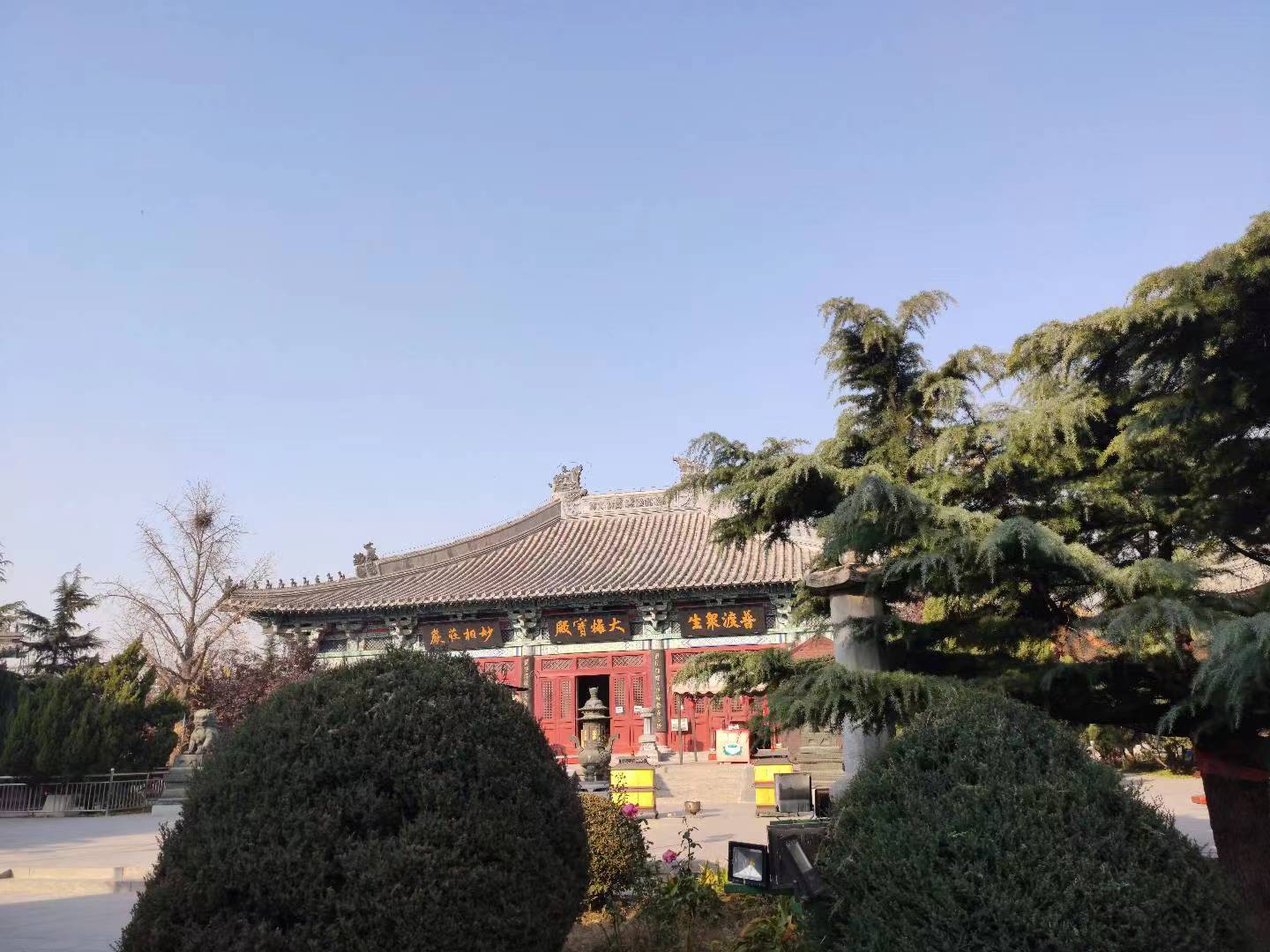
Guangji Temple (Tianjin)
In 1932, an architect named Liang Sicheng traveled to Baodi District in Tianjin to survey a Buddhist temple that was already more than nine centuries old. He measured its beams, photographed its halls, and recorded the details of Liao dynasty construction techniques in what would become one of China's foundational texts on architectural history. The temple he documented so carefully would later be destroyed. But because Liang Sicheng wrote it all down, Guangji Temple was rebuilt in 2007 -- almost exactly 1,002 years after the monk Hongyan first laid its foundations.
Foundations Laid by a Monk
According to a tablet inscription preserved within the temple grounds, Guangji Temple was first built in 1005, during the Tonghe era of Emperor Shengzong's reign over the Liao dynasty. The project was the vision of a Buddhist master named Hongyan. After his death, his disciples Daoguang and Yihong carried on the work, completing the complex in 1025. For centuries the temple stood as a repository of Liao architectural principles -- the interlocking timber joints, the gracefully curved eaves, the careful proportions that defined the dynasty's building philosophy. The Liao dynasty itself rose from the Khitan people of the northern steppes, and their architecture blended Central Asian influences with Chinese traditions in ways that would influence builders for generations.
The Man Who Saved It on Paper
Liang Sicheng is often called the father of modern Chinese architectural history. When he arrived at Guangji Temple in the early 1930s, he was on a mission to document China's surviving ancient buildings before war, modernization, or neglect claimed them. His detailed measurements and photographs of the temple's halls became part of his landmark work on Chinese architecture. Liang's records would prove prophetic. In 1947, a local magistrate ordered the temple demolished on the eve of the Communist takeover of Baodi, its ancient timbers repurposed for a river bridge -- one of countless historical structures lost during the upheavals of the mid-twentieth century. Without Liang Sicheng's meticulous survey, the knowledge of how Guangji Temple was built would have been lost along with its timbers.
A Thousand-Year Resurrection
In 2005, the local government launched a reconstruction project that aimed to replicate the original Liao dynasty architectural style as faithfully as possible. The effort drew on Liang Sicheng's documentation as its primary blueprint. Three years of work produced a temple complex that opened in 2007. The centerpiece is the Hall of Three Bodhisattva, constructed on a low pedestal and measuring 24.5 meters long by 18 meters wide. Inside, statues of Guanyin, Manjusri, and Samantabhadra sit on lotus thrones at the central altar. Eight warrior-attendant bodhisattva statues stand before them, with six more flanking below alongside figures of Narayana and Skanda. The Eighteen Arhats line both sides of the hall, their serene expressions presiding over a space that attempts to recapture the devotional atmosphere of a millennium ago.
Between Destruction and Memory
Guangji Temple today is a place where history loops back on itself. The original building techniques of the Liao dynasty -- a civilization that peaked nearly a thousand years ago -- survive because a twentieth-century scholar had the foresight to record them, and because twenty-first-century builders had the resources and will to reconstruct what was lost. Walking through the rebuilt halls in Baodi District, visitors encounter a temple that is both ancient and new: the proportions and decorative schemes echo the Liao originals, but the timber is fresh, the paint is vivid, and the statues gleam. Whether this constitutes preservation or reinvention is a question that Chinese heritage philosophy has grappled with for centuries. In a culture where the act of rebuilding can itself be a form of continuity, Guangji Temple stands as an argument that a building's spirit can survive even when its materials do not.
From the Air
Located at 39.73N, 117.31E in the Baodi District of Tianjin municipality. The temple sits in a suburban area northeast of central Tianjin. The nearest major airport is Tianjin Binhai International (ZBTJ/TSN), approximately 60 km to the south. Beijing Capital International (ZBAA/PEK) lies about 120 km to the northwest. Best viewed from 3,000-5,000 feet AGL.