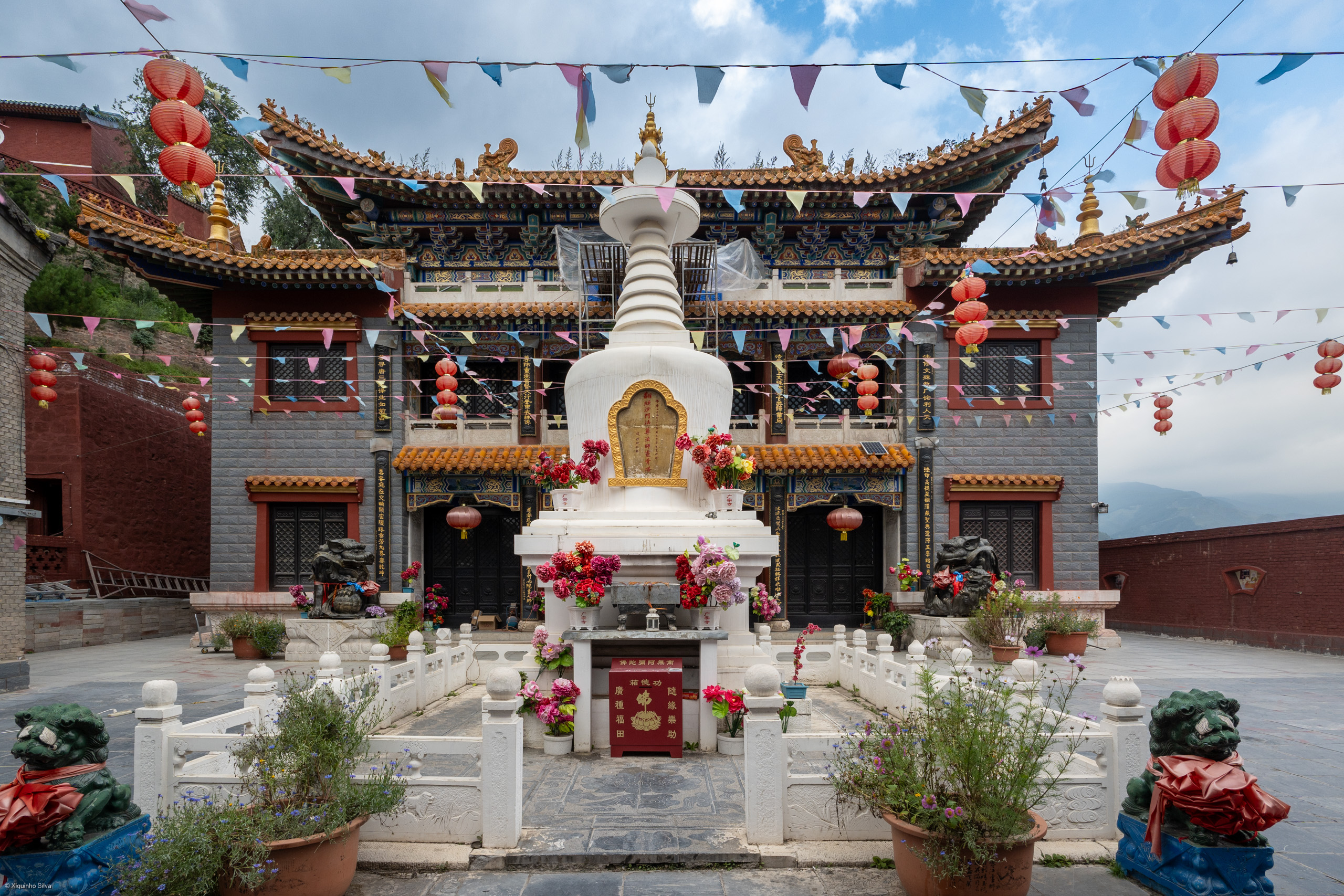
Guangzong Temple (Mount Wutai)
In the courtyard of Guangzong Temple, a solitary stupa rises six meters above the flagstones. It marks the resting place of Master Fazun, a Buddhist scholar whose translations bridged the gap between Tibetan and Chinese Buddhism in the twentieth century. The stupa is modest compared to Mount Wutai's grander monuments, but its presence in this particular temple -- one built by imperial command five centuries ago -- gives it a quiet authority.
An Emperor's Commission
According to the Records of Qingliang Mountain, Guangzong Temple was first constructed in 1507 by order of the Zhengde Emperor under the Ming dynasty. The Zhengde reign (1505-1521) was known for its eccentricities -- the emperor was famous for his unconventional behavior -- but his patronage of Mount Wutai's temples followed a well-established tradition of imperial support for Buddhist institutions. The temple was rebuilt during the subsequent Qing dynasty (1644-1911), and in 1983 it was inscribed as a National Key Buddhist Temple in Han Chinese Area, recognizing its historical and religious significance at the national level.
Two Stories, Two Worlds
Guangzong Temple, commonly known as the Tongwadian, covers a compact 2,900 square meters and contains 28 rooms and halls. The Main Hall -- also called the Grand Buddha Hall -- is its architectural centerpiece, divided into upper and lower stories beneath double-eaved gable and hip roofs. The arrangement creates two distinct spiritual spaces under one roof. The upper story enshrines the Three Saints of Huayan: Sakyamuni at the center, flanked by Manjushri and Samantabhadra, with the Eighteen Arhats arrayed along both sides. The lower story houses the Three Sages of the West: Guanyin, Amitabha, and Mahasthamaprapta. This vertical pairing of different Buddhist devotional traditions within a single structure reflects the ecumenical spirit that has long characterized Mount Wutai.
The Translator's Monument
Master Fazun spent his life making Tibetan Buddhist texts accessible to Chinese readers, a labor that required deep fluency in both languages and both scholarly traditions. After his death, the monks of Guangzong Temple erected a stupa in his memory -- a six-meter monument that stands in the temple grounds as a tribute to the power of translation as a spiritual act. On a mountain where Chinese and Tibetan Buddhism have coexisted for centuries, sometimes in harmony and sometimes in tension, Fazun's work of bridging those traditions carries particular resonance. His stupa at Guangzong Temple is more than a memorial; it is a marker of the intellectual exchange that has kept Mount Wutai's Buddhist community vital across linguistic and cultural divides.
From the Air
Located at 39.02N, 113.60E on Mount Wutai in Taihuai Town, Shanxi Province, China. Elevation approximately 1,700 meters. The temple is part of the dense Taihuai valley temple cluster visible from altitude. Nearest airports: Wutai Mountain Airport (ZBWT) at roughly 50 km and Taiyuan Wusu International Airport (ZBYN) approximately 230 km to the southwest. Recommend 3,000-5,000 feet AGL for viewing. Look for the temple cluster nestled between the five distinctive flat-topped peaks.