Gubeikou
Every invasion route has its bottleneck, and for anyone approaching Beijing from the northeast, that bottleneck has always been Gubeikou. This small mountain town in Miyun District sits where the Great Wall crosses a natural gap in the Yan Mountains, forming a pass so strategically vital that emperors named it, armies fought over it, and the wall here was built and rebuilt across dynasties. With a population of just over 7,000, Gubeikou today is a quiet place. But the wall draped across its ridgelines tells the story of a chokepoint that shaped the military history of northern China.
A Name from the Emperor's Own Hand
Gubeikou received its current name in 1736, during a visit by the Qianlong Emperor. The emperor combined two existing inscribed names -- Guguan, meaning "ancient pass," and Beikou, meaning "northern mouth" -- into the compound Gubeikou, which translates roughly as "ancient northern mouth." The name stuck. On the 1754 Provincial Atlas of the Qing Empire, Gubeikou appears as one of the principal gateways through the Great Wall, a designation that reflected its continuing strategic importance well into the eighteenth century. For the Qing rulers, who had themselves entered China through passes like this one, the Great Wall's gates were not just military installations but symbols of imperial authority over the boundary between Inner China and the northern frontier.
The Chokepoint Between Worlds
Gubeikou's significance lies in geography. The Yan Mountains run roughly east-west across northern Beijing, forming a natural barrier between the capital and the vast plains of Manchuria and Mongolia to the north. Few passes cut through this wall of rock, and Gubeikou is one of the most important. For centuries, it served as the primary land route between Northeast China and Beijing, used by armies, trade caravans, and diplomatic missions. The town borders Luanping County in Hebei Province to the north and is flanked by the Beijing towns of Gaoling, Xinchengzi, and Taishitun. National Highway G101 now threads through the pass, following a route that humans have used for millennia.
Wall Upon Wall
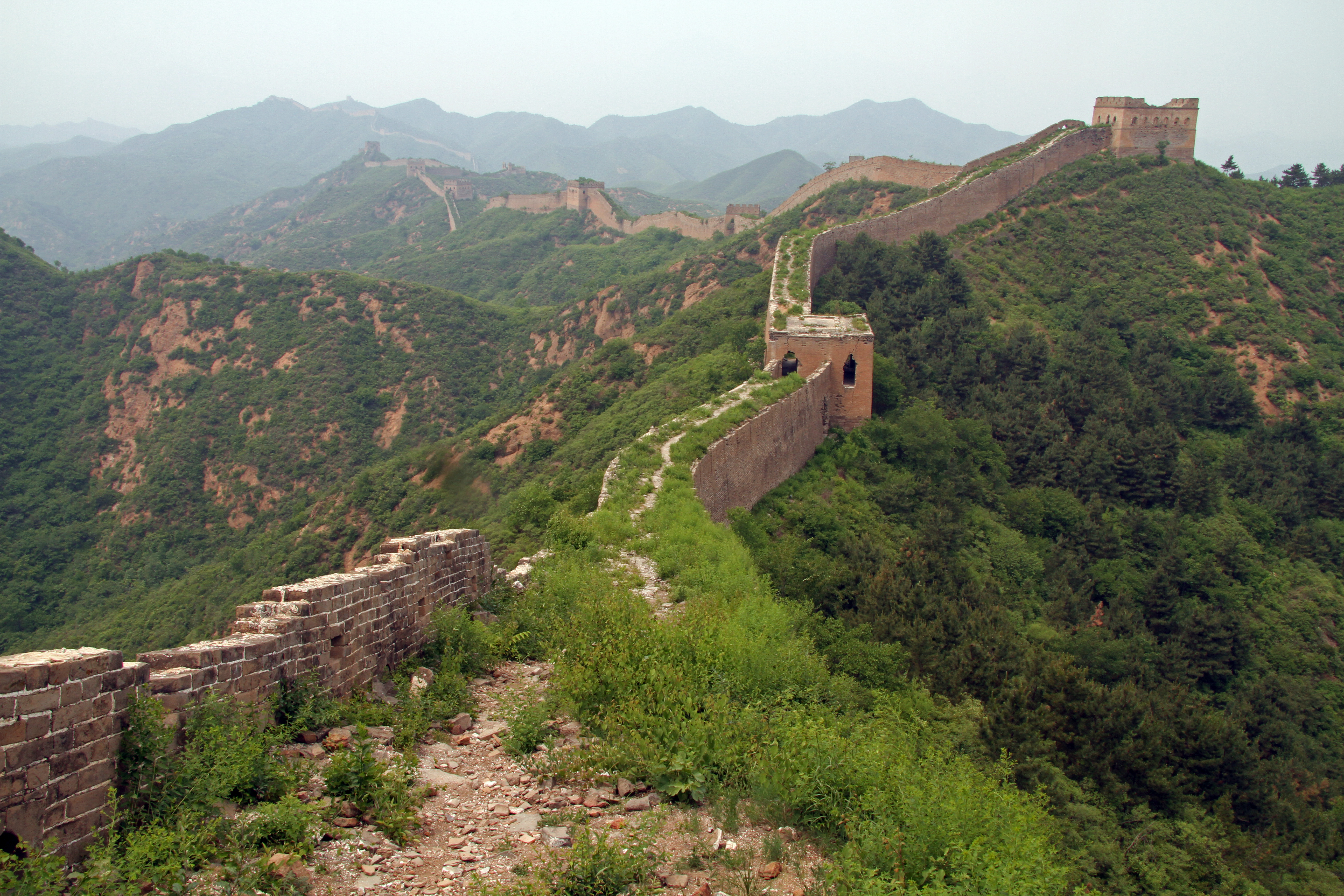
The Great Wall at Gubeikou represents layers of construction spanning multiple dynasties. The pass was fortified long before the Ming dynasty's famous rebuilding campaign, though the Ming-era walls and watchtowers are the most visible features today. Unlike the heavily restored tourist sections closer to Beijing, much of the wall at Gubeikou retains a weathered, unrestored character. Crumbling watchtowers stand along the ridgelines, their brick surfaces worn by centuries of wind and frost. The wall itself extends in both directions from the pass -- westward toward Jinshanling and eastward toward Simatai -- creating a continuous defensive line that could be reinforced from either direction. Hikers who walk between these sections experience the wall as it exists on the boundary between preservation and natural decay, a state that many consider more evocative than the rebuilt sections.
The Pass at Rest
A Taoist temple sits near the pass, evidence of the spiritual life that once accompanied the military garrison. Gubeikou Railway Station, part of the rail line connecting Beijing to the north, adds another layer to the town's role as a transit point. The Great Wall stretching west toward Jinshanling offers some of the most photographed views of the wall in existence -- a serpentine line of stone and brick following the mountain crests into the distance. For a place that once determined the fate of empires, Gubeikou is remarkably understated. There are no massive visitor centers or cable cars here. The town goes about its business, population 7,170, while one of the most consequential defensive structures in human history runs across its skyline, still marking the boundary that once separated two worlds.
From the Air
Located at 40.69N, 117.16E in the Yan Mountains, northeastern Beijing (Miyun District). The Great Wall is clearly visible from the air as it follows the mountain ridgeline. The pass itself is a natural gap in the mountains. The nearest major airport is Beijing Capital International (ZBAA/PEK), approximately 120 km to the southwest. Terrain is mountainous with limited emergency landing options. Adjacent Great Wall sections at Jinshanling (west) and Simatai (east) are visible from altitude. Best viewed from 3,000-6,000 feet AGL.