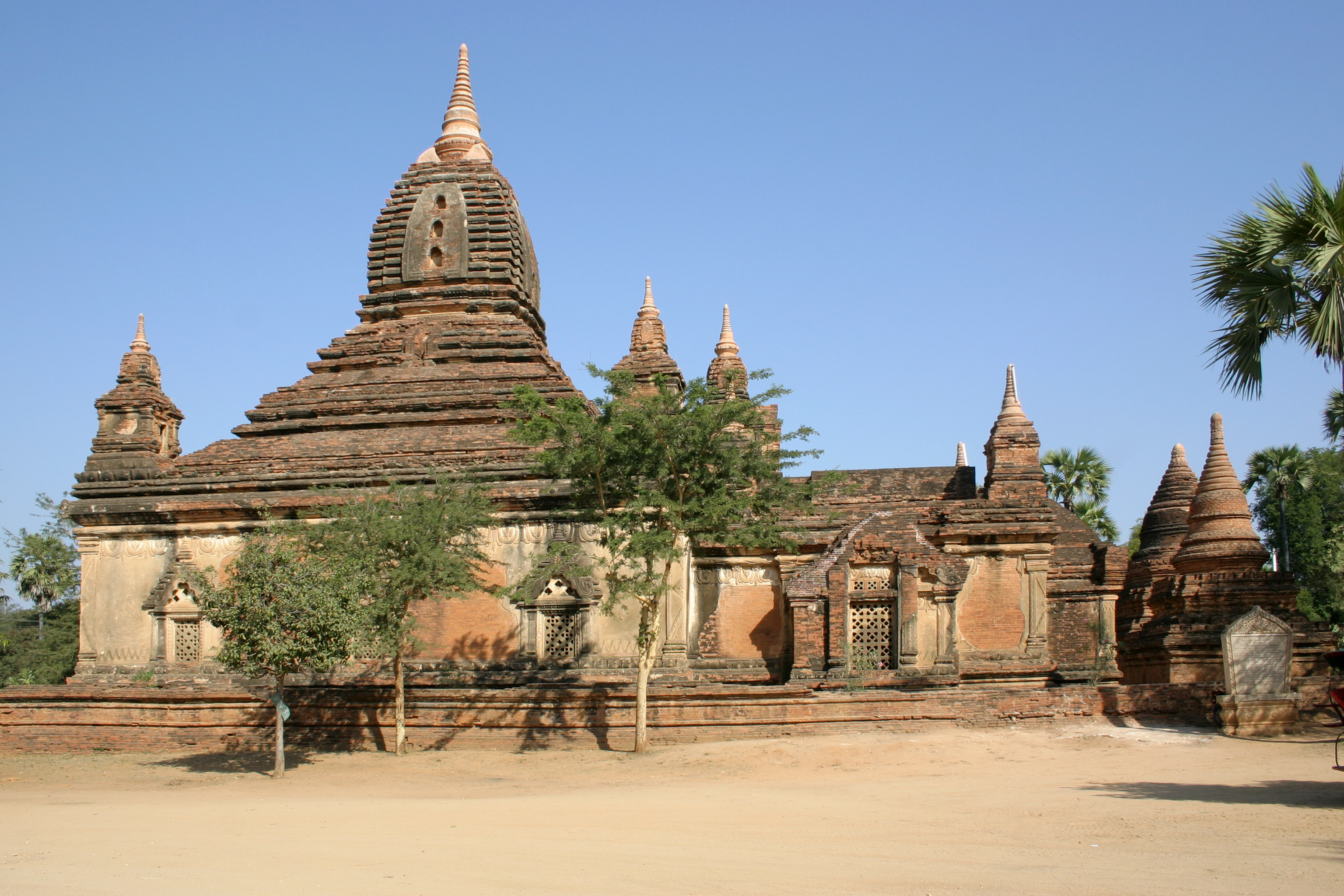
Gubyaukgyi Temple (Myinkaba)
Step inside Gubyaukgyi and your eyes need a moment to adjust. The eleven perforated windows, cut in the old Pyu style with shapes of banyan leaves and swastikas, admit only thin blades of light. As the darkness resolves, the walls come alive: 547 paintings, nine centuries old, depicting the Jataka tales of Buddha's previous lives in a style that traces not to Myanmar but to Sri Lanka. Built in 1113 AD by Prince Yazakumar in the village of Myinkaba, just south of Bagan's main temple plain, Gubyaukgyi is a place where grief, devotion, and artistic ambition converged. The prince raised the temple shortly after the death of his father, King Kyansittha of the Pagan Dynasty, and what he created became both a memorial and an irreplaceable record of Southeast Asian civilization.
A Captive King's Legacy
The story of Gubyaukgyi's distinctive Mon style begins sixty years before its construction. Around 1054 AD, King Anawrahta, founder of the Pagan Empire, conquered the Mon capital of Thaton and brought its king, Makuta, back to Bagan as a captive. Along with the defeated monarch came copies of the Tipitaka written in Mon, and scores of Mon monks and artists. Makuta himself, still a prisoner, built the nearby Nanpaya Temple in Myinkaba Village. His presence sparked a century of Mon-influenced construction across Bagan, from roughly 1060 to 1160 AD, and Gubyaukgyi stands among the finest examples. Nearly every Mon-style temple built during this period carries inscriptions in the Mon language, a testament to how thoroughly the conquered culture reshaped the conqueror's architecture.
Myanmar's Rosetta Stone
Just west of the temple stands the Myazedi Pagoda, where two stone pillars were discovered bearing inscriptions in four ancient languages: Pali, Old Mon, Old Burmese, and Pyu. Scholars have called this the Burmese Rosetta Stone, and the comparison is apt. Just as the original Rosetta Stone unlocked Egyptian hieroglyphs, the Myazedi inscription gave researchers the key to deciphering Pyu, a language that had long resisted translation. The inscription records the dedication of the temple by Prince Yazakumar, linking the pillar directly to Gubyaukgyi's founding in 1113. Four languages on a single stone, each representing a different people who had passed through Bagan's orbit of power. In a few carved lines, the pillar maps the multilingual, multicultural reality of the medieval Pagan Empire.
Walls That Remember Sri Lanka
The 547 Jataka paintings inside Gubyaukgyi are extraordinary not only for their age but for their origin. They draw directly from Sri Lanka's historical chronicles, the Mahavamsa, rather than from local Burmese traditions. Panels depict Arahant Mahinda spreading Buddhism to the island, King Devanampiyatissa receiving the faith, and the national hero Dutugamunu riding his war elephant Kandula. One panel shows Prince Gamini sending women's clothing to his father for refusing to fight for his country's freedom, a scene of pointed political theater. Even the invader Elara appears, depicted in the Mahavamsa tradition as a just ruler whose bell of justice hung around the neck of a calf. Each painting carries an ink caption in Old Mon, making these murals the most complete collection of Jataka tales in that language anywhere in the world. King Kyansittha's wife Abeyadana is believed to have come from the Comilla district of Bengal, and her influence shows in the textiles depicted on the walls, where geometric patterns of circles, diamonds, and hexagons echo Bengali weaving traditions.
Saving Nine Centuries of Paint
By 1982, a UNESCO survey found Gubyaukgyi in distress. The original exterior cornice had been lost, replaced by black algae and lichen. Stucco was pulling away from the walls. Earthquakes had damaged the entrance hallway. Insects had bored into the plaster, and earlier conservators had applied polyvinyl acetate to stabilize flaking paint, with mixed results. A joint UNESCO and UNDP project launched in 1984 to preserve several Bagan monuments, and by 1991 the restoration of Gubyaukgyi was complete. Conservators cleaned the interior frescoes, reinforced endangered panels and stucco, and applied anti-insect treatments. Electrical lighting was installed to allow visitors to see the murals without damaging them further. The Zamani Project has since documented the temple with laser scanning and 3D modeling, creating a digital record that will survive even if the physical structure does not.
A Dim Room, a Bright Record
The interior of Gubyaukgyi is deliberately dark. The Pyu-style windows were never meant to flood the space with light. Instead, the temple was designed for contemplation in near-darkness, where the paintings on the walls revealed themselves slowly, scene by scene, as if the stories of Buddha's past lives were emerging from shadow. Today, the installed lights make the murals easier to study, but the original experience of the space, entering from the bright Bagan sun into a hushed vestibule, then passing through a hallway into the shrine room, remains intact. The perimeter vestibule wraps around the small central shrine, its walls covered in paintings that connect twelfth-century Myanmar to the literary traditions of Sri Lanka, the artistic traditions of Bengal, and the spiritual traditions of India. In one modest brick temple on the outskirts of Bagan, the cultural networks of medieval Asia are written on the walls.
From the Air
Located at 21.157N, 94.861E in the Bagan archaeological zone of central Myanmar. The temple sits in Myinkaba Village, just south of the main temple plain. Bagan Nyaung-U Airport (VYBG) is approximately 5 km to the northeast. From the air at 3,000-5,000 ft, the Bagan plain is unmistakable: over 2,000 temples and pagodas spread across a semi-arid landscape along the east bank of the Irrawaddy River. Gubyaukgyi is a smaller structure near the Myazedi Pagoda, south of the main cluster. Best visibility in the dry season (November-March).