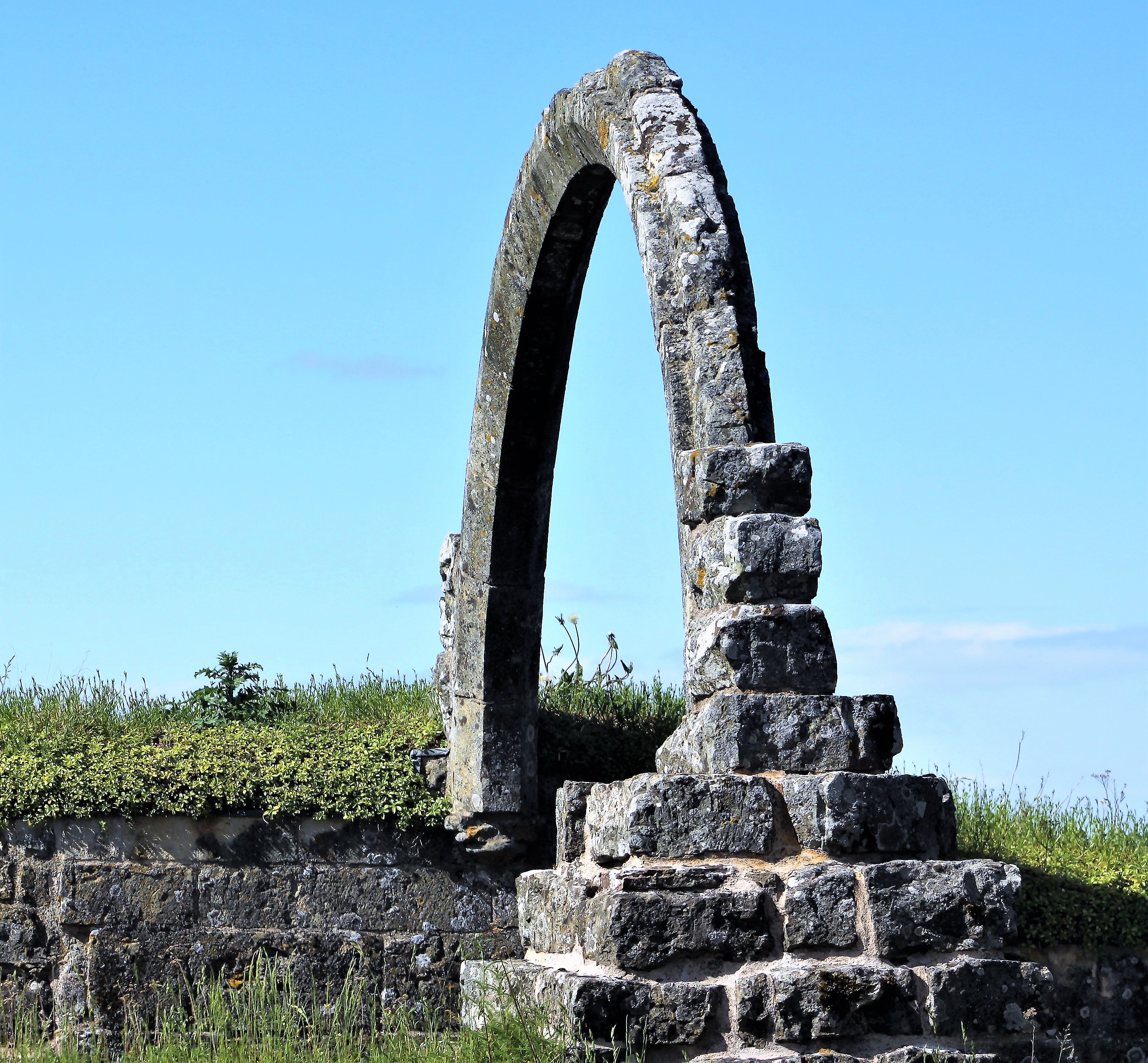
Gudhem Abbey
The name itself carries the weight of religious transformation: Gudhem means "Home of the Gods," and according to medieval tradition, one hundred images of Thor once filled this hilltop in Västergötland. Then Christianity came, and in 1152 the thunder god's domain became a Cistercian nunnery. For 377 years, women in white habits walked these grounds, until the Swedish Reformation and an accidental fire ended their community in 1529. Today only ruins remain, but they tell a story of sacred space continuously reinvented across two thousand years of Scandinavian faith.
A Legend and Its Correction
Popular tradition long claimed that a Danish queen founded Gudhem Abbey in 1052 - Gunnhildr Sveinsdóttir, who supposedly retreated here after the Church annulled her marriage to King Svein II of Denmark. The story has romantic appeal: a royal widow seeking penitence in the Swedish countryside, transforming a pagan sanctuary into Christian devotion. History, however, tells a different tale. The abbey was founded exactly one century later, in 1152. King Charles VII of Sweden donated the royal manor during his reign from 1161 to 1167, when records describe the nunnery as newly established. The legend persists because it captures something true about the site's ancient sanctity, even if it misses the facts by a hundred years.
Among Sweden's Eldest
Gudhem ranks as the third oldest convent in Sweden, following Vreta Abbey (founded 1100) and Alvastra Abbey (1143). It began under Benedictine rule before transitioning to the stricter Cistercian order, joining a network of white-robed communities that stretched across medieval Europe. At least nineteen abbesses governed over the centuries - Katarina Folkesdotter served from 1250 to 1271, and the records continue through Ingerid Jönsdotter in 1513. These women administered substantial properties, navigated church politics, and maintained a community that outlasted kingdoms and plagues before meeting its end not through invasion or doctrine, but through the bureaucratic machinery of the Reformation.
The Final Sisters
In 1527, King Gustav I seized monastic properties across Sweden, and Gudhem Abbey passed to the nobleman Nils Olofsson the following year. The crown showed unusual mercy: former nuns received allowances from their confiscated lands and permission to remain in the buildings they had always known. Two years later, fire destroyed the abbey. The last abbess petitioned the king to rebuild, but her request went unanswered. The surviving sisters dispersed to neighboring farms, supported by their dwindling allowances. Records show former nuns still living near the ruins as late as 1540, aging witnesses to a vanished way of life.
Stones That Speak
After the fire, the abbey became a convenient quarry - local builders carried away worked stone for their own projects, slowly dismantling what flames had spared. Not until 1928 did systematic excavation begin, continuing until 1969 and revealing the footprint of the medieval complex. Nearby stands Gudhem Church, built between 1160 and 1200 while the abbey flourished, looted and burned in the 1560s, and repeatedly restored since. The ruins themselves gained new literary life when author Jan Guillou set scenes of his Crusades trilogy here, imagining his character Cecilia imprisoned within these walls. Fiction and archaeology together keep Gudhem's memory alive where the sisters' prayers have long fallen silent.
From the Air
Located at 58.24°N, 13.55°E near Falköping in the Falbygden plain of Västergötland. The abbey ruins and adjacent Gudhem Church are visible in an agricultural landscape dotted with characteristic flat-topped hills (table mountains). Best viewed at 2,000-4,000 feet where the ruins and church complex become distinct. Jönköping Airport (ESGJ) lies approximately 70 kilometers to the east; Gothenburg Landvetter (ESGG) is about 100 kilometers west. The region's table mountains (Billingen, Kinnekulle) provide excellent visual navigation references.