Guernsey
The fortifications that ring Guernsey tell the story of invasions that never came. Castle Cornet guards the harbor of St Peter Port, its medieval walls strengthened and re-strengthened through centuries of tension with France. Victorian forts dot the coastline, built against some imagined threat from Napoleon III. And most extensively, German bunkers and gun emplacements from World War II occupation survive in remarkable condition - never tested in battle because the liberation came peacefully. This is Guernsey, the main island of a self-governing Crown Dependency that has spent a millennium preparing for attacks while quietly prospering from activities that ranged from perfectly legal fishing to decidedly illegal smuggling, with some profitable privateering in between.
A Constitutional Curiosity
When William, Duke of Normandy, conquered England in 1066, his descendants ruled both lands. As England lost its French territories over subsequent centuries, only the Channel Islands remained - and remain they do today, in a constitutional arrangement so peculiar that no one quite wants to test it. Guernsey is not part of the United Kingdom, has never been part of the European Union, and maintains its own parliament, laws, and crucially, tax system. The British monarch serves as Duke of Normandy rather than sovereign, and the island issues its own currency on parity with the pound sterling. This arrangement - a Crown Dependency neither fully in nor fully out of British control - has proven remarkably durable, providing the legal framework for the offshore finance industry that now underpins the island's prosperity.
Victor Hugo's Exile
When the French writer Victor Hugo was expelled from France for opposing Napoleon III, he found refuge first in Jersey, then in Guernsey, where he would spend fifteen years in a house he transformed into an artistic statement. Hauteville House, now a museum, displays Hugo's extraordinary interior design: rooms decorated with carved wooden panels, mirrors, and tapestries that the author arranged with obsessive attention to symbolism and effect. Here he completed Les Miserables and wrote The Toilers of the Sea, a novel celebrating Guernsey's fishing community. The house stands in St Peter Port, a short walk from the waterfront where ferries still arrive from England and France, much as they did when Hugo watched the sea from his glass-enclosed writing room at the top of the house.
Beaches and Bays
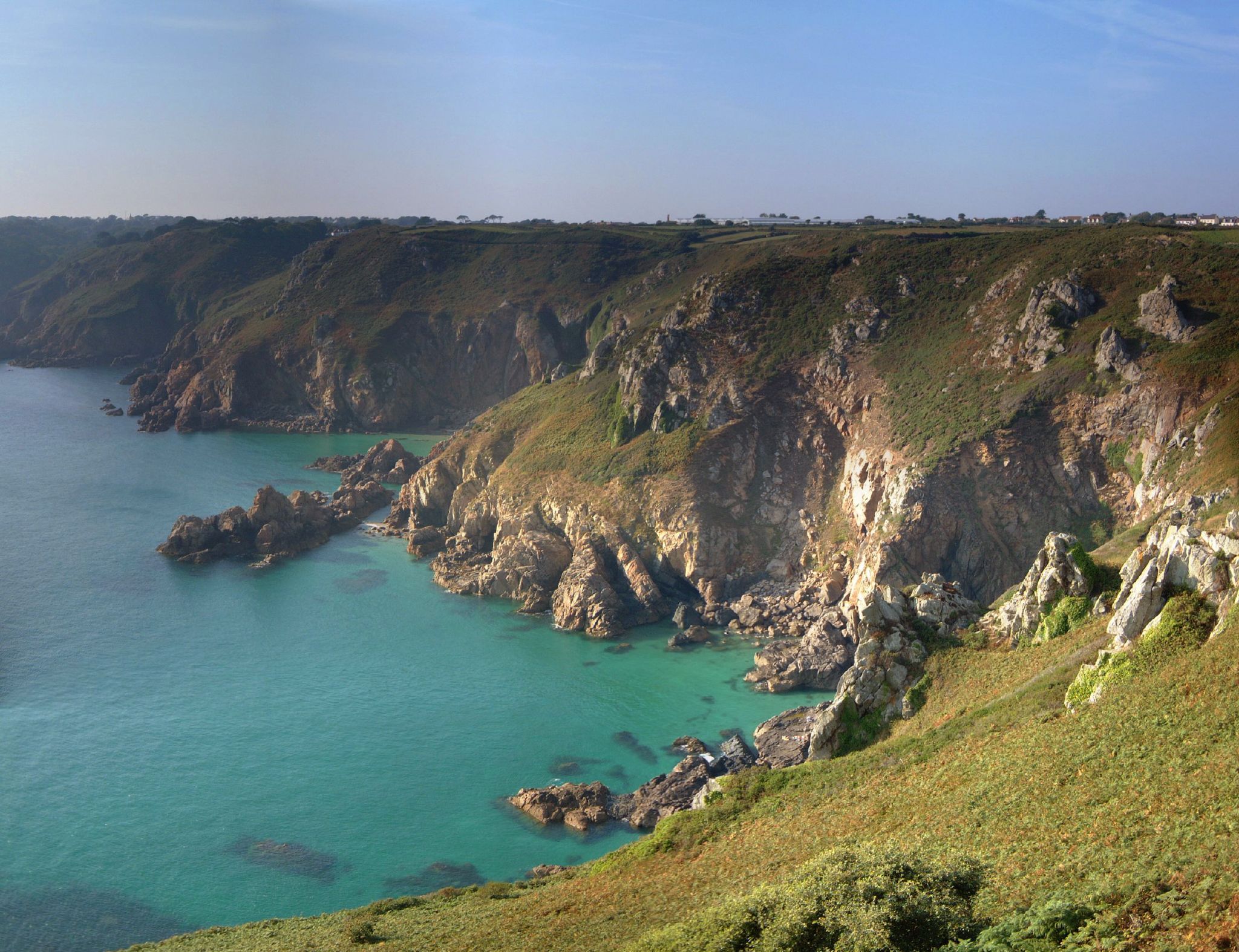
Despite its small size - roughly six miles by three - Guernsey offers more than two dozen beaches, each with its own character. The western shores face the open Atlantic, presenting sandy strands like Vazon Bay and Cobo Bay where surfers ride the swells and families stake out territory on summer weekends. The southern coast, by contrast, drops away in dramatic cliffs punctuated by small coves that Renoir painted during his 1883 visit, capturing the particular quality of light that still draws artists today. Lihou Island, accessible by causeway at low tide, offers the ruins of a medieval priory and wetland nature reserves. And the eastern beaches around St Peter Port provide calmer waters for swimming, though the North Sea chill requires determination or a wetsuit regardless of the season.
The Little Chapel
Brother Deodat Antoine arrived in Guernsey in 1914 with a vision of creating a miniature version of the grotto at Lourdes. What emerged after three attempts - he demolished his first two versions as unsatisfactory - is the Little Chapel, a structure just sixteen feet long and nine feet wide, every surface encrusted with seashells, pebbles, and broken china. This peculiar folk-art creation has become one of the island's most visited sites. Brother Antoine returned to France in 1939 and died there, never seeing his chapel finished; volunteers have maintained and expanded it since. It sits half a mile from the German Underground Hospital, a very different monument: miles of tunnels carved by forced laborers during the occupation, now a museum to that dark chapter when the Channel Islands became the only British territory occupied by Nazi Germany.
From the Air
Located at 49.45N, 2.55W in the English Channel, approximately 50 km west of the Cotentin Peninsula in Normandy, France. Guernsey Airport (EGJB/GCI) offers connections to UK cities and serves as a hub for inter-island flights to Alderney. The island measures roughly 10 km by 5 km with its highest point at 110 m. St Peter Port on the eastern coast serves as the main harbor for ferry connections to Poole, Portsmouth, St Malo, and Jersey. From altitude, the island's patchwork of small fields and glasshouses is distinctive, along with the numerous fortifications ringing the coast.