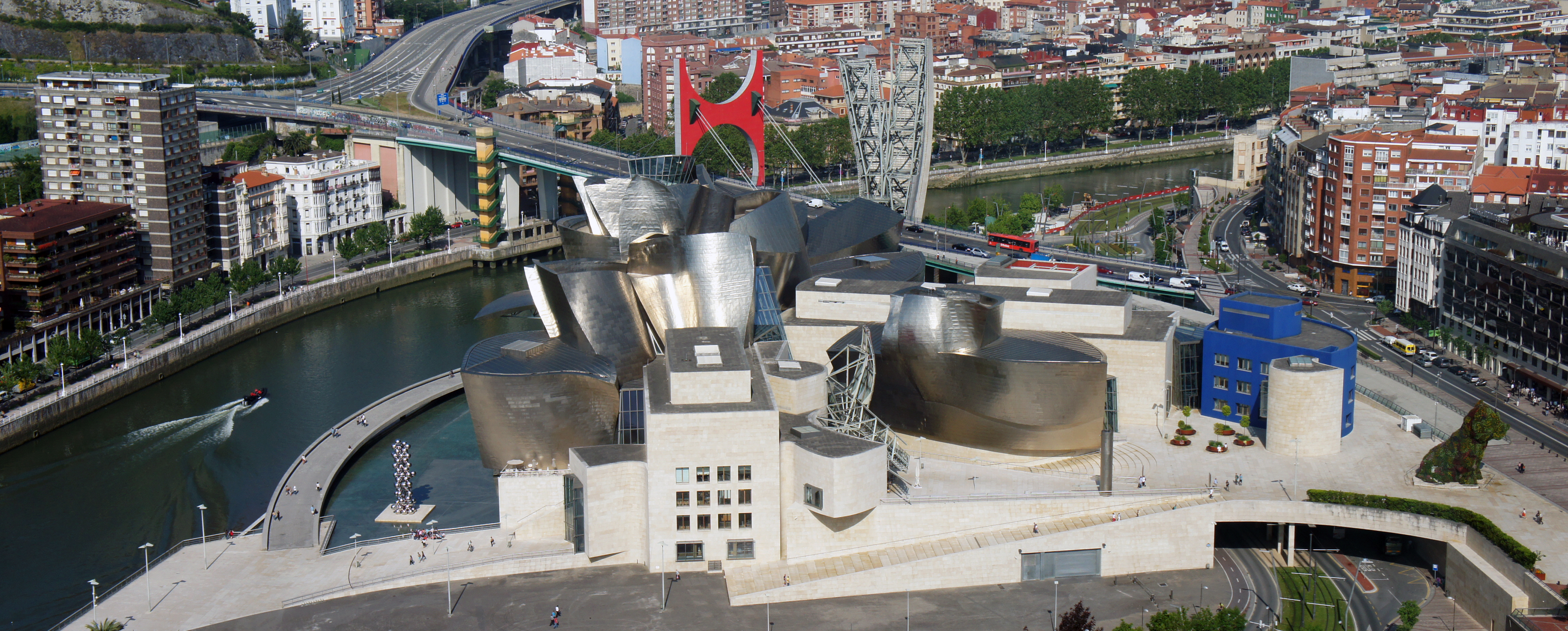
Guggenheim Museum Bilbao
Calvin Tomkins, writing in The New Yorker, called it "a fantastic dream ship of undulating form in a cloak of titanium." Philip Johnson went further: "the greatest building of our time." What made the Guggenheim Museum Bilbao remarkable when it opened in October 1997 was not just Frank Gehry's architecture, breathtaking as it is, but the sheer unanimity of the response. Critics, academics, and the public agreed. That almost never happens.
A City's Gamble
In the early 1990s, Bilbao was a city in crisis. Its industrial economy had collapsed, the Nervion River was polluted, and unemployment was punishing. The Basque government made what seemed like an audacious bet: it agreed to cover $100 million in construction costs, create a $50 million acquisitions fund, pay a $20 million fee to the Guggenheim Foundation, and subsidize the museum's $12 million annual budget. In exchange, the foundation would manage the institution and rotate its permanent collection through Bilbao. It was an enormous financial commitment for a regional government, and skeptics were plentiful. Gehry was chosen as architect and given an instruction that was simultaneously liberating and terrifying: design something daring.
Titanium and Light
The building sits alongside the Nervion River, its 33,000 titanium panels arranged like fish scales to catch and scatter the Basque Country's shifting light. Gehry nicknamed the central atrium "The Flower" for its petal-like form, and from inside it opens views onto the estuary and the green hills beyond. The curves were designed to look random but were, in fact, precisely modeled using CATIA software, the same tool used to design fighter jets. It was one of the first major buildings to rely so heavily on computational design, a process that kept the project on time and within its $89 million construction budget. Beneath the shimmering skin, 665 pilings were driven into bedrock through clay from the old estuary bed, and more than 25,000 tonnes of concrete form the foundations. The base is clad in beige limestone quarried near Granada.
Art on an Industrial Scale
The museum houses large-scale, site-specific installations that would overwhelm most galleries. Richard Serra's Snake — three curving steel plates each roughly 32 meters long — occupies a cavernous ground-floor gallery, and Jeff Koons's Puppy, a 40-foot terrier made of living flowers, has become the building's mascot, greeting visitors at the entrance. Inside, the collections lean toward avant-garde art, twentieth-century abstraction, and non-objective work. David Hockney's 2012 exhibition drew over 290,000 visitors. The scale of the interior spaces has drawn criticism from some, including art critic Brian O'Doherty, who noted that works by Braque, Picasso, and Rodchenko "looked absurd" against the enormous walls. The tension between container and contained is real, but it is also part of what makes the museum unforgettable.
The Bilbao Effect
Almost immediately after opening, the museum became a global tourist attraction. In its first three years, nearly four million visitors came, generating an estimated 500 million euros in economic activity. The regional council collected over 100 million euros in taxes from hotels, restaurants, and transport, more than paying for the building. The transformation was so dramatic that it coined a term: the "Bilbao effect," the idea that a single iconic building could revive an entire city. Other cities rushed to replicate the formula, mostly without success. The Wall Street Journal later suggested the phenomenon should be called the "Bilbao anomaly," because the chemistry between building, image, and public attention turns out to be exceedingly rare.
Beyond the Spectacle
The museum's story is not without complications. In 2008, an audit revealed that director Roberto Cearsolo Barrenetxea had been diverting funds from museum accounts since 1998. In 2021, the museum's eighteen cleaners, mostly women, went on strike for nine months before winning raises and full-time contracts. Plans to build a satellite facility in the Urdaibai estuary, a UNESCO biosphere reserve, were abandoned in 2025 after sustained protests from locals and environmental groups including Greenpeace and WWF. These chapters are part of what the Guggenheim Bilbao has become: not just an architectural icon, but a living institution with all the messiness that entails.
From the Air
Located at 43.27N, 2.93W along the Nervion River in Bilbao. The museum's distinctive titanium curves are visible from the air, reflecting light near the river's south bank. Nearest airport is Bilbao (LEBB), approximately 9km north. Best viewed at 2,000-4,000 feet AGL. The Cantabrian coast is visible to the north.