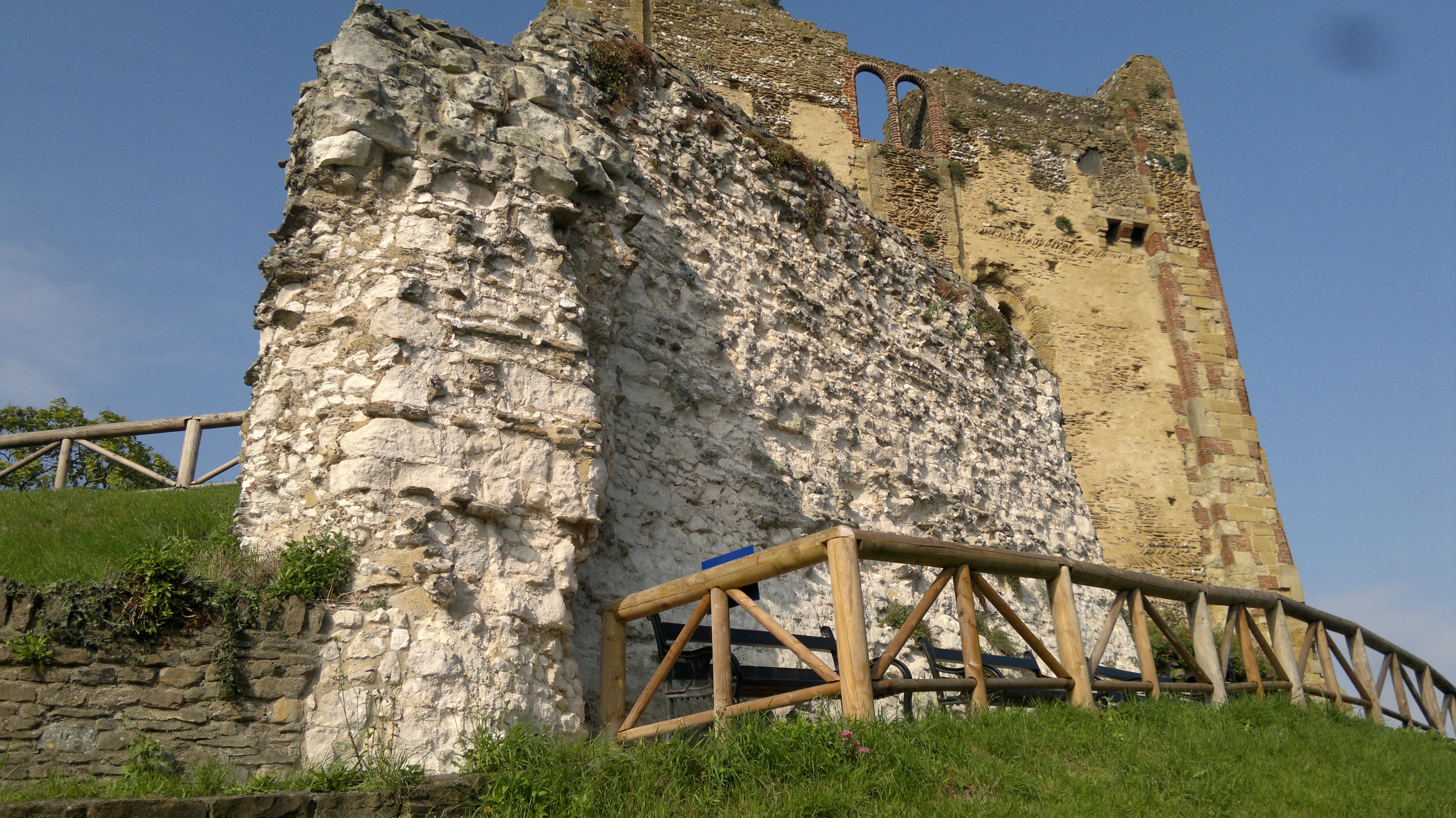
Guildford Castle
Henry III had his private chamber at Guildford Castle painted green with gold and silver stars. He added marble columns to the queen's apartments, commissioned coloured glass windows for the great hall, and built a garden enclosed by yet more marble pillars. By the 1370s, every one of these rooms had decayed beyond repair, and the castle keep was being used to house prisoners. Such is the arc of a Norman fortress that began as a conqueror's stronghold and ended as a public garden -- with a detour through cockfighting.
Bargate Stone and Chalk Bedrock
After the Battle of Hastings in 1066, William the Conqueror's army marched to Canterbury and then sacked towns along the Pilgrims' Way, Guildford among them. The castle that rose on the hill above the town followed the standard Norman pattern: a motte surrounded by a ditch, a bailey enclosed by a wooden palisade. By the early twelfth century, the wooden structures were being replaced in Bargate stone quarried from nearby Godalming, bonded with mortar so durable it has outlasted the walls it held together. The keep, added around the 1130s, was quadrangular -- 47 feet by 45 -- with walls ten feet thick at the base, its foundations sunk into the chalk bedrock. The entrance was on the first floor, a standard defensive measure. A second floor, added shortly afterwards, brought the keep to over 70 feet, its roof sheathed in lead and its interior walls plastered and whitewashed.
A Palace in All but Name
Guildford Castle was never successfully attacked, but it was no mere garrison. Henry III, who reigned from 1216 to 1272, lavished such attention on the buildings that the castle became known as a palace. The great hall received painted decorations and stained glass. The queen's apartments were fitted with large new windows. In 1245, Henry purchased additional land to extend the bailey and build quarters for his son Edward, the future Edward I. The gate at Quarry Street was completed in 1256. A fire damaged the hall in 1254, but improvements continued regardless -- this was a king who understood that architecture was an expression of royal authority, and Guildford was one of his favourite residences.
From Palace to Prison to Cockpit
When a royal hunting lodge across the river was improved in the 1360s, the monarchy abandoned the castle for more comfortable quarters. By 1379, only the king's great chamber survived; the rest of the royal apartments had simply rotted away. The keep found new purpose as the common gaol for Surrey and Sussex, holding prisoners until 1487 when Sussex's inhabitants petitioned Parliament to move inmates to Lewes, arguing it had a more secure facility. In 1544, John Daborne became keeper of the castle garden; his family added the brick windows and fireplaces still visible in the ruins. The 1630s saw the roofless tower repurposed as a cockpit. The Duke of Norfolk bought the site around 1820, and in 1885 Lord Grantley sold it to the Guildford Corporation, who restored the tower and opened the grounds as pleasure gardens in 1888 to mark Queen Victoria's Golden Jubilee.
Alice in the Ruins
Today, the castle gardens are among the most popular green spaces in Surrey, their flower beds centred on the twelfth-century keep. A life-size statue of Alice Through the Looking Glass stands among the plantings, a memorial to Lewis Carroll, who lived nearby at The Chestnuts -- his sisters' house -- from 1868 until his death in 1898. A major conservation project in 2003 partially restored the keep, flooring and roofing the first floor and discovering original features including crenellations that had survived centuries of neglect. The keep now houses a visitor centre with a model of the castle as it appeared around 1300, when Henry III's green-and-gold chambers still stood and marble columns caught the Surrey light. The old gatehouse contains part of Guildford Museum, including a specialist needlework collection -- a quiet domestic art housed in a building that once controlled access to a Norman stronghold.
From the Air
Located at 51.23N, 0.57W in the centre of Guildford, Surrey. The castle keep is visible on a hill above the High Street, with the surrounding gardens a patch of green in the town centre. The River Wey runs to the west. Nearest airports: EGLF (Farnborough, 10nm northeast), EGKB (Biggin Hill, 22nm east). The North Downs ridgeline runs east-west to the north of the town.