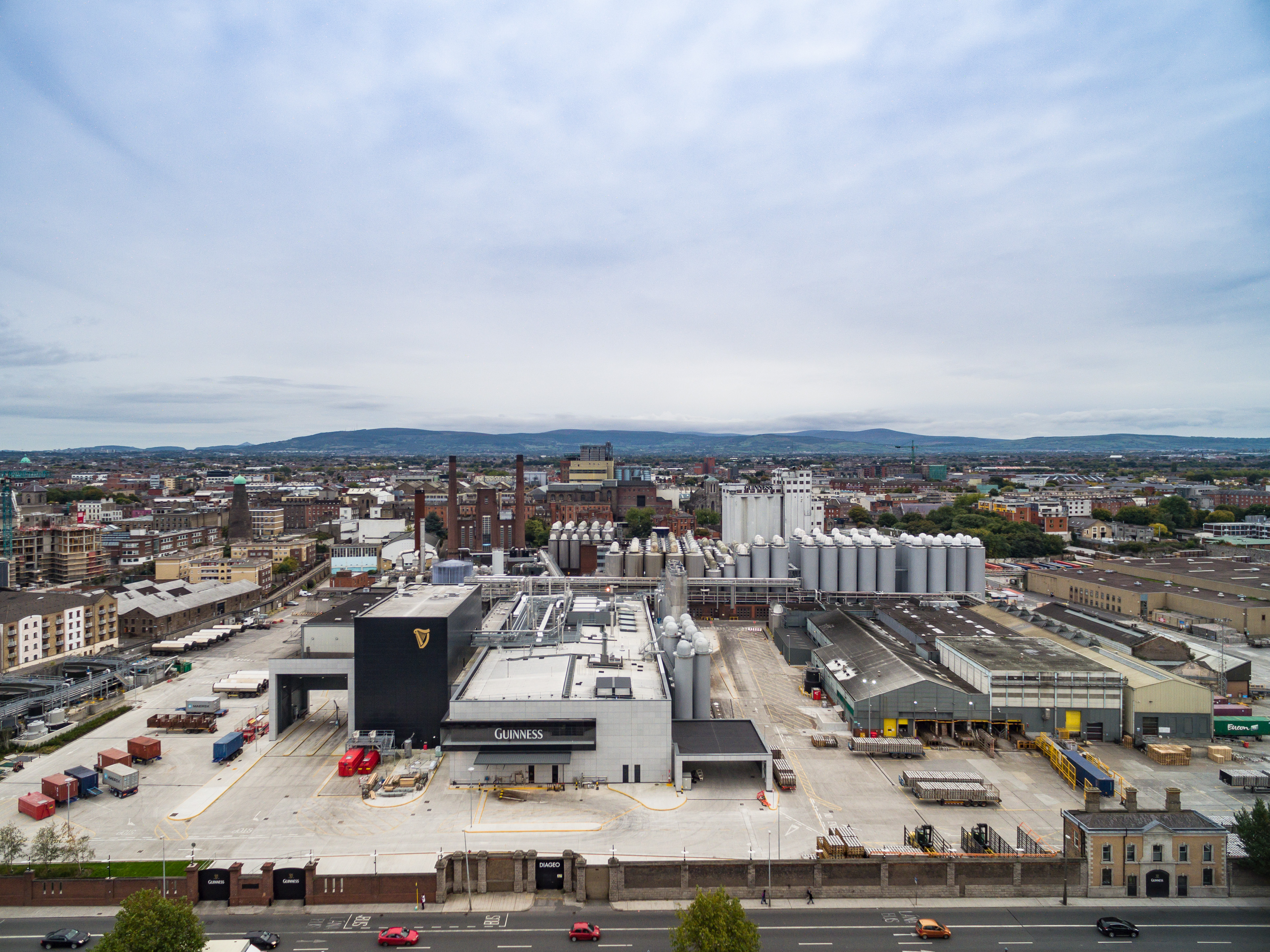
Guinness Brewery
Nine thousand years. That was the term Arthur Guinness demanded when he signed the lease for a disused brewery at St. James's Gate on the last day of 1759 -- forty-five pounds a year, for a period that would not expire until the year 10759. The lease has long since been rendered moot by outright purchase, but its audacity captures something essential about the enterprise it launched. From a four-acre site on the western edge of Dublin, the Guinness family built the largest brewery in the world and turned a dark Irish stout into one of the most recognizable beverages on the planet.
From Ales to Empire
Guinness started by brewing ales in Leixlip, County Kildare, before moving to St. James's Gate. Within a decade he had switched entirely to porter, the dark beer that London brewers had popularized. It was a bold bet: in the 1770s, London firms like Whitbread and Barclay Perkins accounted for 80 percent of the porter sold in Dublin. But Guinness's version found its audience. On May 19, 1769, the brewery exported its first six and a half barrels to England. By the time Benjamin Lee Guinness died in 1868, the site had grown from one acre to over sixty-four, and the business was worth more than a million pounds. His son Edward took it further, floating 65 percent of the company on the London Stock Exchange in 1886 for six million pounds -- capital that fueled expansion across the British Empire, from the Caribbean to West Africa to Australia.
The Statistician's Pint
Guinness did not succeed on marketing alone. The brewery was an early pioneer of scientific quality control. In 1899, the company hired a young statistician named William Sealy Gosset, who spent his career developing mathematical techniques to ensure consistency in brewing. Because Guinness prohibited employees from publishing under their own names, Gosset wrote under the pseudonym 'Student' -- and the methods he devised, including Student's t-distribution and the Student's t-test, became foundational tools of modern statistics. Few people raising a pint of Guinness realize they are drinking a product shaped by one of the most important statistical innovations of the 20th century.
The Brewery as City
At its peak in the late 19th century, St. James's Gate was not merely a brewery but a self-contained industrial city. By 1886, with an annual output of 1.2 million barrels, it was the largest brewery in the world. The complex had its own railway system, its own power station, and its own cooperage producing the wooden barrels that carried stout to ports worldwide. The Guinness family became Dublin aristocracy -- Benjamin Lee Guinness served as Lord Mayor and received a baronetcy, while his son Edward was created Earl of Iveagh. Their philanthropy reshaped the city, funding housing projects, parks, and the restoration of St. Patrick's Cathedral. The brewery and the city grew intertwined to a degree that made them almost inseparable.
Pilgrims and Pints
St. James's Gate carries a layer of history older than brewing. The gate was traditionally the departure point for Irish pilgrims beginning the Camino de Santiago -- the Way of St. James -- with their passports stamped here before they sailed for Spain. Pilgrims can still get their credentials stamped at the Guinness Storehouse, adding a spiritual footnote to what is now Dublin's most popular tourist attraction. The Storehouse itself, a converted fermentation plant, takes visitors through seven floors shaped like a fourteen-million-pint glass. At the top, the Gravity Bar offers a near-360-degree panorama of the city and a complimentary pint of the black stuff, poured where the Dublin skyline meets the Wicklow Mountains on the horizon.
Still Pouring
The brewery that Arthur Guinness leased for nine millennia remains operational. A 153-million-euro expansion completed in 2013 consolidated all Guinness production for the UK and Ireland at St. James's Gate, after the closure of the Park Royal brewery in London. According to Diageo, the conglomerate that now owns the brand, the Dublin brewery operates at over 90 percent capacity and is one of the most profitable in the world. The Guinness family, whose members chaired the company through three earldoms, no longer sits on the board. But the stout -- nitrogen-infused, creamy-headed, dark as a December evening in Dublin -- pours on. Arthur's nine-thousand-year lease may be a legal curiosity, but his brewery shows no sign of needing a fraction of that time.
From the Air
The Guinness Brewery at St. James's Gate is located at 53.3444N, 6.2889W on the south bank of the River Liffey in western central Dublin. From altitude, the brewery complex is identifiable as a large industrial site with distinctive grain silos and the Guinness Storehouse building. Nearest airports: Dublin Airport (EIDW) 11km north, Casement Aerodrome (EIME) 8km southwest.