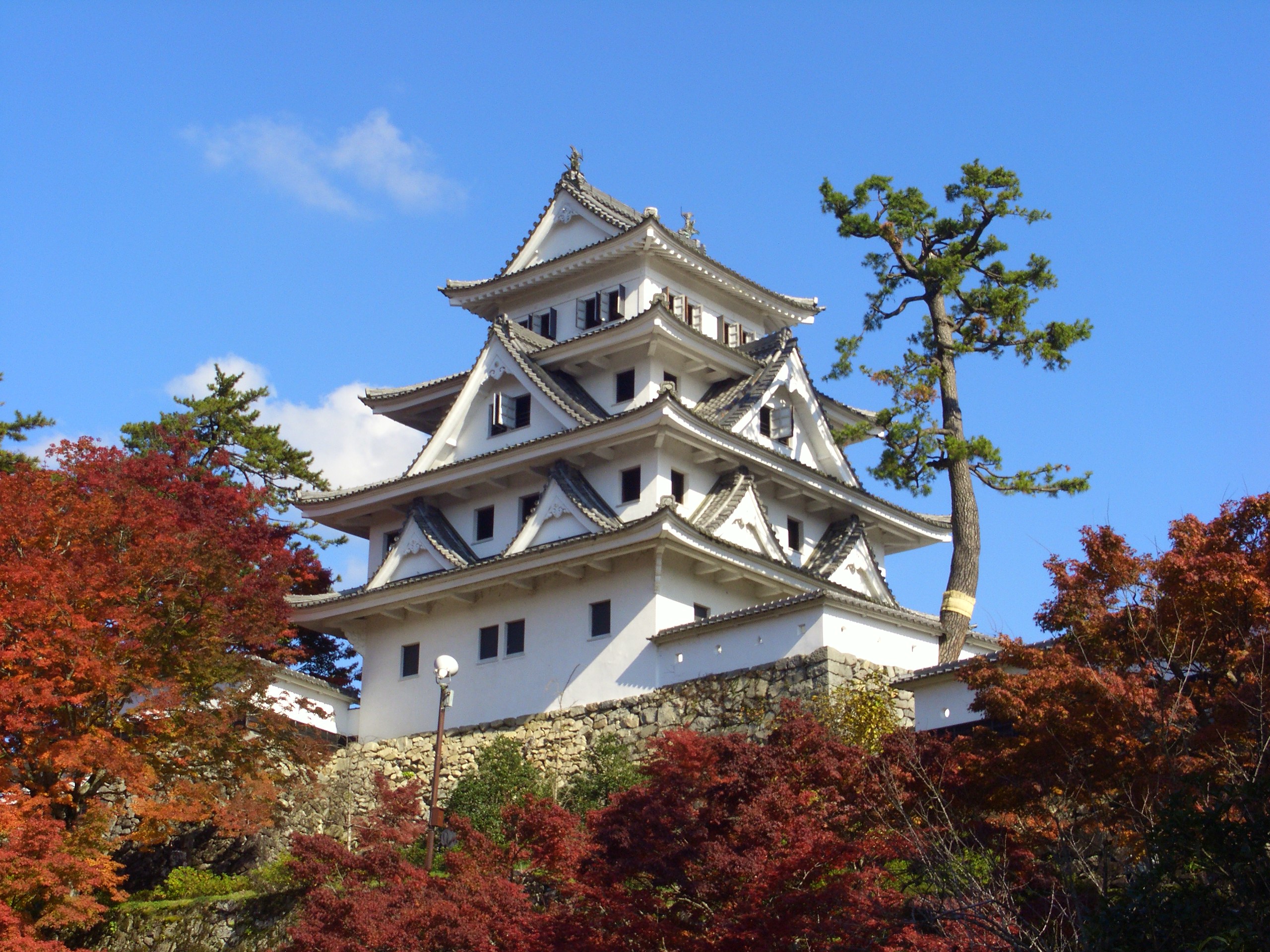
Gujo Hachiman Castle
On certain autumn mornings, when fog fills the valley below and only the white tower rises above the clouds, locals call it tenku no shiro -- the castle in the sky. Gujo Hachiman Castle sits at the summit of 350-meter Mount Hachiman in Gifu Prefecture, where the Yoshida and Kodaraga Rivers meet the main stream of the Nagara River. The Japanese have a phrase for what happens when the fiery red maples encircle the white tower in November: tenshu enjo, the castle tower on fire. Built in 1933 from wood rather than concrete, it holds the distinction of being Japan's oldest reconstructed wooden castle, and it earns its reputation every autumn when photographers gather before dawn, hoping the fog cooperates.
A Poet's Fortress
The castle's origins stretch back centuries before its current tower existed. In the Kamakura period, a cadet branch of the Chiba clan controlled this strategic mountain pass connecting central Mino Province to the Sea of Japan. They became known as the To clan, and their rise had an unlikely foundation: poetry. The To clan's mastery of waka verse made them close retainers of the Ashikaga shogunate. When the 8th Shogun Ashikaga Yoshimasa sent To Tsuneyori on a military expedition, rivals seized his castle in his absence. But Tsuneyori's reputation as a poet proved more powerful than any army -- he persuaded the usurper Saito Myochin to return the castle with nothing more than a poem. It remains one of feudal Japan's most remarkable acts of diplomacy through art.
Warring Clans and Shifting Loyalties
The Sengoku period brought harsher realities. In 1559, Endo Morikazu overthrew the To clan and built a new fortress on Mount Hachiman, but died before he could fully enjoy it. His son Endo Yoshitaka inherited the castle and pledged loyalty to Oda Nobunaga, then to Nobunaga's third son after the great warlord's assassination in 1582. When Toyotomi Hideyoshi emerged victorious, Yoshitaka surrendered, and the castle passed to Hideyoshi's retainer Inaba Sadamichi, who modernized it with stone walls. After Hideyoshi's death in 1598, the castle became a prize contested between the Endo and Inaba families. Both rivals eventually fought on the same side at the Battle of Sekigahara in 1600, and Tokugawa Ieyasu resolved the dispute by sending Inaba to Kyushu and returning the castle to the Endo. The castle then passed through several ruling clans -- the Inoue, the Kanamori, and finally the Aoyama, who held it until the Meiji Restoration.
Demolished and Reborn
In 1870, the Meiji government ordered all remaining castle structures demolished, leaving only the inner moats and stone walls on the mountaintop. For over sixty years, the summit stood bare. Then in 1933, local citizens undertook something unusual for the era: they rebuilt the tenshu in wood, modeling it after Ogaki Castle's design. Though not historically accurate to the original structure, the reconstruction gave Gujo Hachiman back its identity as a castle town. The wooden tower was designated a Tangible Cultural Property of Gujo city in 1987, and in 2017 the castle earned a place on the Continued Top 100 Japanese Castles list. Inside, a small museum displays artifacts from the castle's layered history, while outside, the mountain's natural defenses -- steep slopes falling away to converging rivers -- remain exactly as they were when the first fortifications rose here centuries ago.
The Water City Below
Gujo Hachiman is not just a castle but the anchor of a town defined by water. The rivers that once served as natural moats now give the town its character, with clear streams running through the streets and stone-lined canals where locals still wash vegetables. The town is famous throughout Japan for Gujo Odori, one of the country's major Bon dance festivals, held each summer for over 400 years. From the castle tower, the compact town spreads below in a grid of traditional houses and temples, hemmed in by mountains on every side. The view captures something essential about Japan's mountain castle towns -- the intimate relationship between fortress, settlement, and landscape, all shaped by the same rivers and ridgelines.
From the Air
Located at 35.753N, 136.961E at the summit of Mount Hachiman (350m). The castle tower is visible from the air, especially in autumn with surrounding red maples contrasting against the white structure. The town of Gujo Hachiman sits at the confluence of three rivers below. Nearest airport: RJNG (Gifu Air Base) approximately 50km south. Best viewed in early morning when valley fog may create the famous 'castle in the sky' effect. The Nagara River corridor provides a natural visual guide from the south.