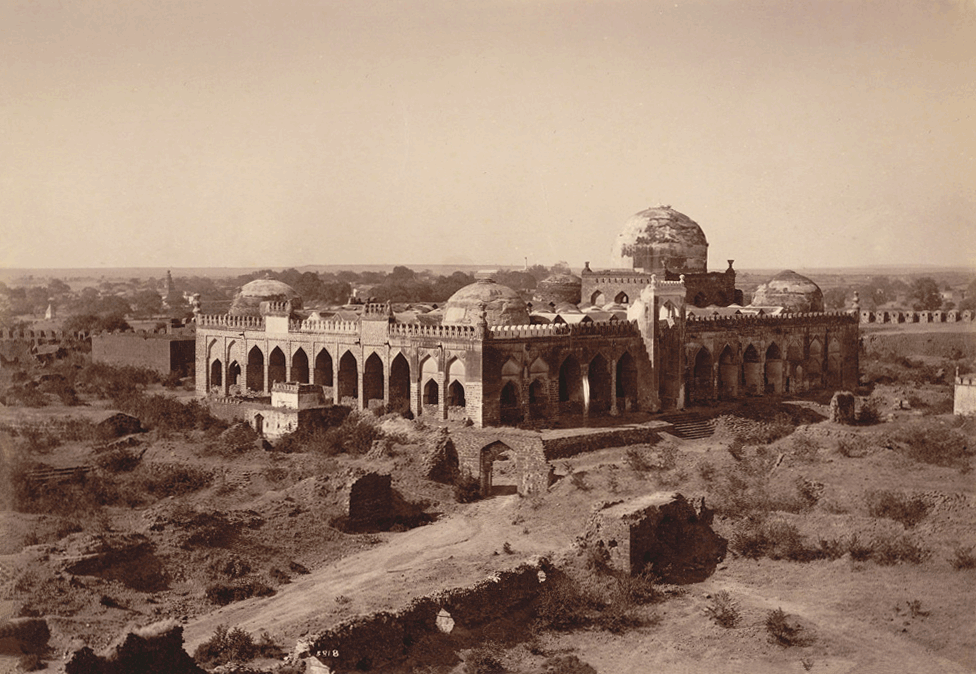
Gulbarga Fort
Walk into the Jama Masjid at Gulbarga Fort and you notice what is missing: the sky. Unlike virtually every other mosque in India, this one has no open courtyard. Instead, 75 small domes and five large ones seal the ceiling above 250 arches, creating an enclosed space that feels more like a Persian prayer hall than anything typically found on the Deccan Plateau. Built in 1367, twenty years after the Bahmani Kingdom declared its independence from the Delhi Sultanate, the mosque was a statement of architectural ambition -- and a declaration that this new southern dynasty would build on its own terms, drawing from Persian traditions rather than copying Delhi's precedents.
A Fort Built Twice
The original fortification at Gulbarga was the work of the Hindu monarch Raja Gulchand, but the structure that stands today is largely the creation of Ala-ud-Din Bahman Shah, who in 1347 established the Bahmani Kingdom and chose Gulbarga as his capital. He enlarged the fort substantially, adding a citadel at the center and fortifying the perimeter in a West Asian and European military architectural style unlike anything the region had seen. The result covers 57 acres with a periphery of three kilometers, surrounded by a moat 30 feet wide. Fifteen towers bristle with 26 cannons, each eight meters long and still preserved. Double walls reinforce the defenses. The fort served as the Bahmani capital until 1424, when the dynasty relocated to Bidar for its more favorable climate -- a move that speaks to the punishing heat of Gulbarga, where the drought-prone district averages only 777 millimeters of annual rainfall across 46 rainy days.
Persian Dreams on the Deccan
The Jama Masjid is the fort's architectural masterpiece and one of the earliest mosques in South India. Its design eliminates the traditional open courtyard entirely, replacing it with a roofed interior where low domes cover each bay, supported by pendentives. The prayer hall occupies the center, surrounded on three sides by outer passageways with low open arcades. Ten bays line the north and south walls, seven on the east. Corner bays are capped with domes, and the front area before the mihrab opens into nine bays under a single large dome. Trefoil interiors and elongated lobes ornament the arches beneath the main roof drum, which sits on a cubic clerestory. The Bahmani sultans claimed descent from the Sassanian emperors of Persia, and the crescent-and-disk motifs on their buildings echo the crowns of those ancient kings. Whether the genealogical claim was genuine or aspirational, the architectural influence is unmistakable.
Centuries of Contested Ground
Gulbarga Fort's history reads as a compressed chronicle of Deccan power politics. The Rashtrakutas held the surrounding region in the 6th century, followed by the Chalukyas for two hundred years, then the Kalachuris of Kalyani until the 12th century. The Yadavas of Devagiri and the Hoysalas of Halebid divided control next, overlapping with the Kakatiya dynasty of Warangal. The Delhi Sultanate absorbed the region in 1321, and the Bahmani breakaway followed in 1347. The Vijayanagara Empire later razed the fort to the ground, but after Vijayanagara's own defeat at the Battle of Talikota in 1565, Yusuf Adil Shah of the Bijapur Sultanate rebuilt it. Mughal Emperor Aurangzeb captured the fort in 1687, appointing Asaf Jah I as governor -- the same man whose descendants would rule the Hyderabad State until Indian independence in 1947.
The Sufi's Tomb and the Living Fort
Beyond the military architecture and the mosque, the fort complex includes the tomb of the Sufi saint Bande Nawaz, built in the Indo-Saracenic style. The dargah's arches follow Bahmani conventions, but the paintings on its walls and ceiling fuse Turkish and Persian artistic traditions, layering yet another cultural influence onto the fort's palimpsest. The Mughals added a mosque near the tomb. Each November, an annual Urs fair draws devotees from across religious communities to honor the saint -- a gathering that reflects the syncretic character of Deccan spiritual life. The fort itself, ringed by its moat and double walls, remains a substantial presence in modern Kalaburagi. Its cannons still point outward from their bastions. The Jama Masjid still shelters worshippers under its seventy-five domes. What the Bahmani sultans built to announce their sovereignty endures as one of North Karnataka's most striking architectural ensembles.
From the Air
Gulbarga Fort (17.34N, 76.83E) is located in Kalaburagi city in northern Karnataka on the Deccan Plateau. The fort's 57-acre footprint with its double walls and moat is visible from altitude. Kalaburagi Airport (VAKS) is the nearest airport. The city is an important railway junction on the Central Railway line connecting Bangalore, Mumbai, Chennai, and Hyderabad. Hyderabad (VOHS) is 225 km northeast, Bangalore (VOBL) is 610 km south. The terrain is flat and semi-arid. Best viewed at 2,000-4,000 ft AGL where the fort's rectangular outline and moat become clear against the surrounding city.