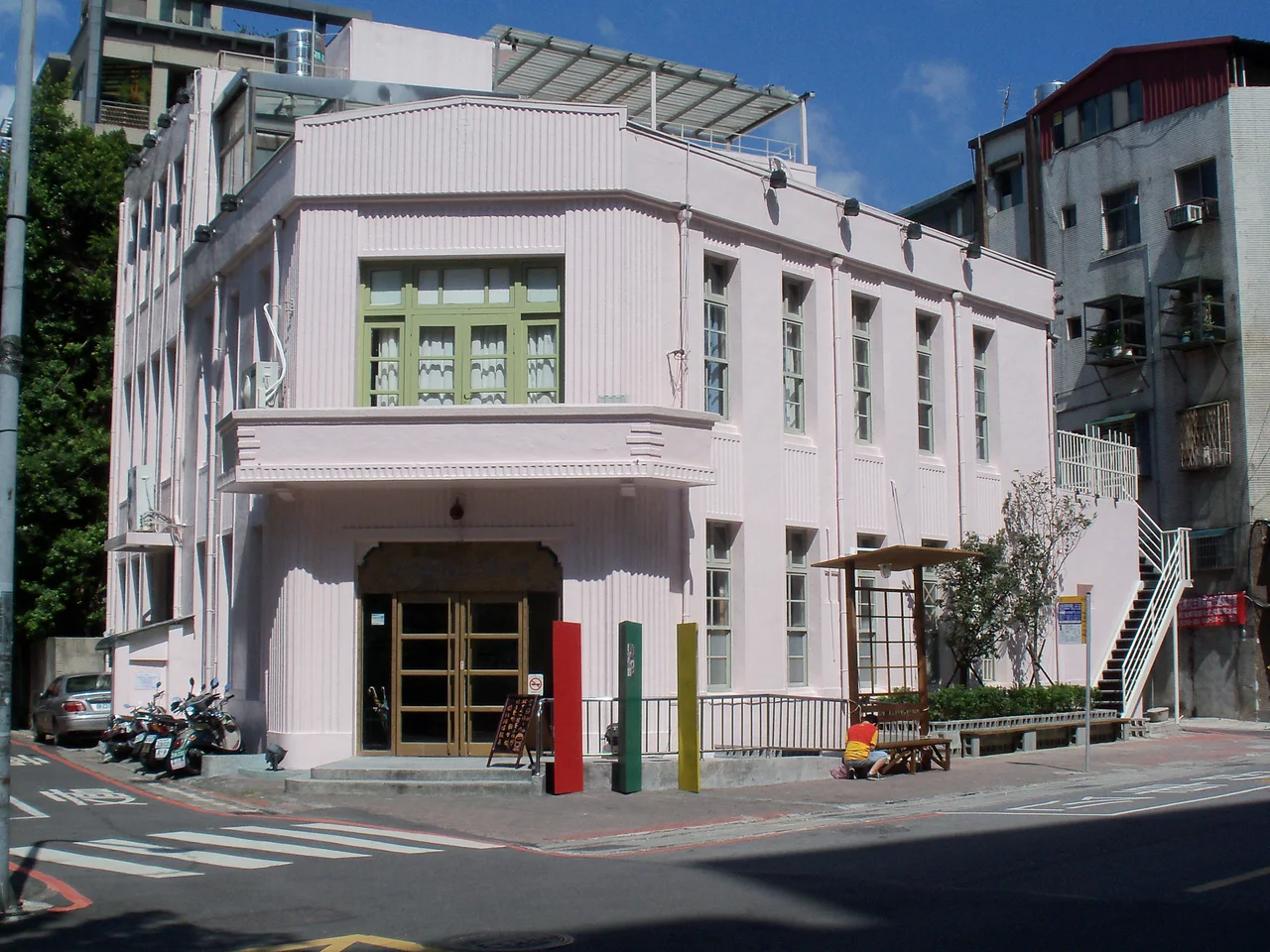

Guling Street Avant-garde Theatre
The detention room is still there. Walk into the Guling Street Avant-garde Theatre and you'll find it preserved exactly as it was when this building served as a Japanese military police station — the iron fittings, the close walls, the particular quality of silence that such rooms accumulate. What surrounds it now is theatre: experimental, often provocative, staged for audiences of fifty to seventy people in a hall that was never designed for art but turns out to be perfect for it. The transformation from instrument of authority to stage for dissent took nearly a century, and the building carries every layer of that history in its bones.
Built for Authority
The structure went up in 1906, during the first decade of Japanese colonial rule over Taiwan. Its Baroque architectural style — then fashionable for civic buildings across Japanese-administered Asia — gave the police station an imposing presence on Guling Street, all thick masonry and formal symmetry. The heavy walls were a product of the era's building logic: solid, permanent, institutional. They were built to project the permanence of the colonial order. The building served as a Japanese military police station for decades, and after the Second World War it passed to the Republic of China government, which used it as the Taipei City Police Department's Crime Section. In 1958 it was rebuilt in the style of a Japanese brick building and converted into the Taipei Police Zhongzheng District second branch. Authority, it seems, found the bones of this building congenial.
A Stage Takes Shape
The second police branch moved out in 1995, leaving behind a historic structure without a clear purpose. The Taipei City Government Information Services Department took control and began imagining what the building might become. The answer, when it came, was unexpected: a venue for small-scale theatrical performance. The same thick walls that had once muffled sounds the police wanted contained turned out to create excellent acoustic separation. The large central area, unobstructed by supporting pillars because of the original Baroque design, gave directors a flexible performance space rarely found in purpose-built theatres. In 2001 the Department of Cultural Affairs formally renamed it the Guling Street Avant-garde Theatre. The following year the theatre opened its doors to audiences, and the old detention room was preserved as part of the visitor experience — a deliberate choice to keep the building's past visible rather than painted over.
Where History Sits in the Audience
There is something particular about watching experimental theatre in a space that was once designed for coercion. The Guling Street Avant-garde Theatre has hosted more than 8,000 guests since it opened in 2002, drawn to a programme that consistently favours work that would have been impossible to stage here during the building's earlier incarnations. The rehearsal room offers over 1,000 square feet of unobstructed floor — ideal for companies developing work before it reaches the main space. The detention room, kept in its original condition, functions as a kind of permanent installation: a reminder of what this building was for, and how completely its meaning has changed. A short walk west of Chiang Kai-shek Memorial Hall Station on the Taipei Metro, the theatre sits at an intersection of history and live art that few venues anywhere can match.
The Street Itself
Guling Street carries its own literary resonance in Taipei. The area around it was home to secondhand book stalls for decades, a bookshop district that drew readers and intellectuals to browse titles that circulated through many hands before finding new ones. Edward Yang's celebrated 1991 film A Brighter Summer Day — one of the landmarks of Taiwanese cinema — takes its name from a line in Elvis Presley's recording of 'Are You Lonesome Tonight?', phonetically transcribed by a character in the film, and is set in the streets of this neighbourhood, tracking the lives of teenagers in the 1960s. The theatre, standing on this same street, inherits a cultural geography already dense with memory. Baroque walls, a preserved cell, the ghost of a bookshop district, and whatever is on stage tonight — Guling Street layers its histories without apology.
From the Air
The Guling Street Avant-garde Theatre sits at approximately 25.032°N, 121.515°E in Taipei's Zhongzheng District, a dense urban neighbourhood in the heart of the city. From the air at 3,000 feet, the area is dominated by the iconic octagonal roof of Chiang Kai-shek Memorial Hall to the east, a useful visual anchor. The theatre itself is a low Baroque-style brick building, easily obscured among the surrounding urban fabric. Taipei Songshan Airport (RCSS) lies roughly 5 km to the northeast; Taoyuan International Airport (RCTP) is approximately 35 km to the southwest. Approach the Zhongzheng District from the northwest for the clearest view of the Memorial Hall grounds and the historic street grid surrounding them.
Nearby Stories
- Dapu Incident 9.3 km away
- Shuanglianpi Wetland 18 km away
- Toufen 41 km away
- North Jiangsu Main Irrigation Canal 980 km away
- General Cliff Rock Paintings 1050 km away
- Sinking of MV Sewol 1061 km away
- Yellow Sea 1111 km away
- Twin Forts of Romblon 1358 km away