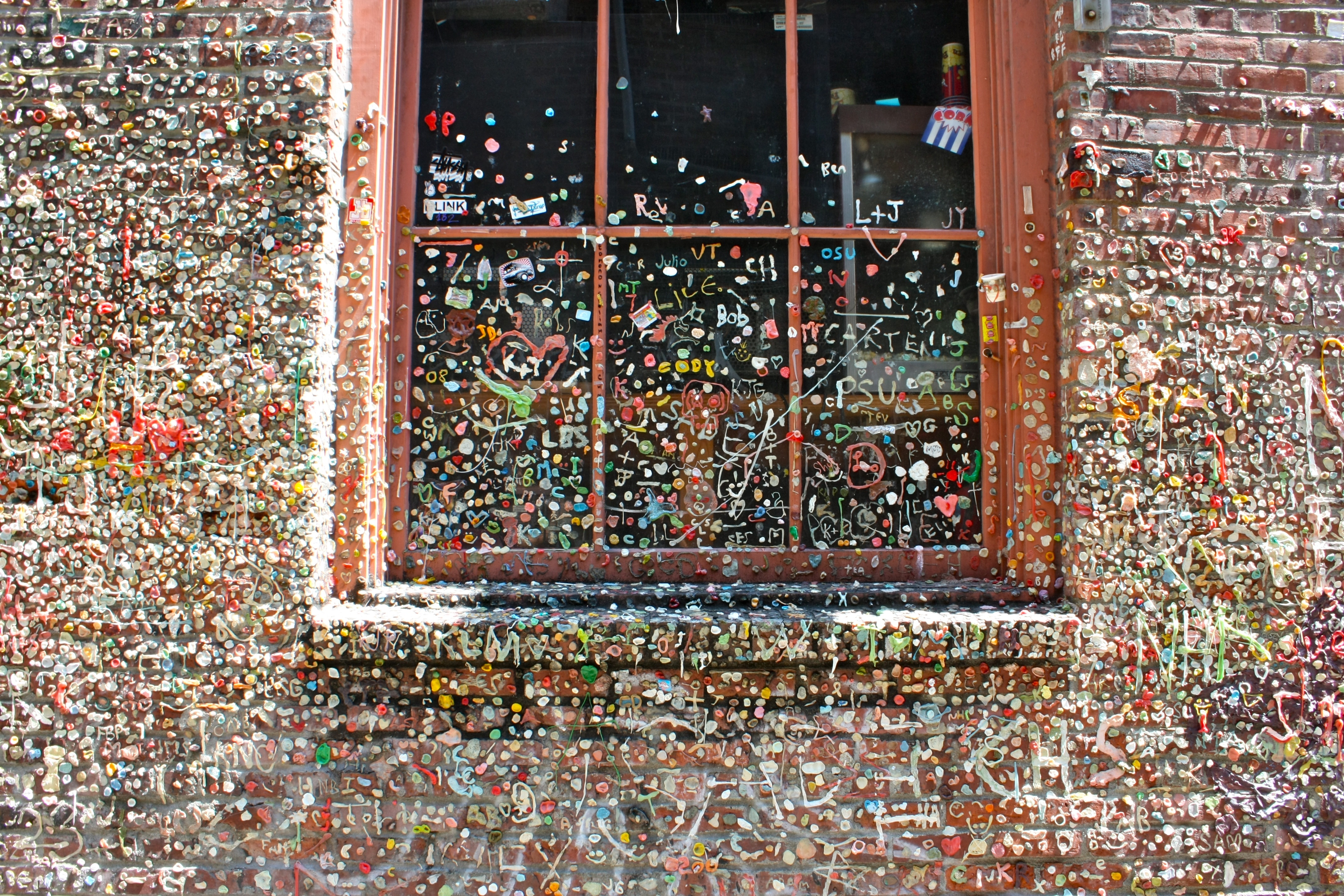
Gum Wall
One hundred and eighty pieces of gum per brick. That is the density officials measured on the walls of Post Alley before the first major cleaning in 2015, a technicolor crust of spearmint, bubblegum, and watermelon several inches thick stretching along a narrow passage beneath Pike Place Market. The Gum Wall was never planned. It began as an act of boredom by theatergoers waiting in line, grew into an act of rebellion when market officials tried to stop it, and eventually became something no city planner could have designed: a collectively authored artwork that Washington Governor Jay Inslee once called his "favorite thing about Seattle you can't find anywhere else."
Pennies, Improv, and an Accidental Landmark
The story begins in 1991, when the Market Theater in Post Alley became the home of Unexpected Productions' Theatresports, a long-running improv competition. Patrons waiting for shows started pressing chewed gum onto the brick walls outside the box office, pushing pennies into the wads for good measure. The Pike Place Market Preservation and Development Authority was not amused. They ordered the walls cleaned, and the coins were scraped away. But the gum kept coming back. After several rounds of cleaning and re-gumming through the 1990s, market officials reversed course around 1999, officially deeming the growing gum crust a tourist attraction rather than a maintenance headache. By the late 2000s, the wall had become one of Seattle's most photographed spots, a sticky spectrum of color that grew longer and taller with every passing year.
The Great Scrub of 2015
On November 3, 2015, the Pike Place Market Preservation and Development Authority announced what felt like sacrilege to some: the Gum Wall would be fully cleaned for the first time in twenty years. The reason was practical, not aesthetic. Sugar in the gum was eroding the century-old bricks, and the wall needed maintenance to survive. Market officials launched a photo contest, inviting fans to share their memories before the gum disappeared. Work began on November 10. A local crew spent 130 hours blasting the walls with steam, carefully calibrating pressure to strip the gum without damaging the brick underneath. The cost was roughly $4,000. The discarded gum went to a landfill. Within hours of the cleaning's completion, fresh pieces began appearing on the bare brick. Some of the first new additions were memorials to the November 2015 Paris attacks, pressing messages of solidarity onto the blank canvas. The wall was cleaned again in September 2018 and November 2024, each scrub a reset on a canvas that immediately begins filling itself in again.
Collective Art in a Sticky Medium
Is the Gum Wall art? The question divides opinion, but the wall's behavior follows the patterns of participatory public art: anonymous contributors, organic growth, no curator, no gate. Some classify it as collective action, a space where something universally considered unpleasant has been transformed through sheer accumulation into something people travel to see. Artists have embraced the medium. Local muralists occasionally paste works onto gum-free patches, and graffiti writers claim the less-encrusted sections. In January 2024, Seattle artist Rudy Willingham chewed 200 pieces of gum to create a portrait of Pete Carroll on the wall, a tribute to the departing Seahawks head coach who was famous for chewing as many as 130 pieces on game days. The mural depicted Carroll in his headset, rendered in solid gum colors. It was, by any measure, an original work of American folk art.
Living with the Sticky Side of Fame
Not everyone in Post Alley is charmed. Bars and restaurants across from the wall have posted "No Gum" signs in a doomed effort to keep the sticky tribute from spreading to their storefronts. The gum attracts rats, and the alley can smell sweet in a way that veers toward cloying on warm afternoons. The Gum Wall also anchors the starting point of the Pike Place Market Ghost Tour, adding a layer of after-dark atmosphere to an already strange corner of the city. Wedding photographers have claimed the alley as a backdrop, posing couples against the rainbow-splattered bricks. For all its contradictions, the Gum Wall endures because it belongs to no one and everyone. Each piece of gum is an anonymous mark, a tiny claim of presence, and together they create something that no single person could have imagined.
From the Air
The Gum Wall sits at 47.608N, 122.340W in Post Alley, tucked beneath the main arcade of Pike Place Market on the western edge of downtown Seattle. It is not individually visible from the air, but Pike Place Market itself is a prominent landmark: look for the long covered market structures and the red "Public Market Center" sign on the hillside above the Seattle waterfront. Post Alley runs parallel to and east of the main market arcade. Nearest airports: Boeing Field/King County International (KBFI) 5nm south, Seattle-Tacoma International (KSEA) 11nm south, Renton Municipal (KRNT) 10nm southeast.