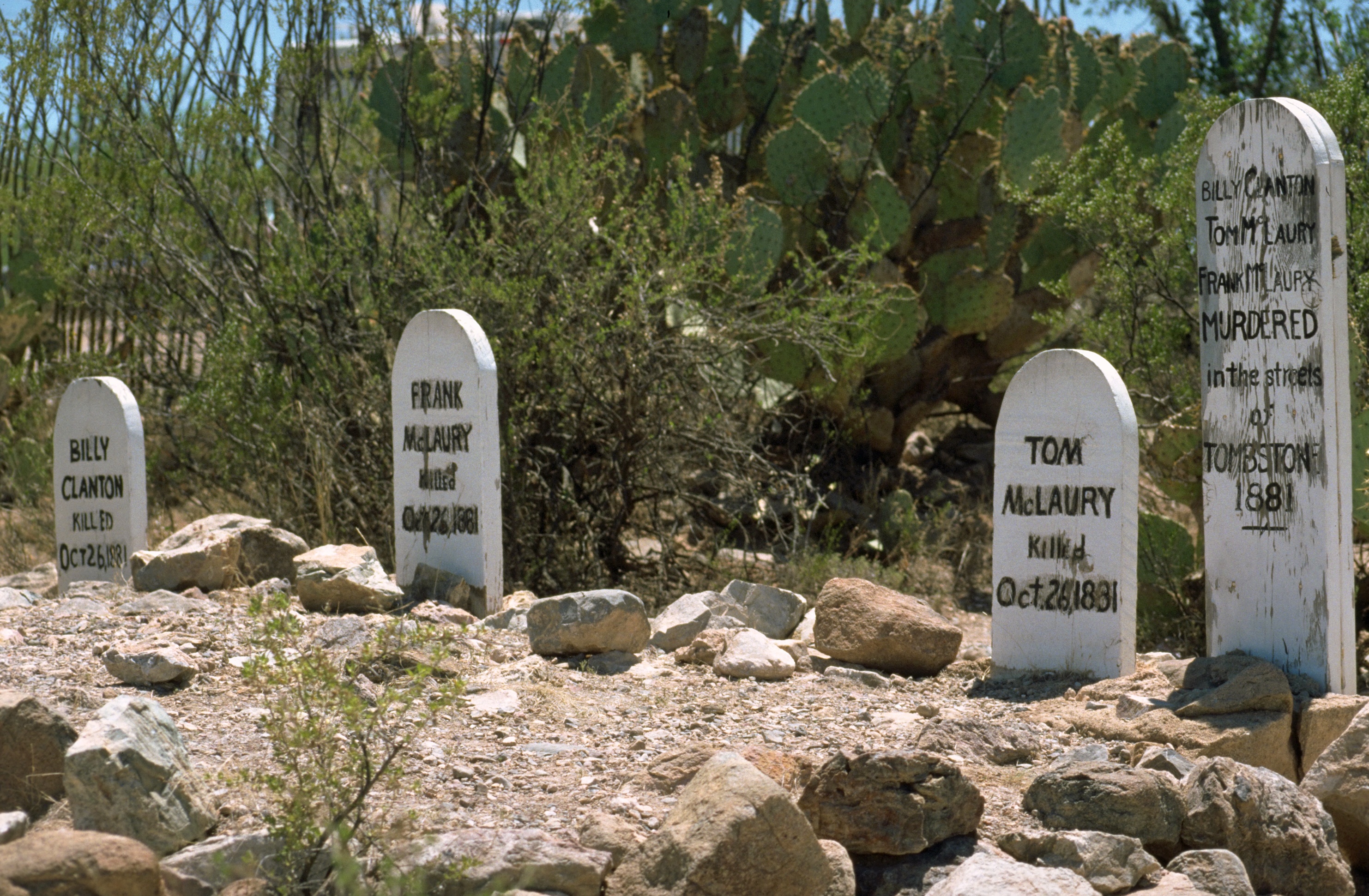
Gunfight at the O.K. Corral
The gunfight did not happen at the O.K. Corral. That name came from a newspaper less than a month after the shooting, and a 1957 movie cemented it in popular imagination. The actual location was a narrow lot on Fremont Street between Fly's Boarding House and the Harwood house, six or seven men crammed into a space smaller than many modern living rooms. On October 26, 1881, in approximately thirty seconds of smoke and thunder, they fired roughly thirty shots. Three men died. Two were wounded. And America gained its most enduring symbol of frontier violence.
The Setup
By October 1881, tensions between the Earp brothers and a loose confederation of ranchers and rustlers known as the Cowboys had reached a breaking point. Virgil Earp served as Tombstone's city marshal. His brothers Wyatt and Morgan backed him up, along with the infamous Doc Holliday, a dentist turned gambler dying slowly of tuberculosis. The Cowboys, including the Clanton and McLaury brothers, were accused of cattle rustling and stagecoach robbery. When citizens reported that the McLaurys and Clantons had gathered on Fremont Street carrying weapons, violating city ordinance, Virgil decided to disarm them. The Earps walked west down Fremont Street, Wyatt carrying a .44 caliber Smith & Wesson in his waistband, Holliday concealing both a nickel-plated pistol and a shotgun beneath his long coat.
Thirty Seconds of Chaos
Who fired first remains disputed to this day. The smoke from black powder ammunition obscured the narrow lot almost immediately. Witnesses loyal to different sides told conflicting stories. What is certain is the outcome. Tom McLaury took twelve buckshot wounds from a single shotgun blast to his right side. Frank McLaury received a shot beneath his right ear that penetrated his brain, causing instant death, and another wound to his abdomen. Billy Clanton, just nineteen years old, was hit in the wrist as he drew his gun and then shot again. Despite his wounds, Billy kept firing. He and Frank managed to wound both Morgan and Virgil Earp before they died. Ike Clanton and Billy Claiborne fled the fight unarmed, leaving the three dead Cowboys behind.
The Hearing
The funerals for Billy Clanton, Tom McLaury, and Frank McLaury drew 300 people in the procession to Boot Hill and 2,000 spectators on the sidewalks. Public sympathy ran strongly against the Earps. Justice of the Peace Wells Spicer convened a preliminary hearing on October 31 to determine if there was enough evidence for a murder trial. Sheriff Johnny Behan, a friend of the Cowboys, testified for two days, turning public opinion further against the Earps. Prosecutors argued that Tom McLaury was unarmed, that Billy Clanton had his hands in the air. On the strength of their case, Spicer jailed Doc Holliday and Wyatt Earp for 16 days. But ultimately, Spicer ruled that even if Tom was unarmed, his presence among armed men resisting arrest could not criminalize the Earps' actions. They walked free.
The Myth Machine
The Cowboys were not finished. In December 1881, Virgil Earp was ambushed and shot, his left arm permanently crippled. In March 1882, Morgan Earp was murdered while playing billiards. Wyatt's subsequent vendetta ride, hunting down those he believed responsible, only added to the legend. But it was Hollywood that transformed a violent episode in a silver mining town into the defining myth of the American West. Films from 1939's Frontier Marshal to 1993's Tombstone have remade the story countless times. At the peak of television Westerns in 1959, six different shows connected to Wyatt Earp aired weekly. Today, Tombstone stages daily reenactments of a fight that lasted half a minute and happened in a different location than its famous name suggests. The truth has long since surrendered to a better story.
From the Air
Located at 31.71N, 110.07W in southeastern Arizona. The historic Tombstone district sits at approximately 4,500 feet elevation. Tombstone Municipal Airport (P29) lies 3nm southeast with a 3,900-foot paved runway. From the air at 1,500 AGL, the rectangular grid of historic Tombstone is clearly visible, with Fremont Street running east-west through the center of town. Bisbee Douglas International (DUG) is 25nm south, Sierra Vista Municipal (FHU) 18nm west. Morning flights offer clearest visibility before afternoon thermals develop over the desert.