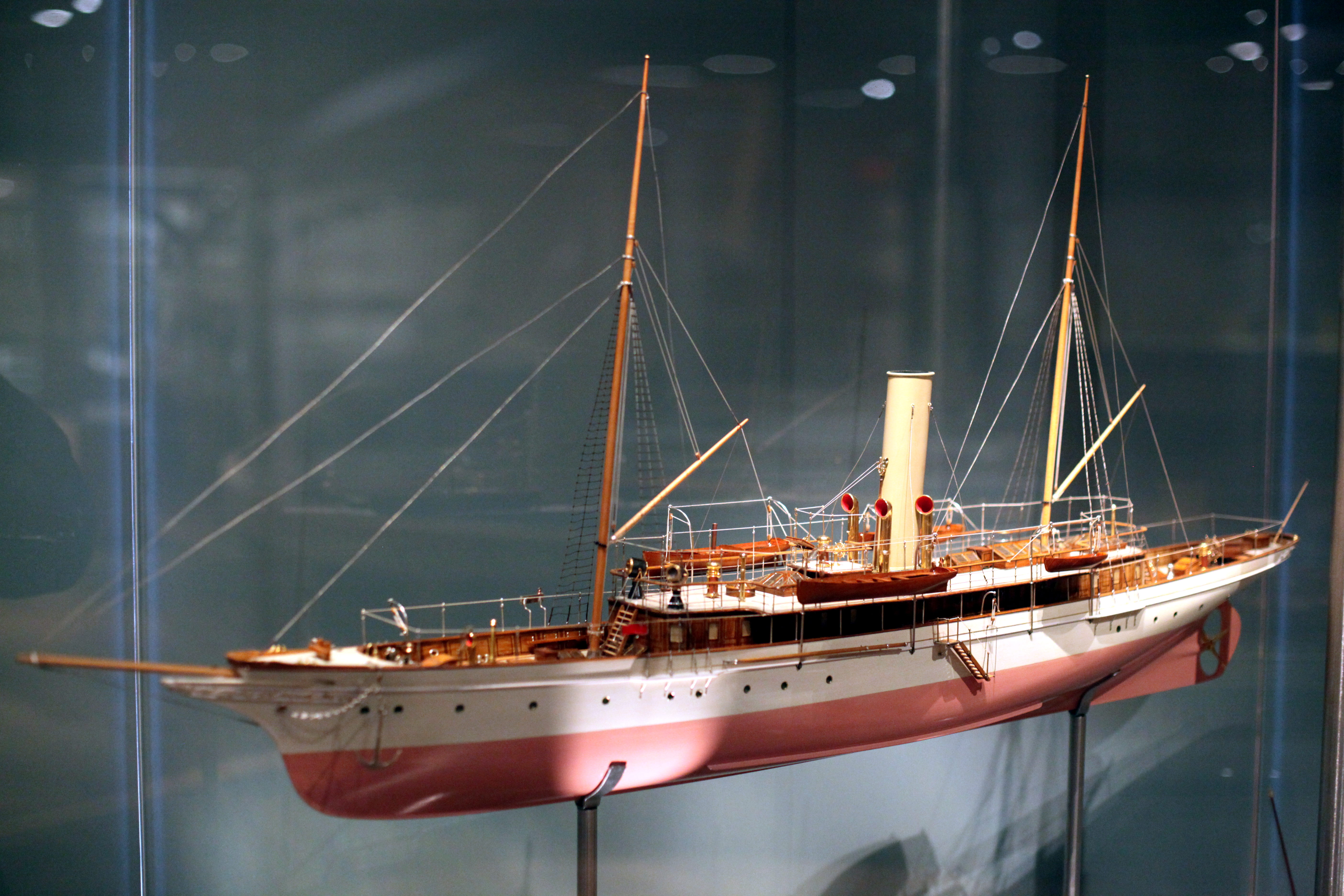
Gunilda
William L. Harkness was an oil baron who could afford anything. He owned a 385-ton steel-hulled steam yacht built in Scotland, the flagship of the New York Yacht Club. He sailed the Caribbean and the Atlantic with a crew of twenty. But when a local pilot on the north shore of Lake Superior offered to guide his ship through unfamiliar waters for fifteen dollars, Harkness said no. It was too much money. That decision would send the Gunilda to the bottom of the lake, and into legend.
Scottish Steel, Gilded Hull
The Gunilda was launched on April 1, 1897, at the Ramage & Ferguson shipyard in Leith, Scotland. Naval architect Joseph Edwin Wilkins designed her for the Sladen family of England, and she cost roughly $200,000 to build -- a fortune in the era. Her name is a variant of Gunhild, an old Germanic word meaning 'war,' though nothing about the yacht suggested battle. She was elegance made seaworthy: a steel hull with gilded accents, a triple-expansion steam engine fed by twin 160-psi boilers, and a complement of fine furnishings that included a piano. She changed hands twice in England before crossing the Atlantic in 1901, crewed by twenty-five men and chartered by a member of the New York Yacht Club. In 1903, Cleveland oil baron William L. Harkness purchased her, and the Gunilda became the club's flagship, cruising the Caribbean and the Atlantic for the next seven years.
Fifteen Dollars Too Many
In the summer of 1911, Harkness brought his family and friends north for a cruise along Lake Superior's rugged shore, bound for Rossport, Ontario, and then Lake Nipigon to fish for speckled trout. When the Gunilda stopped at Coldwell Harbor, Harkness asked about hiring a pilot to navigate the shoal-strewn waters ahead. Donald Murray, an experienced local man, offered his services for fifteen dollars. Harkness refused. At the next stop, Jackfish Bay, another pilot named Harry Legault quoted twenty-five dollars plus train fare home. Captain Alexander Corkum and the crew thought the price fair, but Harkness overruled them again. The American charts showed no shoals on their course. Harkness decided to proceed at full speed. Not far from Rossport, the Gunilda slammed onto McGarvey Shoal -- known locally as Old Man's Hump -- driving so far onto the rocks that her bow rose high out of the water.
A Second Refusal
Harkness took a motor launch to Rossport and caught a train to Port Arthur, where he hired the tug James Whalen to pull the Gunilda free. The tug's captain advised bringing a second tug and barge to stabilize the yacht during the extraction. Harkness refused once more. On August 11, 1911, a sling was wrapped around the Gunilda's hull and attached to the James Whalen. The tug pulled. The yacht's engines reversed. Nothing moved. They swung the stern back and forth. Still stuck. Finally, wrecking master J. Wolvin hauled hard to starboard, and the Gunilda slid free -- but as she hit deep water she suddenly keeled over, her masts smacking the lake surface. Water poured through every porthole, door, hatch, and skylight. The Gunilda sank in minutes. The James Whalen's crew frantically cut the towline to keep from being dragged down with her. Everyone aboard survived. Lloyd's of London paid out a hundred thousand dollars.
The Most Beautiful Shipwreck in the World
The wreck lay undiscovered until 1967, when diver Chuck Zender located her resting upright on an even keel at the base of McGarvey Shoal, roughly 270 feet down. What he found was extraordinary: the Gunilda was almost perfectly intact. Her superstructure stood complete. Both masts remained in place. The compass binnacle sat undisturbed on the bridge. Inside, a piano, lanterns, and furniture remained exactly where they had been when the water rushed in fifty-six years earlier. Even the gilding on her hull still gleamed. In 1980, Jacques Cousteau and the Cousteau Society brought the research vessel Calypso and the diving saucer SP-350 Denise to film the wreck. The Society declared the Gunilda 'the best-preserved, most prestigious shipwreck in the world' and 'the most beautiful shipwreck in the world.' In 2019, a PADI blogger ranked her the second-best technical dive site on Earth, behind only the German battleship SMS Markgraf at Scapa Flow.
Dreams and Depths
The Gunilda has resisted every attempt to raise her. Ed and Harold Flatt of Thunder Bay tried cranes and barges in the late 1960s, managing only to pull up a piece of mast before a storm destroyed their equipment. Fred Broennle spent a decade obsessed with salvaging the wreck, building diving bells and purchasing a submersible called Constructor. The effort cost $1.5 million and bankrupted him. Worse, his dive partner Charles 'King' Hague died during a 1970 dive on the wreck; Broennle located Hague's remains near the stern six years later. A second diver, Reg Barrett, died on the Gunilda in 1989. Broennle's story was made into a 1997 documentary called Drowning in Dreams. The Gunilda remains where she sank, a time capsule of Edwardian luxury preserved by the cold, dark water of Lake Superior -- and by a rich man's refusal to spend fifteen dollars.
From the Air
The Gunilda wreck lies at approximately 48.78N, 87.42W near McGarvey Shoal on the north side of Copper Island, just offshore from Rossport, Ontario, on Lake Superior's north shore. The wreck is underwater and not visible from the air, but the rocky shoals and islands near Rossport are clearly identifiable. Look for the small cluster of islands south of the Trans-Canada Highway corridor along the rugged coastline. Recommended viewing altitude: 2,000-4,000 feet AGL for the Rossport archipelago. Nearest airports: Marathon Aerodrome (CYSP) approximately 35nm east, Thunder Bay International (CYQT) approximately 120nm west.