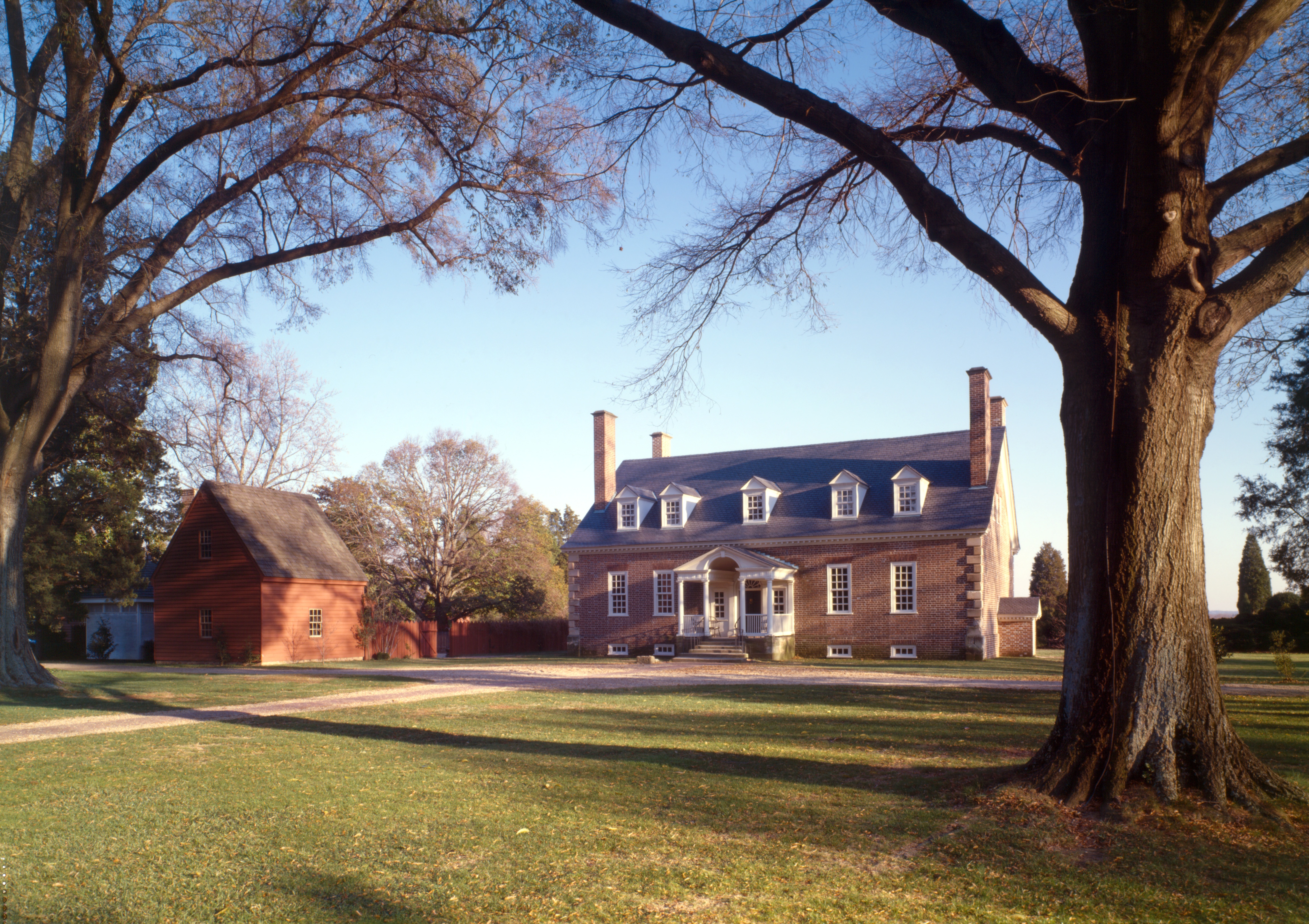
Gunston Hall
Thomas Jefferson came to Gunston Hall one last time in 1792, not for politics or debate, but to sit at the deathbed of George Mason. The man dying in that emerald-green bedchamber had refused to sign the Constitution because it lacked a bill of rights, and he had spent his life on this bluff above the Potomac drafting the words that would eventually become the first ten amendments. But the house itself tells another story entirely. Built between 1755 and 1759 on Mason Neck in Virginia, Gunston Hall is a Georgian brick mansion whose restrained exterior hides one of the most extraordinary interiors in colonial America, a place where rococo, chinoiserie, and Gothic styles collide in ways that no other house of the period dared to attempt.
An Indentured Man's Masterpiece
The genius behind Gunston Hall's interiors was William Buckland, a carpenter and joiner who arrived in Virginia as an indentured servant. In August 1755, Buckland signed an agreement with Thomson Mason, George's brother: in exchange for free passage from England, room and board, and twenty pounds sterling per year, he would work as a craftsman for the Masons for four years. What he produced exceeded anything the colonies had seen. Working alongside another indentured servant, William Bernard Sears, Buckland filled the house with ornate woodwork and carved detailing that blended Chinese, Gothic, and French rococo motifs. The chinoiserie dining room remains the only known example of that decorative style in colonial America, an astonishing accomplishment for a young man fresh from his apprenticeship. Buckland would go on to design notable buildings across Virginia and Maryland, but Gunston Hall was where his talent first announced itself.
Rooms That Speak in Riddles
The first floor is split by a central passage lined with six Doric-style pilasters, where a double arch topped by a carved pine cone divides the front hall from the back. One of the four doorways off this passage is a fake, installed purely for symmetry. The parlor features the chinoiserie that made Gunston famous, while the primary chamber was Mason's private retreat, its walls painted in emerald green, a color considered luxurious at the time. Upstairs, the layout breaks every convention. Where most houses of Gunston's stature mirror their ground floor on the second, this one pivots entirely: a narrow passage cuts sideways through seven bedchambers and a storage room, with corner rooms painted in Prussian blue and verdigris. At the top of the main stairway, a tri-part arch with fluted pillars frames a small gallery overlooking the staircase below. The front porch was Buckland's most individualistic creation, its classical lines drawn from a Roman medal depicting the Temple of Tyche in Eumeneia, Asia Minor, a design engraved only once.
The Patriarch and His Declaration
George Mason was not a man who sought the public stage, but what he wrote from Gunston Hall changed American history. His Virginia Declaration of Rights, adopted in June 1776, declared that all men are by nature equally free and independent, language that Thomas Jefferson drew upon weeks later when drafting the Declaration of Independence. Mason served as a delegate to the Constitutional Convention in 1787 but refused to sign the final document, objecting fiercely to the absence of a bill of rights and to provisions that allowed the continuation of the slave trade. His stubbornness won out: the Bill of Rights was ratified in 1791, one year before Mason died in the house he had built. The Mason family had roots in Gunstone, South Staffordshire, England. After the Royalist defeat at Worcester in 1651, Philip Mason I emigrated to Virginia, and the name of the family's English home was carried across the Atlantic to become Gunston Hall.
From Plantation to Preservation
After Mason's death, the house passed through many hands. In 1868, it was purchased by Edward Daniels, a former Union cavalry officer and ardent abolitionist who had served as a Civil War colonel. In 1912, retired Marshall Field & Company executive Louis Hertle bought the property, and he and his wife Eleanor set about restoring the mansion to its original plan, hosting prominent guests through the decades. Hertle's 1949 will gave Gunston Hall to the Commonwealth of Virginia, to be operated as a museum by the National Society of the Colonial Dames of America. Behind the house, the formal garden sits on a man-made level platform exactly one acre in area, where boxwoods now roughly 250 years old crowd a gravel path that once matched the width of the central passage inside. The path ends at an overlook where the Potomac River stretches out below, a view that was even more dramatic in Mason's day when the surrounding trees were cleared. Gunston Hall was designated a National Historic Landmark in 1960.
A Plantation's Wider World
Gunston Hall was the center of a network of Mason family properties stretching across the Virginia and Maryland landscape. George Mason gave Hollin Hall to his third son Thomson through deeds of gift in 1781 and 1786. Lexington Plantation went to his eldest son, George Mason V, after his return from Europe in 1783. His fourth son, John, received Barbadoes Island, now known as Theodore Roosevelt Island in the Potomac, which had been purchased by George Mason III in 1717. John built a summer home there in the 1790s before financial troubles forced foreclosure in 1833. The reach of the Mason family mirrored the reach of the ideas that George Mason composed at Gunston Hall. His insistence on individual rights did not merely influence America's founding documents; it embedded a principle into the nation's DNA that continues to shape law and liberty today.
From the Air
Gunston Hall sits at 38.664N, 77.160W on the Mason Neck peninsula along the Potomac River in Fairfax County, Virginia. Best viewed at 1,500-2,000 feet AGL approaching from the southeast over the river. The Georgian brick mansion and its formal garden are visible below tree canopy on a bluff overlooking the Potomac. Nearby airports include Stafford Regional (KRMN) approximately 20nm south and Manassas Regional (KHEF) approximately 18nm west. Washington's Mount Vernon is visible roughly 8nm to the northeast along the same stretch of the Potomac. Be aware of restricted airspace associated with the Washington DC SFRA (Special Flight Rules Area) to the north.