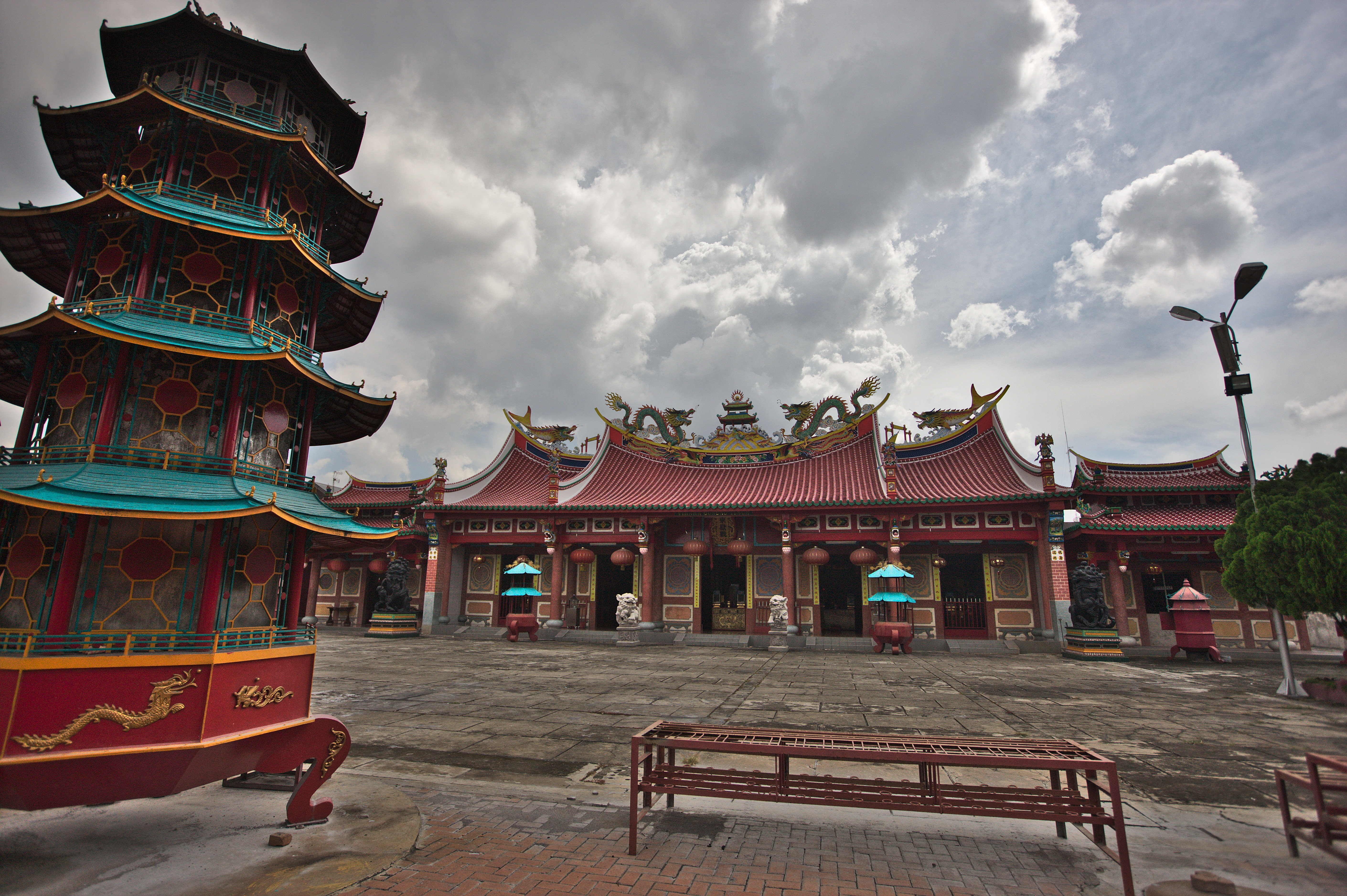
Gunung Timur Temple
Eighty gods live under one roof on Jalan Hang Tuah. The Gunung Timur Temple -- Medan's largest Chinese temple and possibly the biggest on all of Sumatra -- houses Taoist immortals alongside Buddhist bodhisattvas in a sprawling riverside compound that smells of sandalwood incense year-round. Built in the early 1960s on steep ground beside the Babura River, it was a joint venture between the city's Taoist and Buddhist communities, a collaboration that still defines the place. The temple is dedicated to Dongyue Dadi, the Great Emperor of the Eastern Peak, but the spiritual census here runs far deeper than any single deity.
Where the River Brings Fortune
The temple's orientation is deliberate. Its front entrance faces the Babura River, following the Chinese geomantic principle that flowing water carries prosperity toward a building. In the 1960s, the steep riverbank land seemed an unlikely site for a major temple, but the community saw exactly what feng shui prescribed: a place where energy gathered. Red and yellow dominate the facade -- colors the Chinese regard as auspicious -- while a pair of green dragons face each other across the roofline, a golden sun suspended between them. Giant dragon-headed fish rise behind them. At ground level, massive lion statues in black and white guard the entrance, their stone eyes fixed on anyone who approaches.
A Pantheon in Miniature
Step inside and the scale becomes apparent. Eighty statues of deities fill multiple altars throughout the complex, each representing a different figure from Buddhist and Taoist tradition. The main hall holds Shen Jing Ru and Shen Zai Zhu Sen Da at the fore, with Cen Cing Tien and Xian Shi Dian deeper within. A Buddhist altar features Maitreya Buddha alongside Guan Yin, the Goddess of Mercy. On the right side, Tua Pek Kong -- the God of Prosperity widely venerated in Southeast Asian Chinese communities -- sits accompanied by Tai Sui, the deity who governs fortune by year. Below them, Tiangou, the celestial dog, and the White Tiger flank Tudigong, the Earth God. The arrangement is not random. It maps a spiritual hierarchy where Buddhist compassion and Taoist cosmology coexist without contradiction.
Festival Days and Lion Dances
For most of the year, the temple serves its neighborhood quietly -- worshippers lighting incense, consulting altars, tending offerings. But during Chinese New Year, the Lantern Festival, and the Ghost Festival, the compound transforms. Lion dance troupes weave through the crowds while a massive drum near the prayer room thunders out rhythms that carry across the Babura. The paved courtyard fills with families. Incense smoke thickens until the air turns hazy. These festivals draw Medan's Chinese community from across the city, and the temple's scale suddenly makes sense: the large main hall, the wide courtyard, even the two covered badminton courts that occupy part of the grounds were designed to hold a community at full celebration.
Medan's Multifaith Corridor
What makes Gunung Timur remarkable is not just its size but its neighbors. Walk 500 meters down the street and you reach the Sri Mariamman Temple, the oldest Hindu temple in Medan, with its South Indian gopuram tower rising over Kampung Madras. Nearby stands the Masjid Agung, a major mosque. This stretch of central Medan compresses three of the world's great religious traditions into a few city blocks -- Chinese Buddhist-Taoist, Hindu Tamil, and Islamic Malay -- each with its own architecture, calendar of festivals, and devoted community. The temple stands as one piece of a larger story about Medan itself: a city shaped by trade routes that brought Chinese, Indian, Malay, and Dutch influences together on the northeast coast of Sumatra, producing a layered urban culture unlike anywhere else on the island.
From the Air
Located at 3.578N, 98.668E on the banks of the Babura River in central Medan, North Sumatra. The temple's red-and-yellow compound is visible among the dense urban fabric. Nearest major airport is Kualanamu International Airport (WIMM), approximately 38 km southeast. Approach from the northeast for views along the river corridor. At low altitude, the green dragon roofline ornamentation is distinctive. The Sri Mariamman Temple is roughly 500 meters to the northwest.