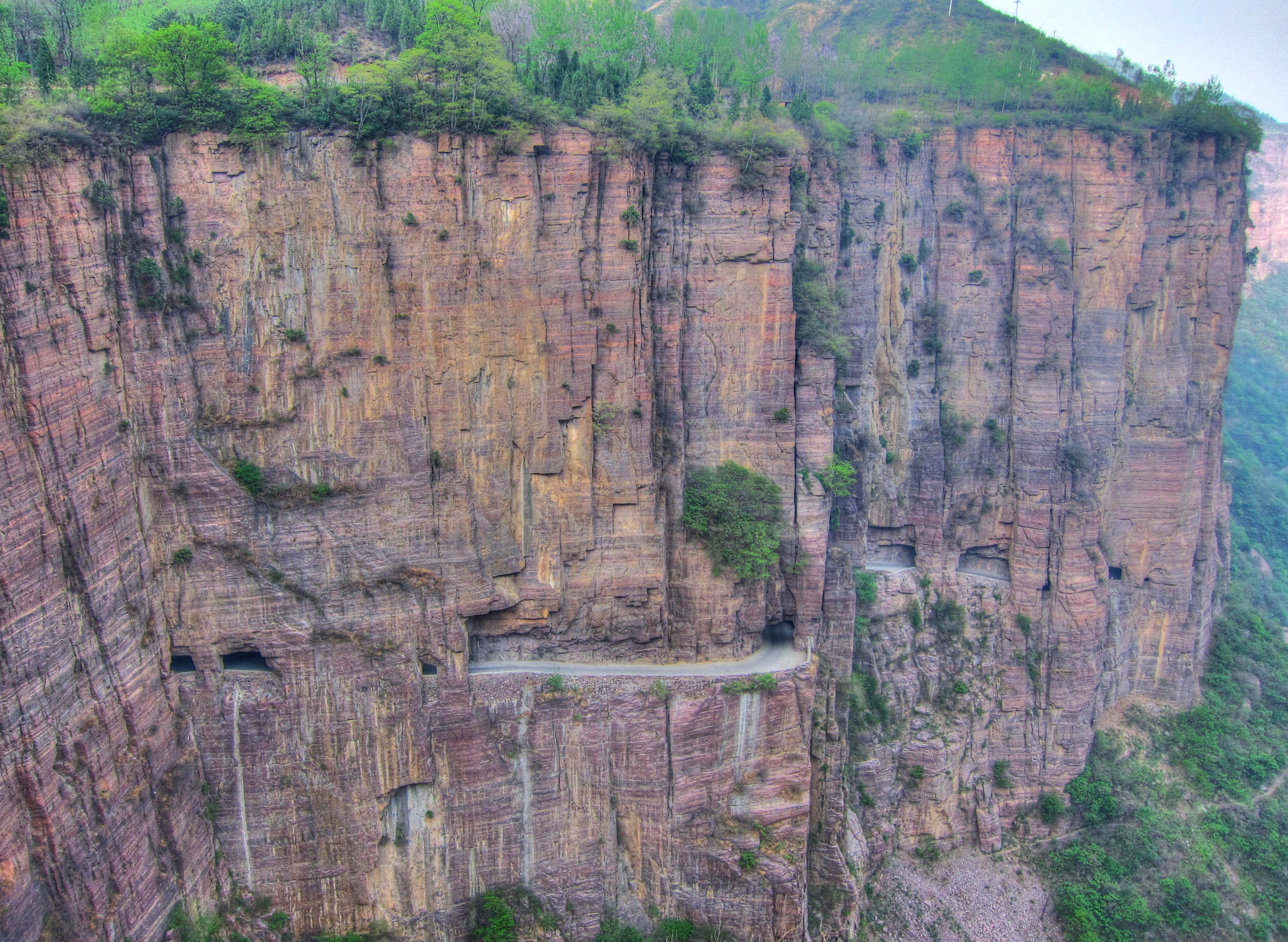
Guoliang Tunnel
Thirteen villagers started with hammers and chisels. One of them died during the work. Five years later, they had carved a road through solid rock. The Guoliang Tunnel, a 1.2-kilometer passage punched through the cliff face of the Taihang Mountains in Henan Province, stands as one of the most remarkable feats of hand-built engineering in modern China. No power tools, no government funding at the outset, no engineering degrees. Just a community that decided isolation was no longer acceptable and attacked a mountain with hand tools until it yielded.
A Village Above the Clouds
Guoliang Village sits high on the Taihang Mountains near Huixian in Xinxiang, Henan Province, perched on cliffs so steep that the settlement was virtually cut off from the outside world. Before the tunnel, the only access was a treacherous path carved into the mountainside, a route so narrow and exposed that livestock could barely be led along it. The village takes its name from a fugitive rebel of the Han dynasty who fought an imperial army to a standstill by exploiting exactly this terrain. The cliffs that once sheltered a guerrilla fighter now imprisoned a farming community, limiting trade, medical access, and any contact with the plains below.
The Impossible Road
In the early 1970s, the villagers decided to build their own road out. They sold their livestock to raise money for tools and materials. Thirteen men and women formed the core work crew, and they began chipping away at the cliff face, boring into the mountain from the outside. Without dynamite or machinery, progress was agonizingly slow. At the most difficult stretches, they advanced just one meter every three days. The tunnel they carved is 5 meters tall and 4 meters wide, enough for a single vehicle to pass through. Along its 1.2-kilometer length, they left openings in the cliff wall that serve as windows, letting light filter into the passage and offering glimpses of the valley hundreds of meters below.
Daylight at Last
The tunnel opened to traffic on May 1, 1977. After years of chipping through sandstone and limestone, the villagers had connected their mountaintop home to the road network in the valley. The cost was more than physical labor. One worker died during construction, and the effort consumed the savings and youth of a generation. But the tunnel transformed Guoliang overnight. What had been a place defined by its inaccessibility became accessible, and the very feature that had made life so difficult, the sheer cliff face, became an attraction.
From Isolation to Destination
Today the Guoliang Tunnel is one of the most visited engineering curiosities in China. Driving through it is a visceral experience: the rough-hewn walls bear the marks of individual chisel strikes, and the windows cut into the cliff face frame vertiginous drops to the valley floor. The road has appeared in several films and has been featured in travel guides alongside the world's most dramatic highways. The village itself has adapted to tourism, with guesthouses and restaurants serving visitors who come to marvel at what determined hands accomplished. It is often compared to Bolivia's Yungas Road for its combination of stunning scenery and sheer drop-offs, though the Guoliang Tunnel carries an additional weight. It was built not by a government, but by the people who needed it most.
From the Air
Guoliang Tunnel is located at 35.73°N, 113.60°E in the Taihang Mountains near Huixian, Xinxiang, Henan Province. From altitude, the Taihang escarpment is clearly visible as a dramatic cliff line running roughly north-south. The tunnel appears as a thin line carved into the cliff face. Nearest major airport is Zhengzhou Xinzheng International (ZHCC/CGO), about 140 km south. Recommended viewing altitude: 3,000-5,000 feet AGL. Terrain is rugged with sheer cliffs; maintain safe clearance.