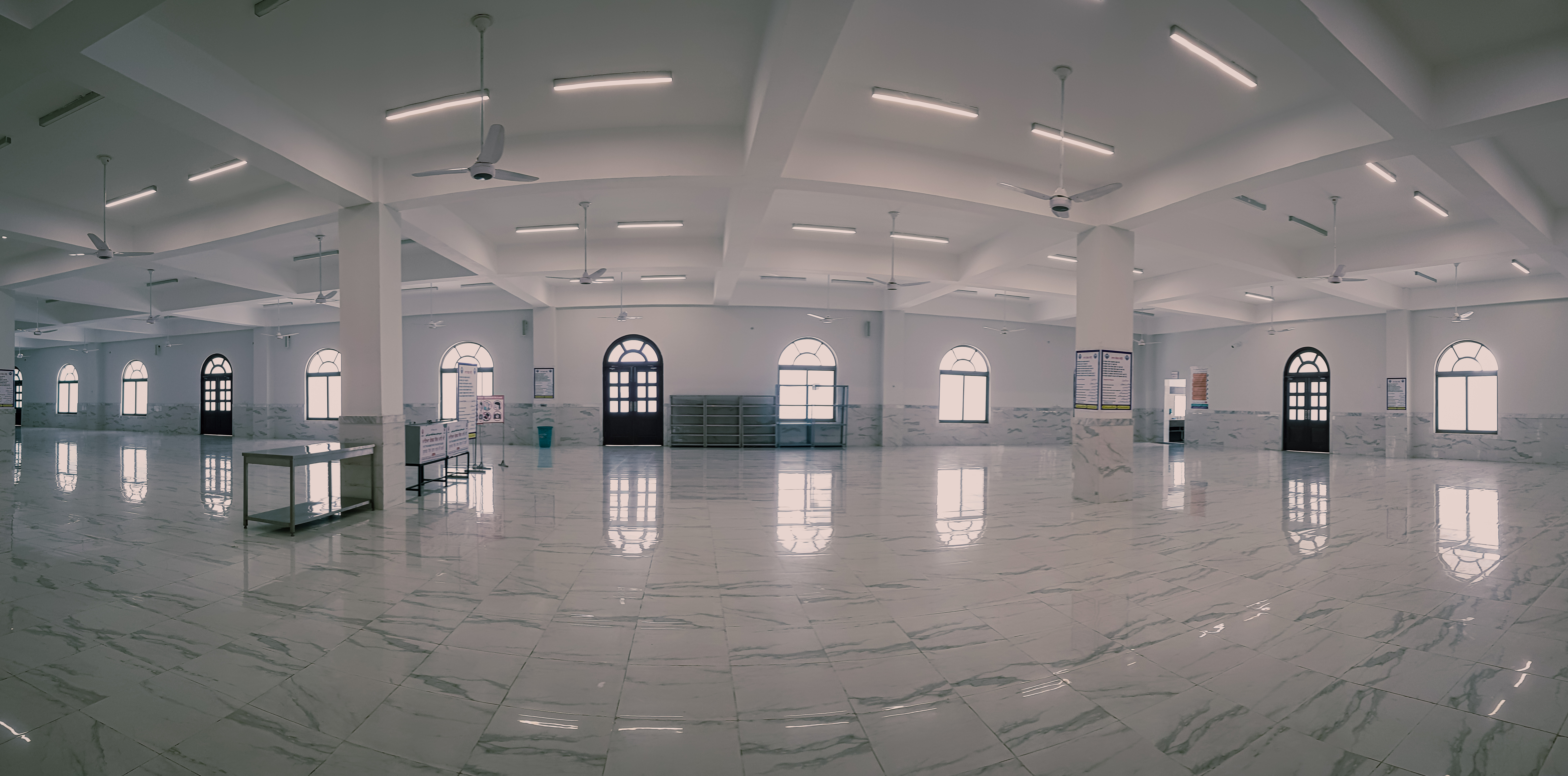
Gurdwara Darbar Sahib Kartarpur
For decades, Sikh pilgrims gathered at the Indian border and squinted across the flatlands of Punjab toward a white dome they could see but never reach. The Gurdwara Darbar Sahib at Kartarpur -- built on the site where Guru Nanak, the founder of Sikhism, spent the final 18 years of his life -- sat just three kilometers inside Pakistan, close enough to glimpse through binoculars but separated by one of the world's most heavily fortified borders. Then, on 9 November 2019, the anniversary of the fall of the Berlin Wall, a corridor opened between the two countries, and the first group of 550 pilgrims walked across.
Where the Founder Put Down the Walking Stick
Guru Nanak was a wanderer. His missionary journeys, called udasis, carried him to Haridwar, Mecca, Medina, Baghdad, Kashmir, and Nepal. But in 1504, he chose a spot along the Ravi River in Punjab and stopped moving. He founded the town of Kartarpur, plowed fields, and established a langar -- a community kitchen where anyone, regardless of caste or faith, could eat together. For 18 years, until his death on 22 September 1539, Nanak lived here, teaching the three principles that would become the bedrock of Sikhism: Kirat Karo (earn an honest living), Naam Japo (remember the divine), and Vand Chako (share what you have with others). The gurdwara stands where Guru Nanak is believed to have died. According to tradition, after his passing, Hindus and Muslims both claimed his body. The dispute was resolved by dividing his chadar -- his shawl -- with the Muslims burying their portion and the Hindus cremating theirs.
A Temple Divided by Borders
When the Partition of 1947 drew a line through Punjab, Kartarpur ended up in Pakistan while the vast majority of the world's Sikhs lived in India. The gurdwara -- one of Sikhism's holiest sites, alongside the Golden Temple in Amritsar and Gurdwara Janam Asthan in Nankana Sahib -- became almost inaccessible. Indian Sikhs gathered at Dera Baba Nanak on their side of the border on holy days, performing darshan -- sacred viewing -- from a distance. The shrine reportedly houses the last copies of the original Guru Granth Sahib, Sikhism's central scripture. The main shrine building was constructed in 1925, funded by Sardar Bhupindar Singh, the Maharaja of Patiala, at a cost of 1,35,600 rupees. Pakistan's government repaired it in 1995 and fully restored it in 2004, but physical access for Indian pilgrims remained a political impossibility for most of the next seven decades.
Twenty Years of Almost
The idea of a visa-free corridor surfaced as early as 1999, when Indian Prime Minister Atal Bihari Vajpayee made his historic bus journey to Lahore. Pakistani President Pervez Musharraf endorsed the concept in 2000 and issued tenders for construction. Then the plan stalled -- caught in the perpetual friction of India-Pakistan relations. For years, the corridor existed only as a persistent Sikh community demand and a diplomatic football. In May 2017, Indian parliamentary committee members declared the project dead, suggesting that the government might instead install binoculars at Dera Baba Nanak so pilgrims could get a slightly better look at what they could not visit. Pakistan broke the impasse unilaterally in September 2018, announcing it would open the corridor before Guru Nanak's 550th birth anniversary, allowing up to 5,000 Indian Sikhs per day to cross visa-free.
The Corridor Opens
The inauguration on 9 November 2019 was heavy with symbolism. Indian Prime Minister Narendra Modi flagged off the first jatha -- a group of more than 550 pilgrims -- and handed its ceremonial flag to the Jathedar of Akal Takht, Giani Harpreet Singh. On the Pakistani side, Prime Minister Imran Khan received the pilgrims and unveiled the corridor by releasing a curtain lifted by hot air balloons to reveal a giant kirpan, the Sikh ceremonial dagger. Former Indian Prime Minister Manmohan Singh read poetry about Guru Nanak from Muhammad Iqbal's Bang-e-Dara, the great Urdu poet's collection. The United Nations and the United States Department of State both welcomed the opening. That the date coincided with the anniversary of the Berlin Wall's fall was no accident -- Pakistan had chosen it deliberately, framing the corridor as its own gesture of walls coming down.
Kartarpur Today
The gurdwara complex now spans 42 acres, expanded in 2018 with a new courtyard, museum, library, dormitories, and locker rooms. It is claimed to be the largest gurdwara in the world. The agricultural fields where Guru Nanak once plowed still surround the complex, and a well attributed to him -- Baba Nanak's Well, with its old Persian wheel -- remains a pilgrimage point within the grounds. A US-based organization called EcoSikh has proposed creating a 100-acre sacred forest around the shrine. For the pilgrims who walk the Kartarpur Corridor today, the experience condenses five centuries into a few hundred meters: a modern border crossing that delivers them to the place where Sikhism's founder taught that honest labor, divine remembrance, and generosity were all one needed to live a worthy life. Every step, as one pilgrim put it, reminds them of the Guru's life.
From the Air
Located at 32.09N, 75.02E in Narowal District, Punjab, Pakistan, just 3 km from the India-Pakistan border. The white-domed gurdwara complex is prominent from the air, surrounded by green agricultural fields along the Ravi River floodplain. The Kartarpur Corridor connecting to Dera Baba Nanak on the Indian side is visible as a road cutting straight to the border. Nearest airports: Sialkot International Airport (ICAO: OPST) approximately 70 km south; Sri Guru Ram Dass Jee International Airport, Amritsar (ICAO: VIAR) approximately 55 km southeast across the border. Best viewed at 3,000-5,000 feet AGL. The India-Pakistan border fencing is clearly visible from above.