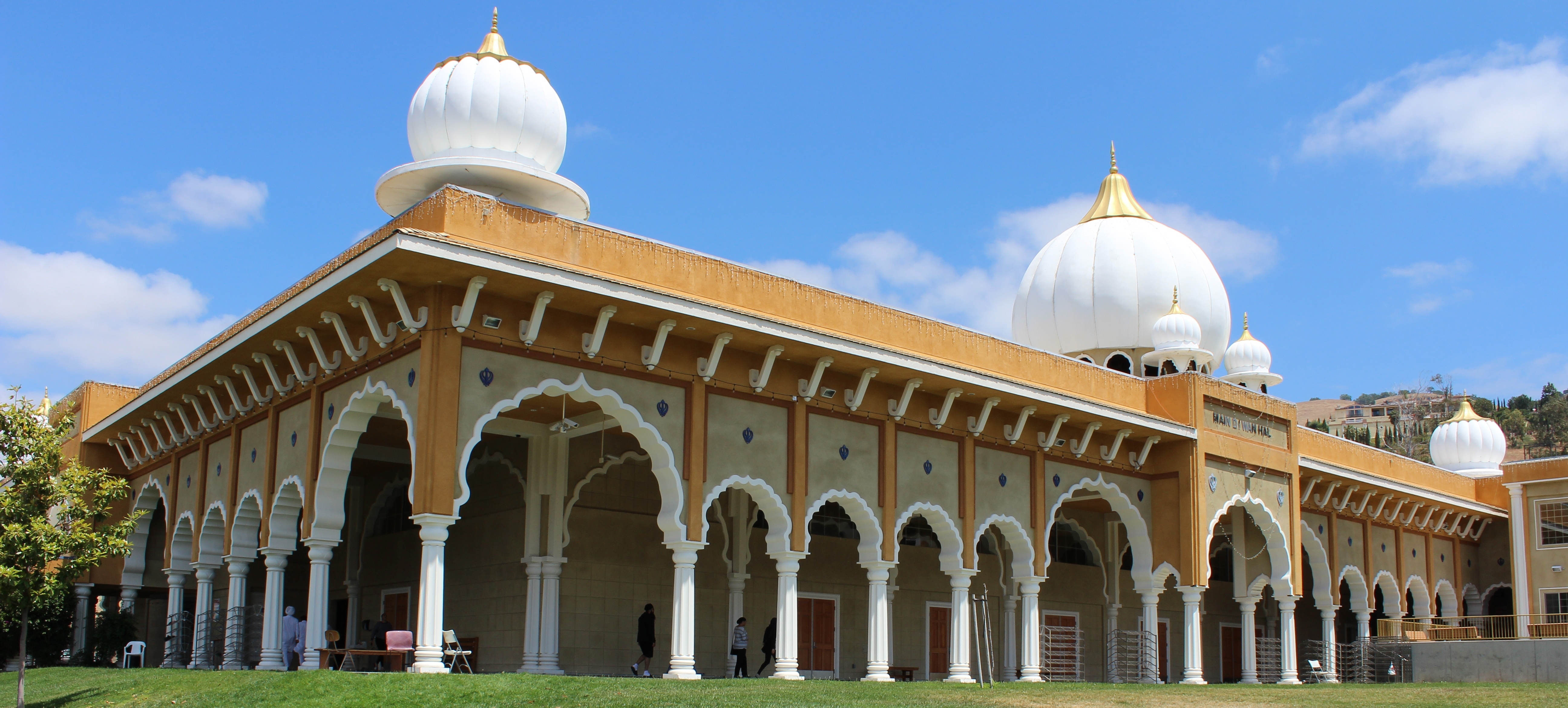
Gurdwara Sahib of San Jose
Every Sunday morning, ten thousand people sit cross-legged on the floor of a single room in east San Jose. They remove their shoes at the door, cover their heads, and listen to hymns sung in Punjabi over a sound system that carries across a prayer hall larger than most concert venues. The Gurdwara Sahib of San Jose is not just the largest Sikh house of worship in North America. At 90,000 square feet, it holds a claim no other gurdwara outside India can match: it is the largest in the world beyond the faith's homeland.
From a Rented Room to Sacred Ground
Silicon Valley's Sikh community traces its organized worship to 1984, when community leaders pooled resources to rent a community center for prayer services. The congregation outgrew that space quickly and purchased a small building in east San Jose. But ambition outpaced the building. By 1995, the community had acquired land nearby for a purpose-built gurdwara, only to discover that construction costs within city limits were prohibitive. They sold the parcel and bought a larger property further east, in the Evergreen district, where the foothills of the Diablo Range begin their gentle climb. The first phase opened in 2004 with nearly 20,000 square feet of worship space. It was a beginning, not a destination.
A Cathedral Built by Community
The late architect Malkiat Singh Sidhu designed the gurdwara's second phase, which was completed in April 2011. The expansion brought the complex to 90,000 square feet, a scale that reshapes the surrounding landscape. White marble domes and golden pinnacles rise above the suburban hills, visible for miles along the eastern ridgeline of the Santa Clara Valley. On opening day, an estimated 20,000 people arrived to see what their community had built. The main Diwan Hall, where the Guru Granth Sahib is installed, accommodates the weekly congregation of ten thousand. The scale is intentional. In Sikh tradition, the gurdwara is open to everyone regardless of faith, caste, or background, and the building's size is a physical expression of that welcome.
The Kitchen That Never Closes
Beneath the prayer hall lies a kitchen and dining facility that embodies langar, one of Sikhism's most distinctive practices. Langar is the communal meal served free to all visitors, a tradition established by Guru Nanak in the fifteenth century to dissolve barriers of caste and class. At the San Jose Gurdwara, volunteers prepare and serve thousands of vegetarian meals every Sunday. Everyone sits together on the floor, side by side, whether they are tech executives from nearby Apple and Google campuses or first-generation immigrants still learning English. The kitchen operates with the precision of a large-scale catering operation, yet every hand stirring dal or rolling roti belongs to a volunteer. No one is paid. No one is turned away.
A School on the Sabbath
The gurdwara's school wing transforms every Sunday into a campus for roughly 700 students learning Punjabi, kirtan (devotional music), and gurbani (scriptural recitation). For children growing up in the English-dominant environment of Silicon Valley, these classes represent a lifeline to their heritage. Students learn to read Gurmukhi script, the alphabet of the Guru Granth Sahib, and to play the harmonium and tabla that accompany kirtan. Basketball courts on the grounds give teenagers a reason to linger after class. A free health clinic on-site serves community members who might otherwise go without care. The gurdwara functions less as a single-purpose temple and more as a self-contained village, providing worship, education, food, recreation, and healthcare under one sprawling roof.
Faith and Silicon
The gurdwara's presence in the Evergreen district reflects a larger story about Sikh immigration to the Bay Area. The community grew rapidly in the 1980s and 1990s as engineers and entrepreneurs arrived to work in the technology industry that was remaking the Santa Clara Valley into Silicon Valley. Many came from Punjab's strong engineering tradition, finding work at the semiconductor and software companies clustered between San Jose and Palo Alto. The gurdwara became both a spiritual anchor and a social hub, the place where new arrivals found their footing and established families found continuity. Its white domes now stand as one of the most recognizable landmarks on San Jose's eastern skyline, a testament to what a community can build when faith and determination share the same foundation.
From the Air
Located at 37.326N, 121.767W in the Evergreen district of east San Jose, California. The gurdwara's white marble domes and golden pinnacles are distinctive from the air, rising prominently above the surrounding suburban development at the base of the eastern foothills. Nearest airports: Reid-Hillview (KRHV, 4nm W), San Jose International (KSJC, 8nm NW). Best viewed at 2,000-3,000 feet AGL approaching from the west, where the complex stands out against the brown-green hills of the Diablo Range foothills.