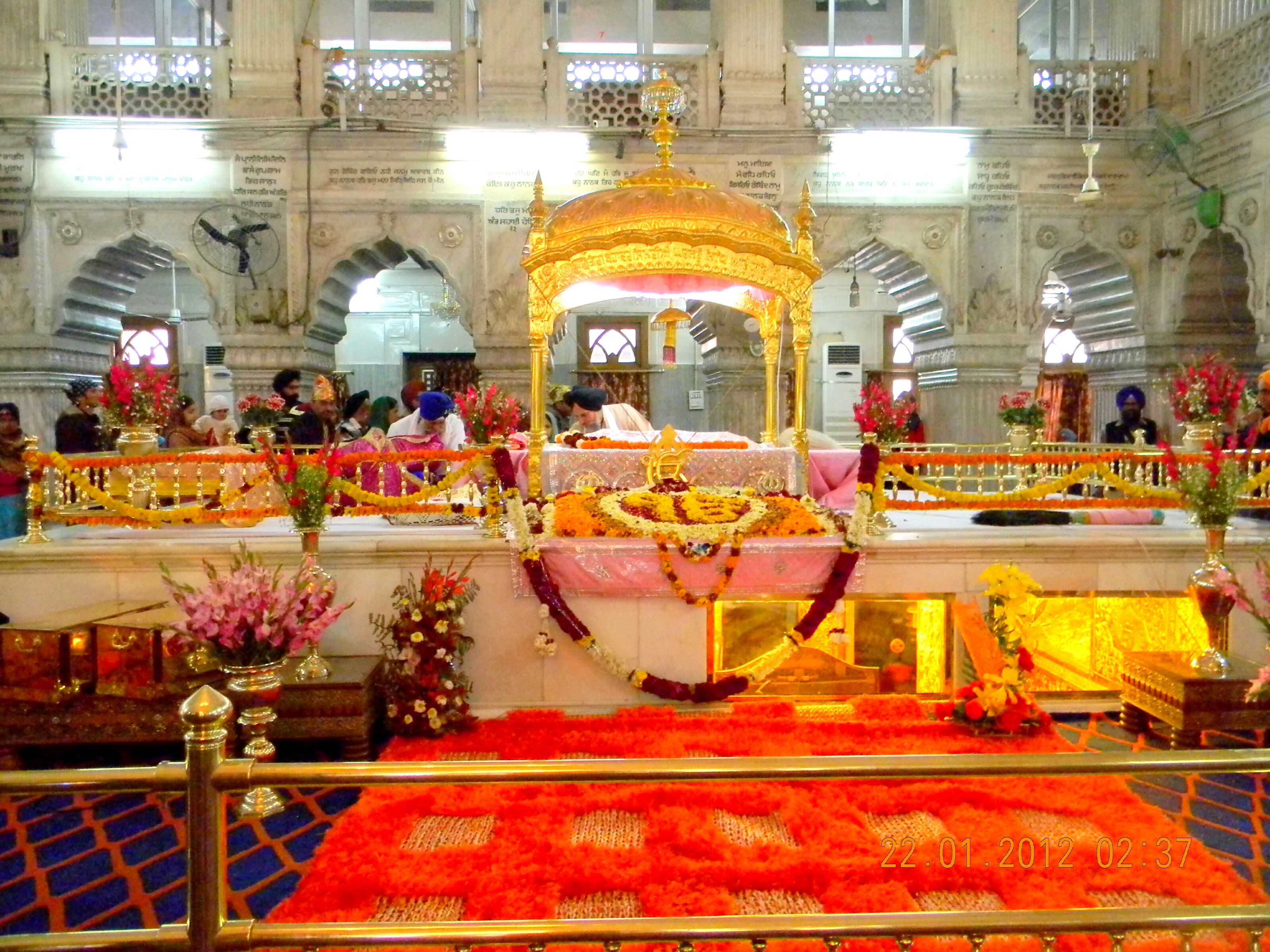
Gurdwara Sis Ganj Sahib
Every Republic Day, as India's military regiments parade down Kartavya Path, the Sikh regiment does something no other unit does: it salutes twice. The first salute is not for the president of India but for a white-domed gurdwara on the crowded main street of Old Delhi. Gurdwara Sis Ganj Sahib stands on the exact spot where the Mughal emperor Aurangzeb ordered the beheading of Guru Tegh Bahadur, the ninth Sikh Guru, on 11 November 1675. The tradition of the double salute has continued since 1979, and it speaks to something central about this place -- that the memory of one man's refusal to submit has outlasted the empire that killed him.
The Ninth Guru's Sacrifice
Guru Tegh Bahadur's execution was a political act dressed in religious authority. Aurangzeb, who had consolidated Mughal power through ruthless efficiency, demanded the conversion of Kashmiri Hindus to Islam. The Guru intervened on their behalf, traveling to Delhi to confront the emperor directly. He was arrested, imprisoned in the kotwali -- the Mughal police station and jail that stood on this very ground in Chandni Chowk -- and given a choice: convert or die. He chose death. The beheading took place in public, a display meant to intimidate. Instead, it galvanized Sikh identity. The word "Sis" in the gurdwara's name means "head" in Hindi and Punjabi, a name that refuses to let the act be forgotten or softened. After the execution, a disciple named Bhai Jaita retrieved the Guru's severed head and carried it to Anandpur Sahib in Punjab, a journey of several hundred kilometers undertaken in secret and at enormous personal risk.
From Kotwali to Gurdwara
For more than a century after the execution, the site remained a Mughal police station. The transformation began in 1783, when the Sikh military commander Baghel Singh marched into Delhi with a substantial force. Rather than sacking the Mughal capital, he negotiated. Baghel Singh occupied the Diwan-i-Am at the Red Fort and struck a deal with the weakened Mughal emperor Shah Alam II: the Sikhs would receive 37.5 percent of all octroi duties collected in the capital, and in exchange, Baghel Singh would be permitted to build gurdwaras on sites sacred to Sikh history. The shrine he erected at the execution site of Guru Tegh Bahadur was modest -- a small memorial rather than the grand structure that stands today. It marked the ground, and that was enough.
Rebellion, Empire, and Reconstruction
The gurdwara's expansion came through the upheavals of colonial history. During the Indian Rebellion of 1857, Delhi was a battleground, and the old Mughal kotwali was demolished in the British reprisals that followed. The land was granted to the Sikhs -- a reward for the military support the maharaja of Patiala and other Sikh leaders had provided to the British during the conflict. The current building, with its white marble domes rising above the chaotic storefronts of Chandni Chowk, was constructed by Rai Bahadur Narain Singh, a contractor who built many of the roads in Edwin Lutyens's New Delhi. The structure grew through successive renovations, probably expanding significantly after Partition in 1947, when Delhi's Sikh community swelled with refugees from what had become Pakistan.
Chandni Chowk's Living Heart
Approaching Gurdwara Sis Ganj Sahib today means navigating one of the most sensory-dense streets in India. Chandni Chowk -- the "Moonlit Crossroads" -- is a seventeenth-century Mughal boulevard that has become a warren of electronics shops, spice merchants, and food stalls, all pressed together under a tangle of electrical wires. The gurdwara's white facade and golden pinnacles rise above the commercial chaos like a different world asserting itself. Inside, the prayer hall is open to all visitors regardless of faith, following the Sikh principle of universal welcome. The Guru Granth Sahib, the Sikh holy scripture, rests in a palki at the center of the Darbar Sahib. Photographs from as early as January 1903, taken by the British traveler Gertrude Bell, show ceremonies at the gurdwara that look remarkably similar to those held today -- the continuity of devotion spanning more than a century of upheaval, partition, and transformation.
Memory as Resistance
Gurdwara Sis Ganj Sahib is one of nine historical gurdwaras in Delhi, each marking a specific moment in Sikh history. Its companion site, Gurdwara Rakab Ganj Sahib near the Indian Parliament, marks the place where Guru Tegh Bahadur's body was cremated by another follower, Lakhi Shah Vanjara, who burned his own home to create the funeral pyre. Together, the two gurdwaras bracket the story of the Guru's martyrdom across Delhi's geography. That Aurangzeb's empire is gone while these places of worship thrive is a point the faithful do not miss. The double salute on Republic Day, the daily prayers, the free meals served to thousands in the langar -- all of it says the same thing the Guru's sacrifice said in 1675: power that demands submission is temporary, but the willingness to die for conscience endures.
From the Air
Gurdwara Sis Ganj Sahib sits at 28.6558N, 77.2325E on Chandni Chowk in Old Delhi. Its white marble domes and golden pinnacles are visible among the dense urban fabric of Old Delhi. The gurdwara is located approximately 500 meters west-southwest of the Red Fort, which serves as the primary visual landmark for locating it from the air. The Jama Masjid, one of India's largest mosques, lies roughly 400 meters to the south. Nearest airport is Indira Gandhi International Airport (VIDP), approximately 16 km to the southwest. Best viewed at 2,000-4,000 feet AGL. The tight cluster of Old Delhi's historical and religious sites -- Red Fort, Jama Masjid, and multiple gurdwaras -- is distinctive from altitude.