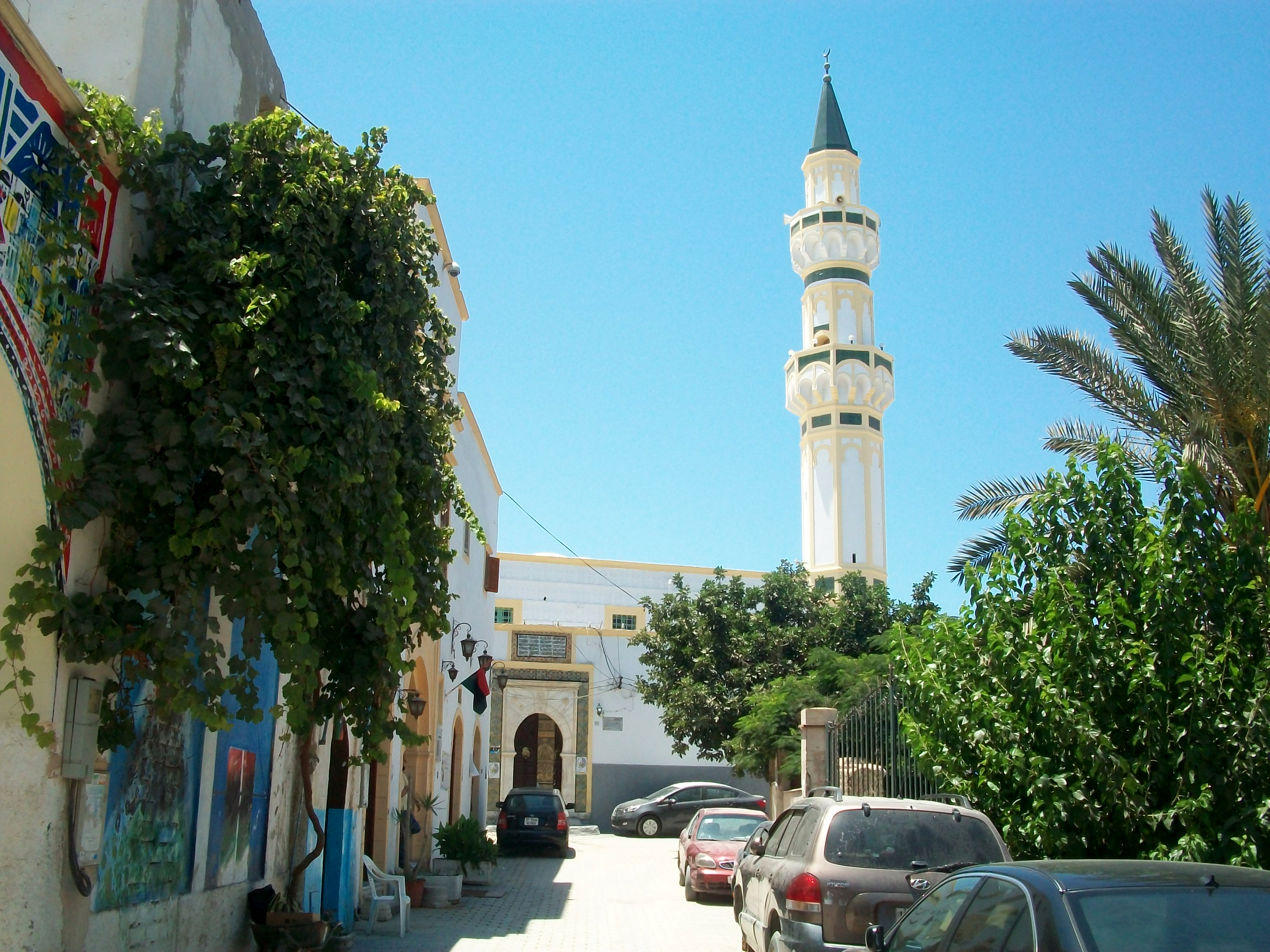
Gurgi Mosque
Fifteen domes crown a building that should not exist in a single architectural tradition. The Gurgi Mosque, tucked into the Bab al-Bahr district of old Tripoli, sits so close to the Mediterranean that salt air mingles with the scent of aged marble in its courtyard. Commissioned in 1834 by Mustafa Gurgi during the twilight years of Ottoman rule under Pasha Yusuf Karamanli, the mosque became something rare in North Africa: a deliberate collision of European and Islamic geometry, assembled not as compromise but as statement.
Where Civilizations Merge in Stone
Step inside the Gurgi Mosque and the eye has nowhere to rest. Walls of natural marble give way to floors of multicolored tile, each surface competing for attention without ever clashing. The columns are European in proportion but Islamic in decoration, and the arched entryways carry floral engravings that echo Andalusian gardens rather than Ottoman austerity. Quranic passages line the walls in Andalusian script, a calligraphic tradition that traveled across the Mediterranean from Islamic Spain centuries before Mustafa Gurgi laid his foundation stone. Geometric forms, plant motifs, and flower patterns cover nearly every available surface, creating an interior that feels less like a place of quiet prayer than a catalogue of Mediterranean artistic traditions condensed into a single room.
The Green Marble Minaret
Rising above the medina's roofline, the minaret announces itself with two balconies crafted from genuine green marble, a material that had to be sourced and transported at considerable expense. The tower serves its practical purpose of calling the faithful to prayer, but it also served as Mustafa Gurgi's declaration of ambition. The prayer hall below matches that ambition with towering marble columns that draw the gaze upward toward those fifteen domes, each decorated individually. Like the nearby Ahmed Pasha Karamanli Mosque, the Gurgi complex follows the Ottoman triple-block plan: mosque, tomb, and school, three functions unified under one architectural vision. Two entrances give access to the complex, one opening west onto Al-Akwash Street, the other through a narrow alley on the northern side, a passage that drops visitors from the bustle of the medina into sudden quiet.
A Patron and His Resting Place
Mustafa Gurgi never left his creation. To the right of the main entrance, an antechamber houses the tombs of Gurgi and his family, following the Ottoman tradition of binding a founder's legacy to the building itself. The courtyard beyond holds the mausoleum alongside other facilities typical of Ottoman mosque complexes. In death as in life, Gurgi remains part of the daily rhythm of the place he built. The school that once operated within the complex educated generations of Tripoli's youth, making the Gurgi Mosque not merely a house of worship but a center of community life in the medina, a role it shared with its architectural cousin, the Karamanli Mosque, just a short walk through the old city's narrow lanes.
At the Crossroads of the Medina
The mosque's location is no accident. Bab al-Bahr, the district along the sea, placed Gurgi's creation at the intersection of trade and faith. A short walk brings visitors to the Arch of Marcus Aurelius, a Roman monument from the 2nd century AD that reminds anyone passing through just how many civilizations have layered themselves onto this particular strip of coastline. Phoenicians, Romans, Byzantines, Arabs, Ottomans, and Italians all left their mark on the ground beneath these fifteen domes. The Gurgi Mosque, built when Ottoman authority in Tripoli was already fraying, captured that accumulated history in its walls, pulling Andalusian calligraphy, European marble-working, and Islamic geometric patterns into a single building that tourists still come to photograph nearly two centuries later.
From the Air
Located at 32.90N, 13.18E in Tripoli's old city medina, on the Mediterranean coast of Libya. The medina district is visible along the waterfront. Nearest major airport is Mitiga International Airport (HLLM), approximately 8 km east. Recommended viewing altitude 2,000-3,000 ft to see the medina layout and proximity to the sea. The Roman Arch of Marcus Aurelius is a nearby landmark.