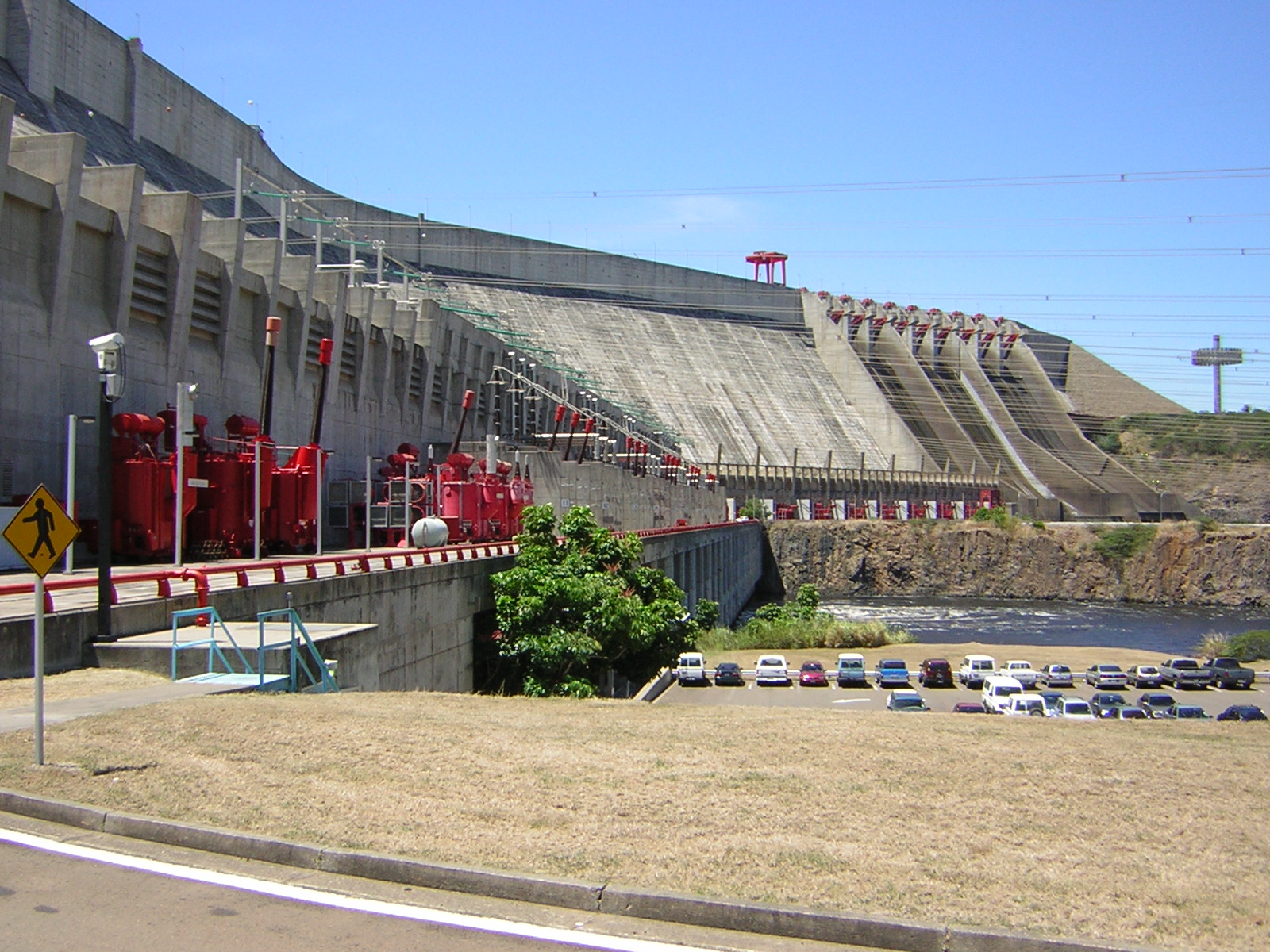
Guri Dam
From space, the reservoir behind Guri Dam looks like an inland sea dropped into the Venezuelan jungle -- 4,250 square kilometers of dark water stretching south from the Caroni River toward the Guiana Highlands. The dam itself, officially named the Simon Bolivar Hydroelectric Plant, generates roughly 74 percent of Venezuela's electricity. When it works, the country has power. When it falters, cities go dark from Caracas to the Colombian border.
Canyon of Ambition
The story of Guri begins in 1961, when the Harza Engineering Company conducted feasibility studies for a dam in the Necuima Canyon, about 100 kilometers upstream from where the Caroni meets the Orinoco. An international consortium of six firms won the construction contract, including four American companies participating under the Alliance for Progress -- John F. Kennedy's Cold War-era program to modernize Latin America. Construction started in 1963, and by 1969 the first phase was complete: a dam 106 meters high and 690 meters long, impounding Venezuela's largest freshwater body and producing 1,750 megawatts of power. The reservoir's water level sits at 215 meters above sea level, creating one of the largest man-made blackwater lakes ever built.
Bigger, Then Biggest
Venezuela's electricity demand grew so rapidly that by 1976, a second construction phase was already underway. Engineers added a gravity dam section, another spillway channel, and a second powerhouse containing ten turbines rated at 725 megawatts each. The reservoir's capacity swelled to 138 billion cubic meters. For a time, the completed Guri Dam held the title of the world's most powerful hydroelectric plant, surpassing Grand Coulee Dam in Washington State. It would eventually be overtaken by the Itaipu Dam on the Brazil-Paraguay border, but Guri remained a point of national pride -- proof that Venezuela could build on a scale to rival any industrial nation. The dam's name itself reflected shifting political tides: originally the Raul Leoni Hydroelectric Plant (named for the president who launched it), it was renamed for Simon Bolivar in 2000.
When the Water Drops
The decision to make an entire nation dependent on a single river system carried risks that decades of prosperity obscured. Government policy dating back to the 1960s deliberately minimized fossil fuel power generation in order to export as much oil as possible, leaving hydroelectric plants to shoulder the load. When drought struck in 2010, water levels behind Guri dropped to dangerous lows, and the government imposed rolling blackouts across the country. Officials told government employees to stay home on Fridays. President Maduro urged women to stop using hair dryers. Shopping malls had their electricity rationed, and three days were added to the 2016 Easter holiday to allow a week-long shutdown of public services and private businesses.
Darkness Falls
The most dramatic crisis came during a massive blackout that knocked out power across most of Venezuela. The key San Geronimo B substation, which distributes an estimated 80 percent of the country's electricity, failed completely. At least four attempts to restart it were unsuccessful, and no timeline for reactivation was announced. Government officials called it sabotage. Independent engineers and energy experts pointed to aging infrastructure and years of deferred maintenance as the more likely culprits. The blackout laid bare a paradox at the heart of Guri's story: a nation rich in both oil and water had built a system so centralized that a single point of failure could plunge millions of people into darkness.
The Giant in the Jungle
A refurbishment project has been underway since 2000, intended to extend Guri's operational life by 30 years through new turbine runners and rehabilitation of the original powerhouse units. Whether the investment can keep pace with the infrastructure's aging remains an open question. From the air, Guri is unmistakable: the dam wall stretches more than seven kilometers across the canyon, and the reservoir spreads across an area larger than the state of Rhode Island. The dark, tannin-stained waters of the Caroni give the lake its distinctive blackwater character, surrounded by unbroken rainforest. It is a monument to what hydroelectric engineering can achieve -- and a reminder that the systems we build are only as reliable as our commitment to maintaining them.
From the Air
Located at 7.77N, 63.00W in Bolivar State, Venezuela. The dam and reservoir are unmistakable from altitude -- the reservoir covers 4,250 sq km of dark blackwater stretching south into jungle. The dam wall is over 7 km long. The Caroni River flows north to meet the Orinoco near Ciudad Guayana. Nearest airport: Manuel Carlos Piar Guayana Airport (SVPR) in Puerto Ordaz, approximately 100 km downstream. Recommended viewing altitude: 15,000-25,000 feet to appreciate the reservoir's scale.