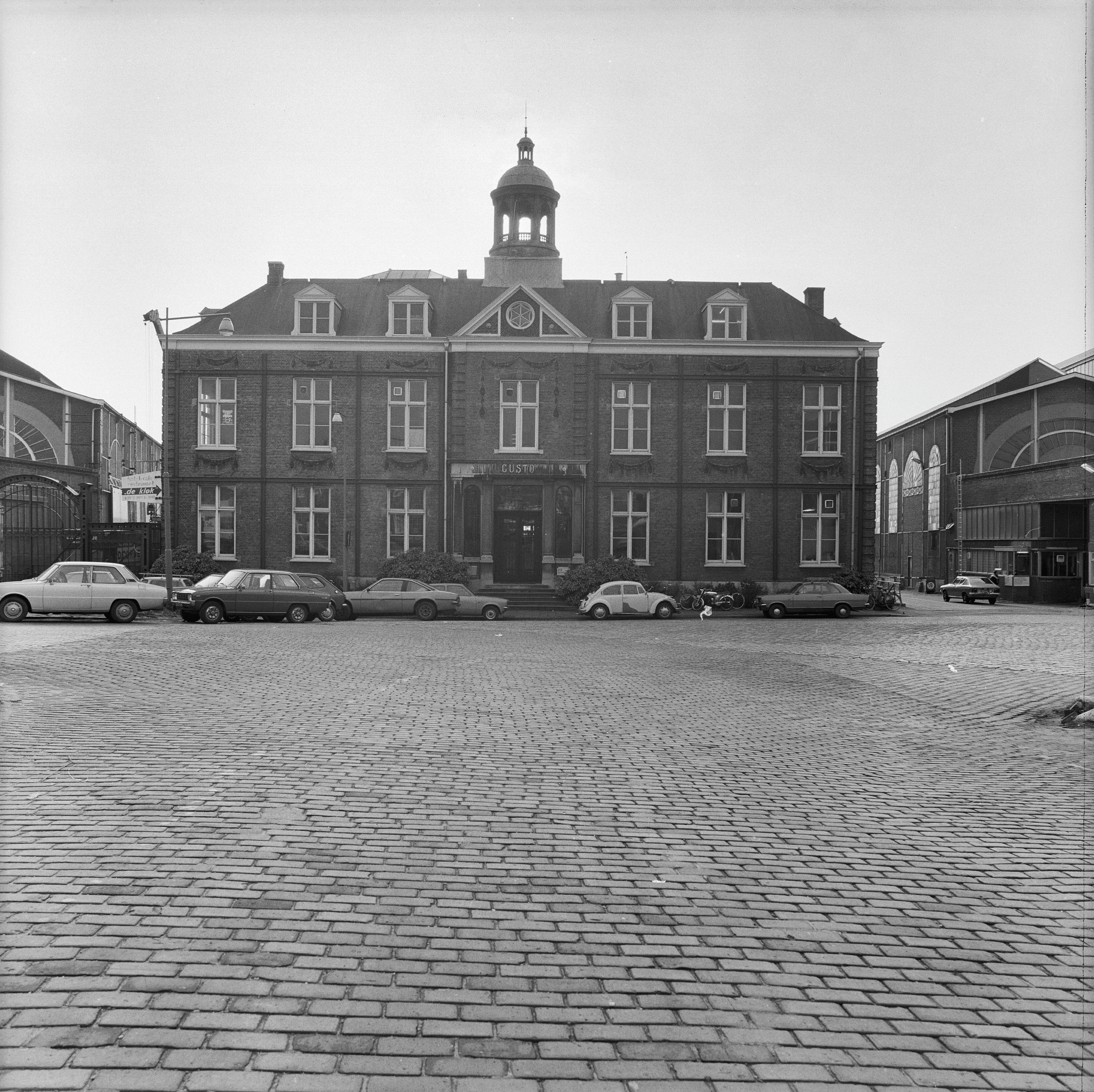
Gusto Shipyard
In 1958, Royal Dutch Shell faced a problem. The American firms Delong and LeTourneau held the patents on jackup oil rigs - those mobile platforms with telescoping legs that walk up out of the sea to perch above the waves while drilling. Their patents amounted to a monopoly, and Shell wanted out from under it. So Shell went to a shipyard in the small Dutch town of Schiedam, just downriver from Rotterdam, and asked: can you design us a jackup rig that doesn't infringe? The answer came back yes. The result, the Seashell delivered in 1959, was the first jackup rig ever built outside the United States. The yard that built it was Gusto. Within twenty years it had pioneered floating cranes, the first single-buoy mooring in the world, and the offshore industry's most innovative platforms. Twenty years after that, despite all of it, the yard was deliberately closed.
From a Margarine Machine to a Shipyard
The story begins in 1862 with A.F. Smulders - known to family as Guust - the son of a Tilburg miller who founded a small machine factory in 's-Hertogenbosch. An iron foundry followed in 1863, then a small shipyard in 1865. His younger brother Charles joined in 1867. By 1872 the brothers had bought the Utrecht iron foundry and machine factory for 60,000 guilders, where they began producing, among other things, the heavy machinery that made margarine - then a brand-new industrial product transforming European diets. In 1885 the Dutch contractor J.C. van Hattum ordered ten bucket-chain excavators from Smulders to dig the Panama Canal. By 1889 the firm employed 323 workers, an enormous workforce by Dutch industrial standards of the day. Two of Guust's sons, Henri and Frans, took over by 1900, and in 1901 made the decision that defined the rest of the story: they bought land for a shipyard on the Nieuwe Maas at Schiedam, where ships could reach the open sea without passing through a single bridge or lock.
The Schiedam Yard
The new shipyard opened on 1 June 1905, combining a shipbuilding hall with a machine factory under one operation. Five hundred workers transferred from Utrecht and another eight hundred from the older Slikkerveer yard, swelling Schiedam's economy and population in a single year. In 1911 the company was renamed Gusto - a combination of the founder's nickname Guust and his wife Catherina's nickname Cato. Schiedam built dredgers for ports being deepened around the world, floating cranes (first one in 1908), floating sheerlegs (first in 1910), and coal elevators that replaced the brutal manual labour of bunkering steamships with mechanical efficiency. During the Great Depression, bridge-building contracts kept the workforce employed. For the Dutch Navy, Gusto built torpedo boats and minesweepers; for the steel industry, the structures of the Koninklijke Hoogovens steel works at IJmuiden. By the time of the Second World War, Gusto had joined with other Dutch dredging-focused shipbuilders to form IHC Holland, a cooperative that shared patents while keeping each yard independent.
The Offshore Era
After 1945, the world's energy industry pivoted offshore. Gusto pivoted with it. The Seashell jackup in 1959 was first. In 1960 they built the world's first single-buoy mooring, an SBM - a floating offshore terminal that lets a tanker connect to a pipeline without coming alongside a quay. By 1966, the Ile de France rig was drilling off Senegal for the French company Foramer. By 1965, IHC's member yards had formally merged and Gusto was renamed IHC Gusto B.V., focused entirely on offshore. They were good at what they did. The problem was what came next.
The Suspicious Closure
In the 1970s the Dutch government convened a Beleidscommissie Scheepsbouw - a policy commission on shipbuilding - to rationalise an industry hit hard by the oil crisis. The commission was chaired by the head of Rijn-Schelde-Verolme, the country's largest shipbuilder, which had its own offshore ambitions through its subsidiary Rotterdamsche Droogdok Maatschappij. The commission placed Gusto, a medium-sized specialist in offshore platforms, into the category of "large shipbuilders of supertankers" - a category that, as it later became apparent, was about to collapse, because nobody was going to need many more supertankers for the foreseeable future. And so in 1978 Gusto Shipyard was closed. Its workers were transferred to Rijn-Schelde-Verolme. The conflict of interest was glaring; many in Schiedam never forgave it. The engineering office survived. It became Marine Structure Consultants, then merged in 2011 to form GustoMSC. In 2018, GustoMSC was acquired by the American oil-rig giant National Oilwell Varco, since renamed NOV Inc. The expertise that Smulders had cultivated for over a century was still in Schiedam, still designing offshore platforms, but the great hall on the Nieuwe Maas was gone.
From the Air
The site of the historic Gusto Shipyard is in Schiedam at approximately 51.91°N, 4.41°E, on the north bank of the Nieuwe Maas just west of central Rotterdam. From the air, Schiedam is recognisable by its surviving giant windmills (the tallest traditional windmills in the world) and its old shipyard basins along the river. Rotterdam The Hague Airport (EHRD) is about 4 km north-northeast. The Maasvlakte port complex stretches 35 km west toward the sea.