Guwenhua Jie
Every year on the twenty-third day of the third lunar month, the street fills with flowers. The festival marks the birthday of Mazu, the medieval Fujianese woman who was deified as goddess of the sea, and it has been celebrated here for centuries. Guwenhua Jie -- Tianjin's Ancient Culture Street -- is a pedestrian complex on the west bank of the Hai River that feels like a portal into the city's pre-modern past, even though the street itself only opened on New Year's Day 1986. What makes it authentic is not the reconstructed Qing dynasty storefronts but the temples at its heart, which have stood in various forms since the Yuan and Ming dynasties.
The Goddess at the Center
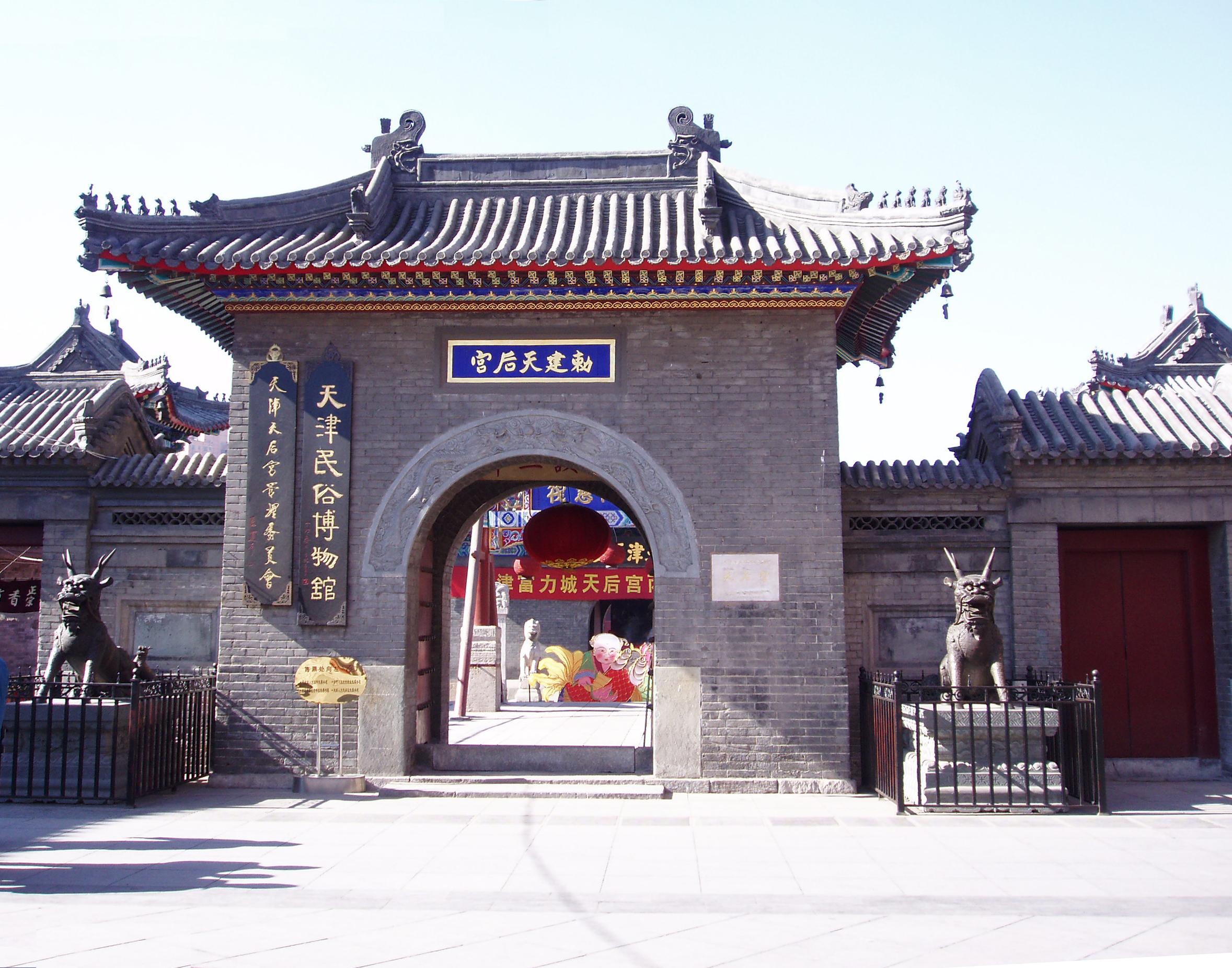
The Niangniang Palace -- also called the Tianhou Temple, the Queen of Heaven Palace, or half a dozen other names -- sits at the midpoint of the Ancient Culture Street. First constructed in 1326 under the Yuan dynasty, it is one of the three major surviving Mazu temples in China and one of the oldest. The complex faces east toward the Hai River, a deliberate orientation: Mazu was the protector of sailors, and the temple's primary purpose was to pray for safe navigation. From the Opera Tower at the eastern entrance to the Zhangxian Pavilion at the western end, the complex unfolds through a sequence of gates, halls, and pavilions that represent nearly seven centuries of continuous worship.
Where Sailors Came to Give Thanks
Tianjin was a port city long before the foreign concessions arrived, and the Niangniang Palace was where that maritime identity found its spiritual center. The temple served as a venue for marine sacrifice across multiple dynasties, a place where sailors gathered both for ceremonial rituals and for the simple pleasure of fellowship after long voyages. Performances were staged to thank the goddess for safe passage. The Main Hall sits on a high, wide platform typical of mid- to late-Ming dynasty wooden construction -- a building technique that signals both the temple's age and the importance its builders placed on elevation, as if lifting prayers closer to the divine.
The Oldest Survivor
A short walk from the Mazu temple stands the Yuhuangge Taoist Temple, built during the Hongwu period of the Ming dynasty in 1368. It is one of the oldest buildings remaining in all of Tianjin. Once the most prominent structure at the Hai River Triple Junction, the Yuhuangge anchors the street's claim to genuine antiquity. In 2007, archaeologists discovered an ancient government road from the Ming dynasty near the site, though large-scale excavation was not pursued for practical reasons. Historians believe that many more historical relics and sites may lie undiscovered around the temple, layered beneath centuries of urban development.
Living Heritage on the River
Today, Guwenhua Jie holds China's highest tourism designation: a AAAAA scenic area, rated by the China National Tourism Administration. The street is lined with kiosks selling traditional crafts, calligraphy, and folk art, all beneath temple gates and archways that preserve the architectural vocabulary of the Qing dynasty. But the real draw remains the living religious practice. Incense smoke drifts from the Mazu temple's bronze burners. The annual flower fair on Mazu's birthday draws crowds who participate in a tradition that stretches back to the Yuan dynasty. In a city known for its foreign concession architecture, this street reminds visitors that Tianjin's identity runs far deeper than its colonial past.
From the Air
Located at 39.14°N, 117.19°E on the west bank of the Hai River in Tianjin's Nankai District. The pedestrian street complex is visible from lower altitudes as a dense cluster of traditional Chinese architecture contrasting with the modern urban fabric. The Hai River provides a clear navigational landmark. Nearest airport: Tianjin Binhai International (ZBTJ), approximately 15 km east. Beijing Capital International (ZBAA) is about 120 km northwest. Best viewed at 2,000-4,000 feet where the temple rooflines and traditional street layout become distinguishable.