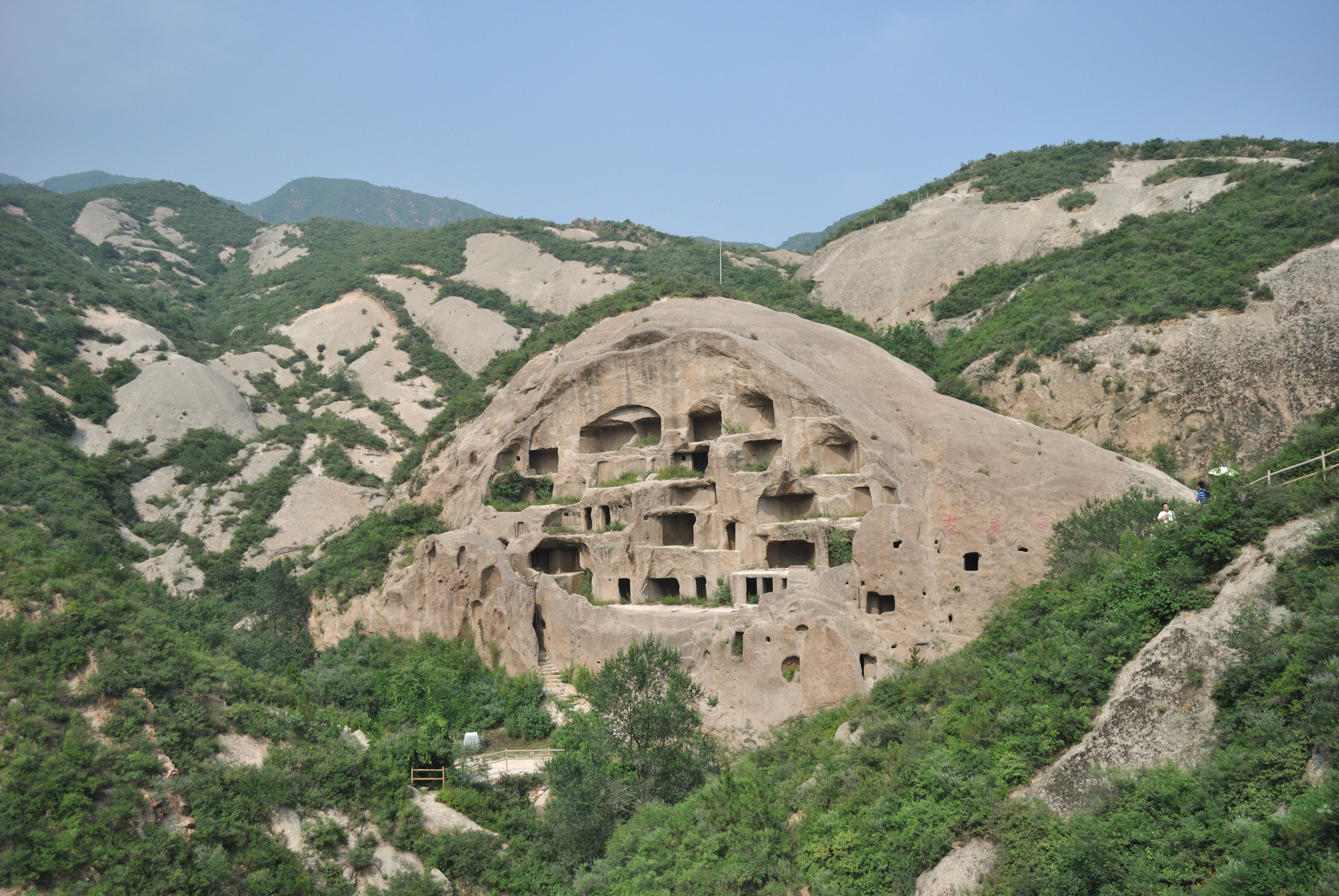
Guyaju Caves
Nobody knows who carved the Guyaju Caves. More than 170 stone rooms are chiseled into the cliff faces of a narrow valley in Beijing's Yanqing District, divided into over 350 individual chambers, equipped with sleeping platforms, flues, window holes, and lampstands -- all the infrastructure of daily life, hewn from solid rock by a community that appeared, thrived, and then vanished without leaving a written record. The historical literature describes their origins as "a continuing archaeological cipher," dating the excavation to somewhere between 1,000 and 2,000 years ago. The most widely accepted theory identifies the builders as Kumo Xi people who lived here from the Tang dynasty into the Five Dynasties period. But even that hypothesis raises more questions than it answers.
An Unsolved Riddle in Stone
The case for the Kumo Xi -- a nomadic people historically associated with the regions north of China -- rests on the caves' location and approximate dating. The Kumo Xi were active in the area during the Tang dynasty, and the sophistication of the cave dwellings suggests a community with enough stability to invest significant labor in permanent construction. But the main objection is telling: historical records suggest the Kumo Xi occupied this area for only about thirty years, and skeptics question whether such a brief occupation would have been long enough to carve the extensive complex. Others have proposed that the caves served as a military garrison, or that they were built by outlaws seeking refuge in the valley's natural defenses. A competing theory argues that Guyaju was actually a Han dynasty beacon post, its domestic features added later. No theory has achieved consensus.
A City Carved from Cliffs
Whatever their origin, the caves themselves are remarkable. The site covers 1.5 square kilometers and divides into two sections: the front ditch and the back ditch, both oriented east to west. Stone stairs more than 10 meters long connect the cave entrances to the ground below. Most rooms are modest -- 1.8 meters high, roughly 4 square meters in area -- but the largest measures 2 meters high, 3 meters wide, and 5.2 meters long. Inside, the builders carved kang bed-stoves, the heated sleeping platforms that remain common in northern China, along with flues to carry smoke away and slots in the roof to collect rainwater. These are not crude shelters. They are engineered living spaces, designed for a community that understood the valley's climate and planned to endure it.
The Largest Cliff Dwelling in China
As of 2016, the Guyaju Caves constitute the largest cliff dwelling site found anywhere in China. The distinction is significant in a country that contains cave dwellings across its northern and western regions, from the loess plateau yaodongs of Shaanxi to the Buddhist grottoes of Dunhuang. What sets Guyaju apart is the domestic character of the complex: these were not temples, military posts, or mines. They were homes, arranged in clusters that suggest family units, with common areas and individual sleeping chambers. The cave chiseling area alone covers 3,931 square meters. When the site opened to visitors in August 1991, it offered the public access to a mystery that archaeologists had been puzzling over for decades.
Protected but Unresolved
In May 2013, the Guyaju Caves were listed as a Major Historical and Cultural Site Protected at the National Level, China's highest designation for heritage sites. The protection ensures the caves' physical preservation while their historical questions remain open. Visitors today walk the same stone stairs the original inhabitants climbed, peer into rooms where families once slept on heated platforms, and try to imagine who would choose to carve a community into cliffs in a valley northwest of Beijing. The absence of answers is itself part of the experience. In a country with one of the world's longest and most thoroughly documented histories, Guyaju stands as a reminder that some stories were never written down, and the stone keeps its secrets.
From the Air
Located at 40.46N, 115.77E in Yanqing District, northwest of Beijing. The cave complex is carved into cliff faces in a narrow mountain valley. From altitude, look for the valley terrain in the mountainous area northwest of the Badaling section of the Great Wall. Nearest airport is Beijing Capital International (ZBAA/PEK), approximately 100 km southeast.