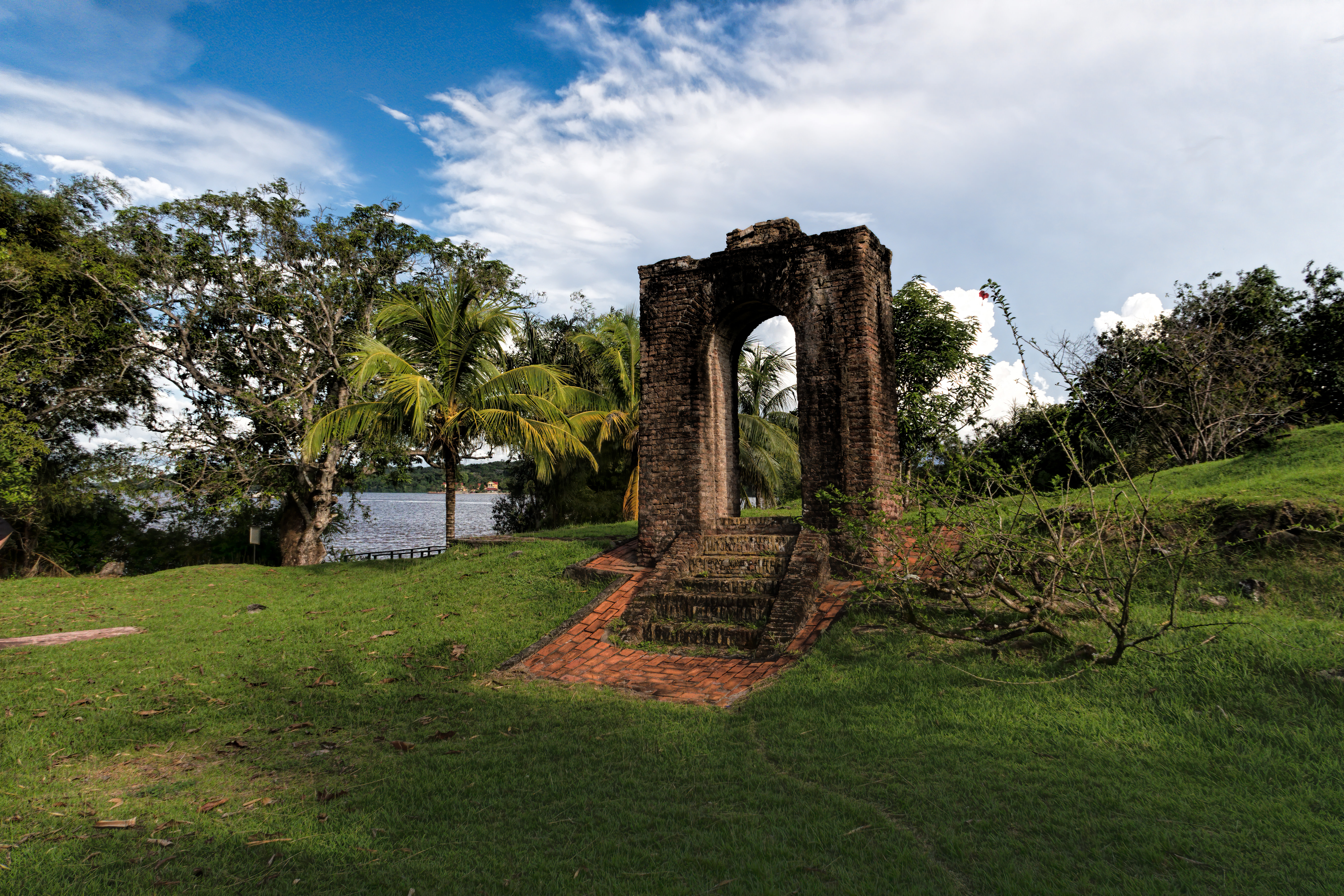
Guyana-Venezuela Territorial Dispute
Draw a line on a map and two countries will argue about it for two hundred years. The Essequibo region -- 159,500 square kilometers of rainforest, savanna, and river basin west of the Essequibo River in Guyana -- has been claimed by Venezuela since before either country existed in its modern form. The dispute was inherited from colonial powers: Spain on one side, the Netherlands and Britain on the other. It has survived the independence of Gran Colombia, the dissolution of the British Empire, a formal arbitration in Paris, a Cold War-era agreement, and a 21st-century referral to the International Court of Justice. The land remains under Guyanese control. Venezuela has never stopped contesting it.
Lines Drawn by Strangers
The trouble began, as it often does, with a surveyor. In 1835, the British government sent German-born explorer Robert Hermann Schomburgk to map the boundaries of British Guiana. The resulting "Schomburgk Line" pleased nobody -- Venezuela rejected it, and even the British found it insufficient, since it failed to include the full Cuyuni River basin they claimed. When gold was discovered in the disputed region in 1876, academic boundary arguments became urgent. Venezuelan President Antonio Guzman Blanco severed diplomatic relations with Britain in 1887. Venezuela then asked the United States to represent its interests, a decision that meant no Venezuelan citizen sat at the table during the most consequential negotiations over Venezuelan territory.
The Paris Award and Its Shadow
In 1899, an arbitral tribunal in Paris drew the boundary that Guyana administers today. Venezuela accepted the ruling at the time but later argued the award was the product of a political deal rather than legal reasoning. In 1949, a memorandum attributed to Severo Mallet-Prevost, one of Venezuela's legal counsel, was published posthumously. In it, Mallet-Prevost alleged that the Russian chairman of the tribunal, Friedrich Martens, had pressured the outcome in Britain's favor. The memo reignited the dispute. Venezuela began claiming not just that the boundary was unfair but that the entire 1899 award was null and void. The 1966 Geneva Agreement between Venezuela, the United Kingdom, and Guyana acknowledged that Venezuela considered the arbitral decision a nullity, and established a process for resolving the controversy -- a process that has now stretched across six decades.
Oil, Ice, and Escalation
What might have remained a dormant diplomatic quarrel gained new urgency in the 21st century. ExxonMobil's discovery of massive offshore oil reserves in Guyana's territorial waters brought billions of dollars into play. Venezuela's economic collapse under Nicolas Maduro made the prospect of reclaiming resource-rich territory more politically attractive at home. In December 2023, Venezuela held a referendum in which voters were asked whether they supported claiming the Essequibo. The results were overwhelmingly in favor, though international observers questioned the turnout figures and the entire exercise. Guyana referred the dispute to the International Court of Justice, which in 2020 ruled it had jurisdiction to hear the case. The proceedings have advanced significantly: Guyana filed its final written brief in December 2024, Venezuela's final written submission is due August 2025, and oral hearings before the Court are expected in the first half of 2026. In May 2025, the ICJ issued provisional measures ordering Venezuela to refrain from conducting elections in the disputed territory, an order Venezuela publicly rejected while continuing to participate in the proceedings. A final binding judgment could come within the next few years. Guyana argues the 1899 award is final; Venezuela contends it was fraudulent from the start.
The Land Itself
While diplomats argue, the Essequibo region goes about its existence. It is administered by Guyana as parts of six of its ten regions. The territory includes dense tropical rainforest, the western bank of the Essequibo River -- one of South America's great waterways -- and scattered indigenous communities whose connection to this land predates every European claim by millennia. Ankoko Island, at the confluence of the Cuyuni and Wenamu rivers, is the one piece of disputed territory that Venezuela actually controls, having occupied it in 1966. For most of the Essequibo's residents, the border dispute is an abstraction that occasionally flares into headline-making tension. The forest does not know which country claims it. The rivers cross no boundaries that matter to them.
From the Air
The disputed Essequibo region lies roughly between 1N-8N latitude and 58W-61W longitude, west of the Essequibo River in Guyana. The reference point at 7.00N, 60.00W places the dispute's geographic center in dense jungle. From altitude, the Essequibo River itself is the most visible landmark -- a massive waterway clearly marking the boundary Guyana administers. Nearest major airport: Cheddi Jagan International (SYCJ) in Georgetown, Guyana. On the Venezuelan side, Ciudad Bolivar (SVBL) and Ciudad Guayana are the nearest significant airfields. The terrain is predominantly flat to rolling tropical forest with few visual landmarks at cruise altitude.