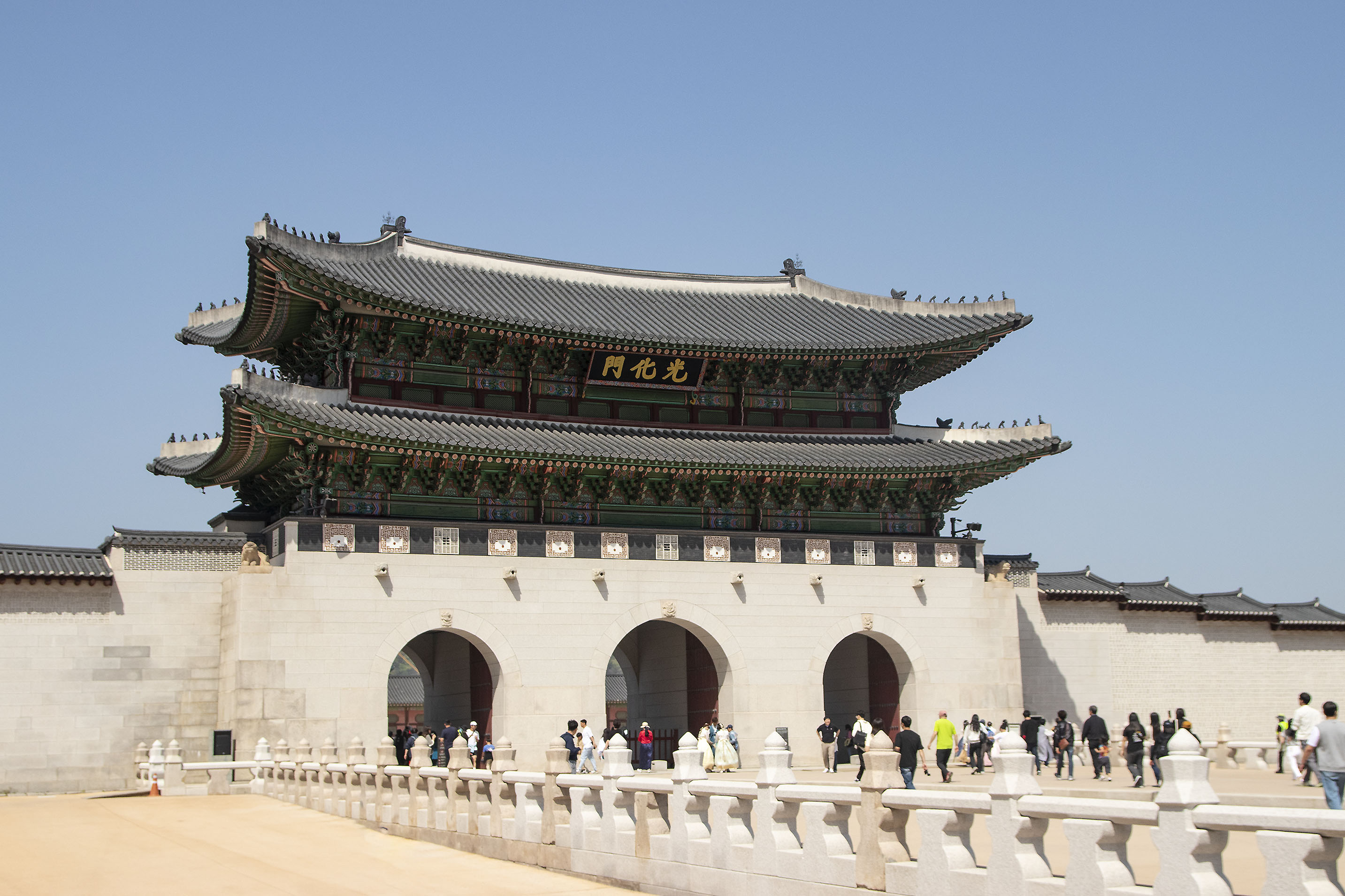
Gwanghwamun
Five times destroyed. Five times rebuilt. Gwanghwamun, the main gate of Gyeongbokgung Palace, has endured the Japanese invasions of the 1590s, colonial-era dismantling, the Korean War, a controversial concrete reconstruction, and a painstaking modern restoration -- each iteration reflecting whatever Korea was becoming at the time. When the gate was reopened on August 15, 2010, the date was no coincidence. It was Gwangbokjeol, Liberation Day. A gate built in 1395 had become something larger than architecture: proof that what can be destroyed can also be brought back.
The Name That Endured
The gate was completed in the ninth month of 1395, when Joseon was barely three years old and Seoul was still being shaped into a capital. Originally called Nammun or Omun, it received its permanent name from Sejong the Great in 1426. Gwanghwamun has been variously interpreted as meaning "era of peace" or "spreading the dignity and virtue of the country far and wide" -- fitting ambitions for a gate that anchors the central axis of the palace and, by extension, the city itself. The gate aligns precisely with the throne hall Geunjeongjeon to the north and the broad avenue of Sejongno stretching south, creating a sightline that organized Seoul's geography for six centuries. Its ceiling is painted with mythological figures: pairs of fenghuang, the phoenix-like birds symbolizing virtue, longma dragon-horses, and turtles. A haetae statue -- a legendary creature believed to guard against fire -- watches the approach, though it failed to prevent most of the fires that would follow.
Centuries of Destruction
The Imjin War of 1592 destroyed the gate along with the rest of Gyeongbokgung. It sat in ruins for nearly three centuries until Gojong's reconstruction of the palace in the 1860s, when it was rebuilt taller than the original and fitted with a large bell. The colonial period brought a different kind of assault. In 1926, the Japanese demolished the gate tower. The following year, the gate itself was physically relocated north of its original position to clear the approach for the massive Government-General Building the colonial authorities were erecting inside the palace grounds. The gate survived this indignity only to lose its wooden superstructure entirely during the Korean War, leaving just a stone base surrounded by rubble.
The Concrete Controversy
After the war, during the Park Chung Hee administration, Gwanghwamun was reconstructed using concrete and steel rather than traditional wood -- a decision that provoked immediate debate. Park's supporters argued that modern materials symbolized Korea's industrialization and forward momentum. Critics saw the concrete as a betrayal of the gate's historical identity. The nameplate bore Park's own Hangul calligraphy rather than the original Hanja characters, adding a political dimension to the architectural one. Completed in December 1968, this version was placed northwest of the gate's original spot, aligned not with the palace axis but with the entrance to the former Government-General Building. For nearly four decades, Seoul's most important historical gate pointed at the wrong thing.
Restoration and the Cracked Nameplate
The major restoration that began in December 2006 aimed to correct every compromise that had accumulated over the previous century. Workers disassembled the concrete structure and shifted the gate 14.5 meters south to its original position, rotating it to realign with Gyeongbokgung's central axis. The wooden structure was rebuilt from pine carefully sourced within Korea -- foreign wood was forbidden for historic restorations. Blueprints drawn by the Japanese colonial government in 1925 and century-old glass plate photographs guided the reconstruction. Yet even this meticulous effort met an embarrassing setback. Within months of the August 2010 opening, a long crack appeared in the new wooden nameplate. The Cultural Heritage Administration blamed dry autumn weather; experts countered that immature pine had been used to meet the deadline. A replacement nameplate was commissioned, and a national debate erupted over whether the inscription should be in Hanja -- as the 1395 original had been -- or in Hangul. A majority of experts favored Hanja. A survey of five thousand citizens split nearly sixty-forty in favor of Hangul.
The Gate Today
A further renovation in 2023 reworked the nameplate with gold characters against a black field and restored the Woldae, the raised stone terrace in front of the gate. The changing of the guard ceremony, performed hourly from 10 am to 3 pm, has become one of Seoul's most popular tourist attractions -- ranked by foreign visitors as their third favorite activity in the city. Gwanghwamun Plaza, the open public space stretching south from the gate, was inaugurated in 2009 as part of Seoul's effort to reclaim Sejong-ro for pedestrians. Standing at the plaza and looking north through the gate toward the mountains behind the palace, you see the sightline that has organized this city since 1395 -- interrupted, obscured, and demolished over the centuries, but reassembled each time with stubborn precision.
From the Air
Located at 37.576N, 126.977E at the southern entrance to Gyeongbokgung Palace in Seoul's Jongno District. The gate sits at the head of Gwanghwamun Plaza, a broad open space extending south along Sejongno. Best viewed at 2,000-3,000 ft AGL. Nearby airport: Gimpo International (RKSS), approximately 12 nm west.