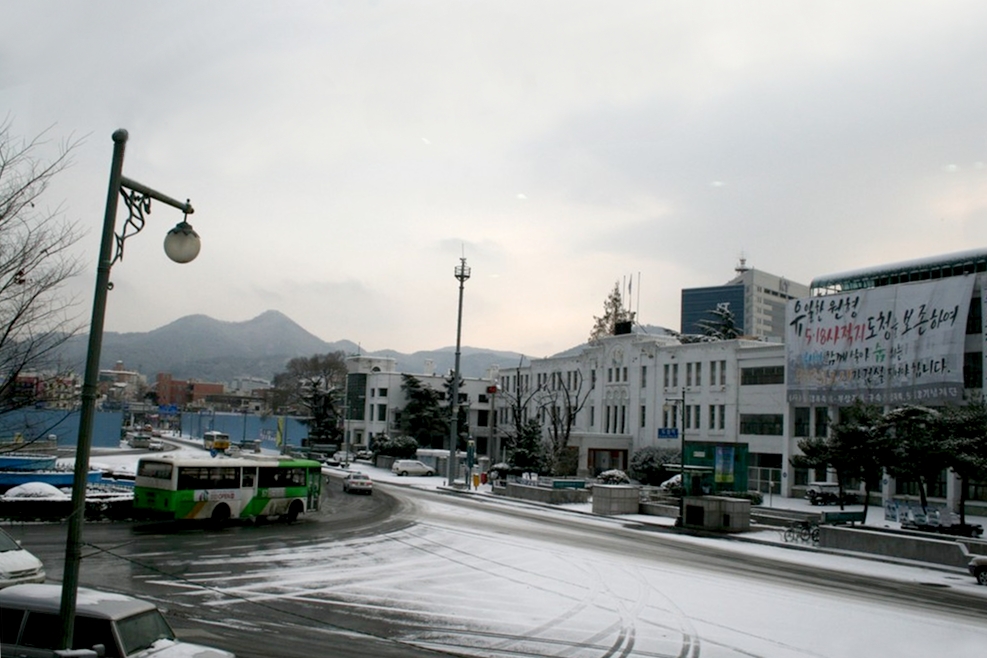
Gwangju Uprising
On the morning of 18 May 1980, students from Chonnam National University gathered at the campus gates to protest martial law. By the time soldiers finished suppressing the city ten days later, Gwangju had become a word that would reshape South Korean politics for a generation. The government called it a riot. The people who lived through it called it a massacre. History has settled on a different term: the beginning of the end for military dictatorship in South Korea.
The General's Coup
The uprising cannot be understood apart from the events that preceded it. In October 1979, President Park Chung-hee was assassinated by the head of his own intelligence service, briefly opening a window for democratic reform. Major General Chun Doo-hwan slammed it shut. On 12 December 1979, Chun staged an internal military coup, seizing control of the army. By May 1980, he had arrested opposition leaders including future president Kim Dae-jung -- a native of the Jeolla region, of which Gwangju is the capital -- closed all universities, banned political activities, and imposed martial law nationwide. The crackdown fell hardest on Gwangju, a city with deep ties to the democratic opposition and a long history of resistance to authoritarian rule. Soldiers from the Special Warfare Command, trained for operations behind enemy lines, were deployed against the city's own citizens.
Ten Days in May
What began as a student demonstration escalated with terrifying speed. When paratroopers attacked the protesters on 18 May, beating and bayoneting students in the streets, the violence did not crush resistance -- it ignited it. Citizens who had no connection to the student movement took to the streets after witnessing the brutality. Taxi drivers organized their vehicles into convoys to transport the wounded. By 21 May, soldiers opened fire on crowds gathered at the Provincial Office building, killing dozens. That afternoon, citizens raided police stations and military armories, seized weapons, and formed militias. They drove the soldiers out of the city center and held it for five days. During that extraordinary interlude, Gwangju governed itself. Citizens organized food distribution, directed traffic, cared for the wounded, and maintained order with remarkably little violence or looting -- a fact that powerfully contradicted the government's narrative of a lawless mob.
The Reckoning
On 27 May, the military retook the city in a predawn assault. Tanks rolled through the streets and soldiers stormed the Provincial Office, where the last holdouts -- many of them teenagers and young adults -- had chosen to remain rather than surrender. The official death toll was set at 165. Independent scholarship now estimates between 600 and 2,300 people were killed. Under Chun's dictatorship, the massacre was erased from public discourse. Newspapers were censored, survivors were imprisoned and tortured, and the uprising was officially classified as a communist insurrection instigated by North Korea -- a claim for which no evidence was ever produced. It was not until the democratization of South Korea in the late 1980s that the truth began to emerge. Kim Dae-jung, imprisoned and sentenced to death for allegedly orchestrating the uprising, was eventually pardoned, elected president in 1997, and awarded the Nobel Peace Prize.
Democracy's Debt
The Gwangju Uprising occupies a position in South Korean memory comparable to Tiananmen Square in China or the Soweto Uprising in South Africa -- with the critical difference that South Korea eventually held its perpetrators accountable. In 1996, former presidents Chun Doo-hwan and Roh Tae-woo were convicted of mutiny, treason, and corruption. Chun received a death sentence, later commuted. May 18 is now a national memorial day. The old Mangweol-dong Cemetery, where victims were initially buried -- some delivered in garbage trucks -- has been preserved, and a new national cemetery was built in 1997. The uprising's legacy extends beyond Korea: it inspired pro-democracy movements across East Asia and demonstrated that a population's willingness to resist, even at enormous cost, could plant seeds that authoritarian power could not ultimately destroy. Gwangju paid for South Korean democracy in blood. The nation has spent the decades since trying to honor that debt.
From the Air
Located at 35.17N, 126.92E, Gwangju is the major city of South Korea's southwestern Jeolla region. The Provincial Office building, center of the uprising, is in the city's downtown core. Gwangju Airport (RKJJ) is approximately 5 nm west of the city center. The May 18th National Cemetery is located in the northern outskirts at approximately 35.24N, 126.94E. Best viewed at 3,000-5,000 ft to see the relationship between the city center, the old Mangweol-dong Cemetery, and the new national cemetery.