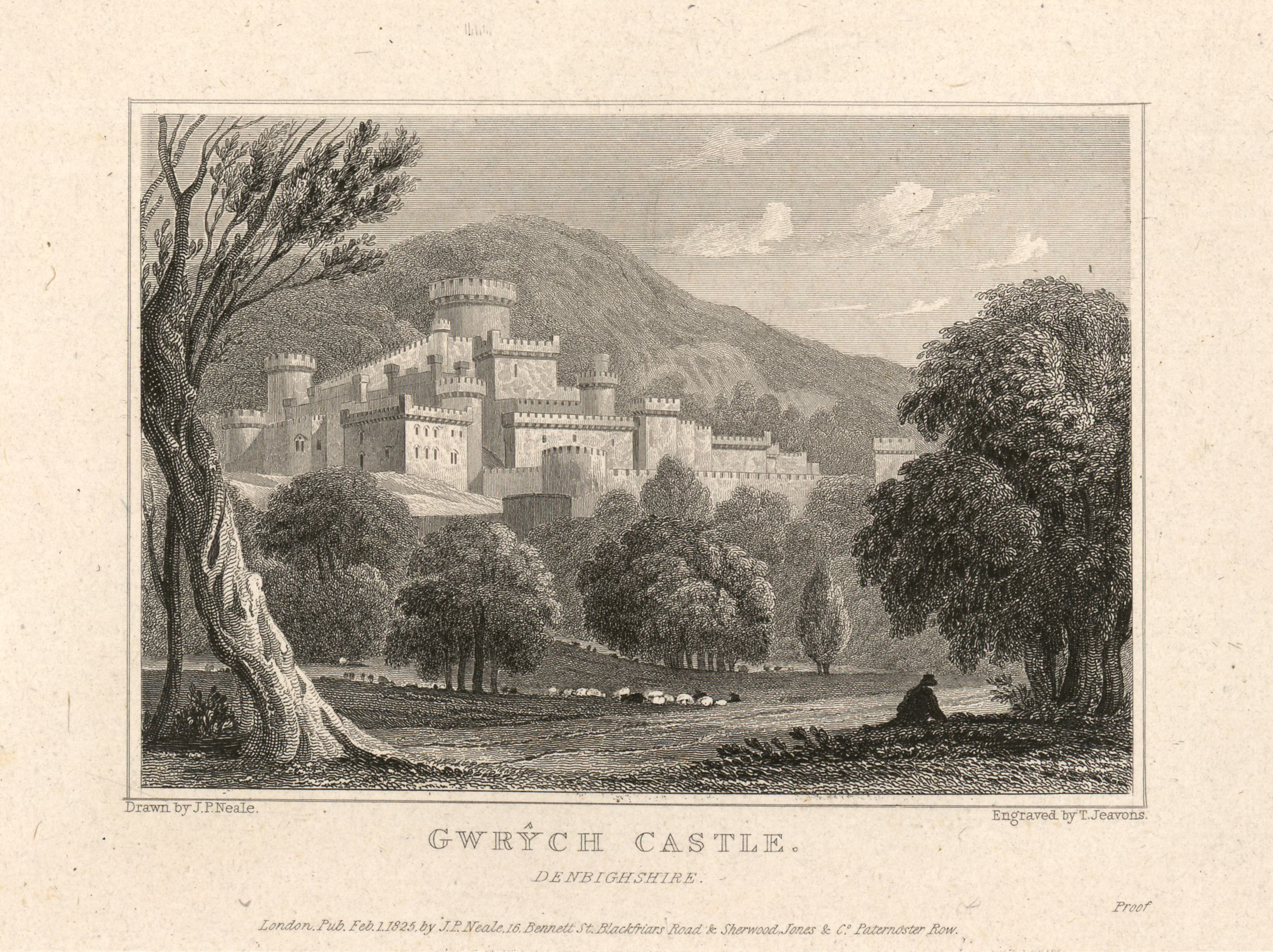
Gwrych Castle
When the Countess of Dundonald died in 1924, she left Gwrych Castle to King George V, hoping it would become the official Welsh residence of the Prince of Wales. The king declined the gift. It was the beginning of the castle's long unraveling -- a century of abandonment, looting, and near-total destruction that would have been complete if not for a twelve-year-old boy who saw the wreckage and decided to save it.
A Mother's Memorial
Lloyd Hesketh Bamford-Hesketh built Gwrych Castle between 1810 and 1825 in memory of his mother, Frances Lloyd, and her ancestors. The family had owned land near Abergele since at least the sixteenth century, but Bamford-Hesketh's ambitions far exceeded the existing house. He commissioned designs from the architect Charles Busby, exhibited them at the Royal Academy in 1815, then sacked Busby and hired Thomas Rickman. The project swelled from a Regency-style country house into an enormous Gothic Revival castle. The foundation stone was laid in 1819, and construction consumed the rest of Bamford-Hesketh's life. His heirs continued building, with architects C. E. Elcock and Detmar Blow adding to the structure until it achieved its final, immense extent -- eighteen towers strung along the hillside above the Irish Sea.
The Countess's Castle
The presiding figure of Gwrych's heyday was Winifred Bamford-Hesketh, the builder's granddaughter and sole heir. She married Douglas Cochrane in 1878 and became Countess of Dundonald when he succeeded to the earldom in 1885. The marriage was unhappy: Winifred spent her time at Gwrych and in London while her husband served overseas, including a posting as General Officer Commanding the Militia of Canada. Queen Victoria and the Prince of Wales both visited during the castle's peak years, when it operated as a full-scale country house with formal gardens, estate lodges, and a landscape designed to frame views of the Irish Sea. On Winifred's death, the castle briefly belonged to the Order of Saint John before her estranged husband bought it back for 78,000 pounds and sold its contents to cover the cost.
Refuge
During the Second World War, the British government used Gwrych Castle to house two hundred Jewish children brought to safety under the Kindertransport programme. The castle became a refuge run by a Jewish Zionist youth movement, and the scholar Daniel Sperber was born there during this period. It is one of the castle's most significant chapters -- a moment when the vast, impractical building served a purpose its builders could never have imagined, providing shelter for children fleeing persecution across Europe.
Destruction
After the war, the Dundonalds sold the estate. For decades it operated as a tourist attraction billed as the Showpiece of Wales, drawing millions of visitors. Randolph Turpin, the World Middleweight boxing champion, trained there in the 1950s. But the castle closed to the public in 1987, and what followed was catastrophic. New Age travellers occupied the site, selling off fireplaces and stained glass, stripping the slate and lead from the roof. Battlements were toppled from the towers. Arsonists set fires. By the twenty-first century, Gwrych was a roofless ruin, its interiors exposed to the Welsh rain. Plans for a hotel development came and went; Clayton Hotels bought the castle in 2007 for 850,000 pounds but went into administration before work was completed.
The Boy Who Saved a Castle
Mark Baker first saw Gwrych Castle being destroyed when he was twelve years old. He began campaigning for its preservation immediately, a one-boy crusade that grew into the Gwrych Castle Preservation Trust. Baker wrote books about the castle and its history, lobbied the local council, and pressured successive owners. In 2018, the trust -- now a registered charity -- purchased Gwrych and some two hundred acres of estate with a grant from the National Heritage Memorial Fund. Stabilization and restoration work began. Then, in 2020, ITV selected the castle as the location for I'm a Celebrity...Get Me Out of Here!, the pandemic having made the show's usual Australian location impossible. The resulting publicity and funding accelerated the rescue. The castle is now open to visitors, though the main building remains a ruin -- a work in progress, like every version of Gwrych that has come before.
From the Air
Gwrych Castle is at 53.2835N, 3.6096W, on the hillside above the A55 expressway near Abergele on the North Wales coast. The castle's eighteen towers stretch along the ridge, with the Irish Sea immediately to the north. From the air, the castle's extensive frontage is visible against the wooded hillside. The Great Orme and Little Orme near Llandudno are visible to the west. Nearest airports: Hawarden/Chester (EGNR), RAF Valley (EGOV). Recommended altitude: 1,500-2,500 ft AGL.