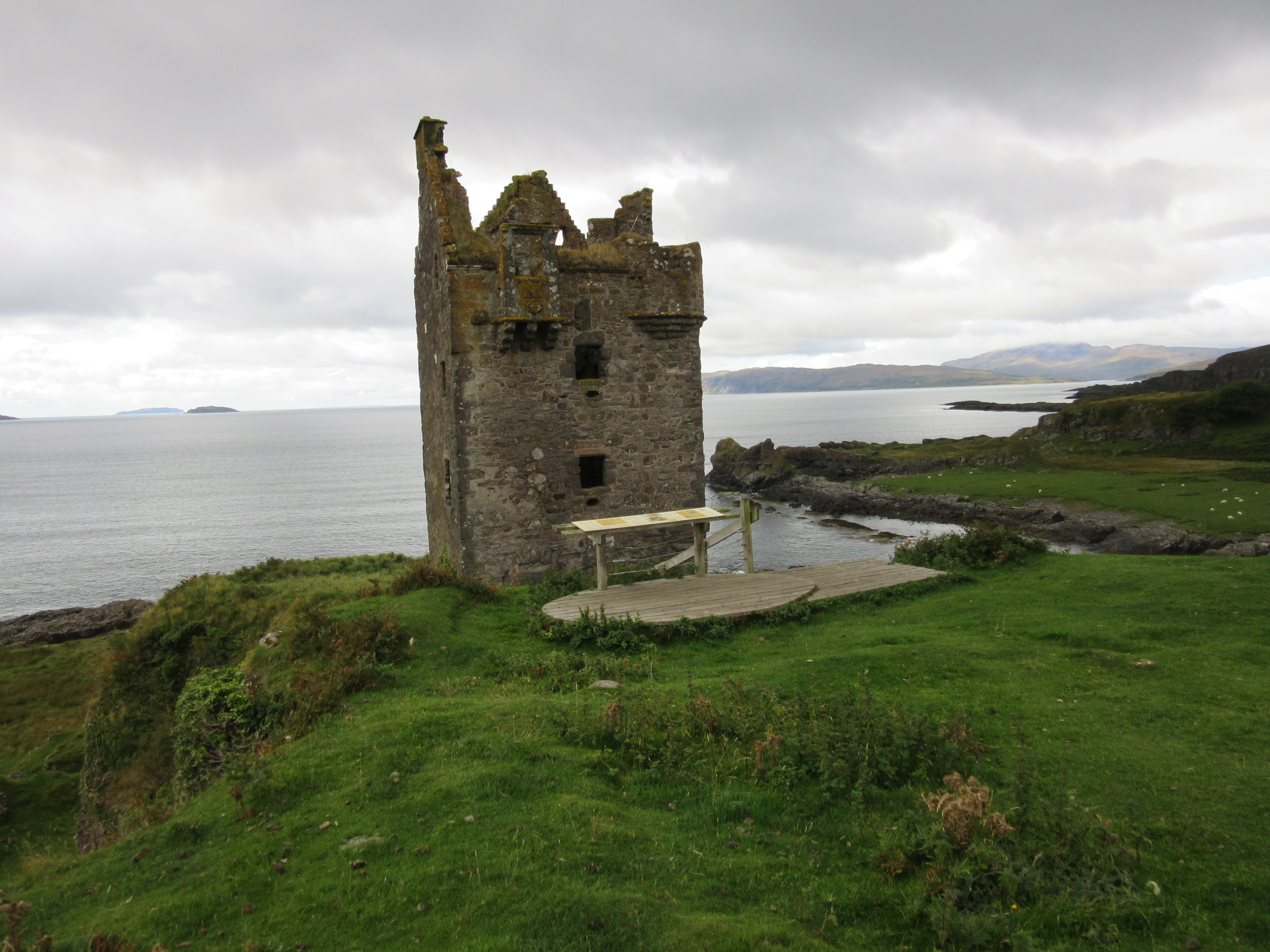
Gylen Castle
Gylen Castle occupies the kind of position that makes you wonder whether its builders chose the site for defense or for the view -- and then you realize that in sixteenth-century Argyll, the two were the same thing. The ruined tower house sits on a rocky promontory at the southern end of Kerrera, a small island sheltering Oban's harbour from the open sea. From its walls, the Firth of Lorne stretches south and west toward Mull and the Atlantic. Built in 1582 by the Clan MacDougall, it was a scheduled monument by 1931, protected by law if no longer by garrison.
The MacDougalls' Last Castle
The MacDougalls were once the Lords of Lorn, a title and territory they held from the thirteenth century until Robert the Bruce stripped them of both after the Battle of the Pass of Brander in 1308. Reduced in power but not extinguished, the clan persisted in Argyll for centuries, and Gylen Castle was built during a period of relative stability in the late sixteenth century. The tower house is a four-storey structure typical of Scottish castle architecture of the period: thick-walled, compact, and designed to be defensible by a small number of people. Its position on Kerrera gave it command over the sea approaches to Oban and the entrance to the Firth of Lorne -- a strategic advantage that any MacDougall chief would have appreciated, given the clan's long experience of being on the wrong side of power.
Island Fortress
Kerrera itself is a modest island, roughly five miles long, accessible by a short ferry ride from Gallanach south of Oban. Two hiking trails branch from the landing pier: one north to Hutcheson's Monument, and one south to Gylen Castle. The southern walk follows the island's spine through rough grazing land before the castle appears on its promontory, framed by sea on three sides. The ruin retains enough structure to convey the original proportions -- the height of the walls, the thickness of the stonework, the narrowness of the windows. What it has lost is its roof, its floors, and whatever domestic life once filled its rooms. The Firth of Lorne below is busy with ferry traffic heading to Mull and the outer islands, the same sea lanes that the MacDougalls once watched from these walls.
A View That Outlasts Its Builders
Gylen Castle was never a great seat of power for long. In 1647, during the Wars of the Three Kingdoms, Covenanting forces under General Leslie besieged and burned the castle; the MacDougall defenders surrendered on promise of clemency that was not honored. Its lasting significance lies in what it represents: the persistence of a clan that lost its lordship, lost its lands, and yet continued to build in stone, to claim a promontory, to face the sea from a position of at least symbolic strength. The castle's ruin is itself a kind of monument -- not to defeat but to the sheer Argyll stubbornness of putting up walls where the wind and salt will eventually take them down. Today the castle draws walkers who make the ferry crossing and the southward hike for the combination of medieval stonework and Hebridean seascape. The view from the promontory has not changed since 1582. The Firth of Lorne still opens to the west, Mull still rises on the horizon, and the Atlantic still sends its weather in without asking permission.
From the Air
Located at 56.38N, 5.56W on the southern tip of Kerrera, a small island just west of Oban in Argyll. The castle ruin is visible on a promontory overlooking the Firth of Lorne. Nearest airport is Oban Airport (no ICAO code); nearest major airport is Glasgow (EGPF) or Inverness (EGPE). Best viewed at 1,500-3,000 feet. Oban harbour and ferry terminal are visible to the northeast.